How to use Long Term and Short Term to Create Wealth
Think investing means choosing one strategy forever? Learn how the Core + Satellite investing approach helps Nigerian investors balance long-term growth with short-term opportunities.
 Yahnic Chigozie
You Don’t Have to Choose One Style Forever
A lot of Nigerians think investing is like marriage.
Once you choose one style, you must stay there forever.
If you buy stocks, you must only buy stocks.
If you trade, you must trade everything.
If you’re long-term, short-term money is “not for you.”
That all-or-nothing thinking is one of the biggest reasons people burn out, lose money, or quit investing completely.
But here’s the truth
Smart investors don’t pick sides. They build systems.
The Pain of All-or-Nothing Thinking
Let’s use a familiar story.
Kunle buys stocks in 2024 and holds them long-term.
Market crashes.
His portfolio drops.
He panics and sells everything.
Next year, he switches to trading.
He makes small wins.
Then one bad trade wipes out months of gains.
By 2024, Kunle says:
“This investing thing no work.”
But investing wasn’t the problem.
Lack of balance was.
Investing Is Not Black or White
You don’t have to choose:
-
Long-term or short-term
-
Stocks or ETFs
-
Growth or income
You can combine them — intelligently.
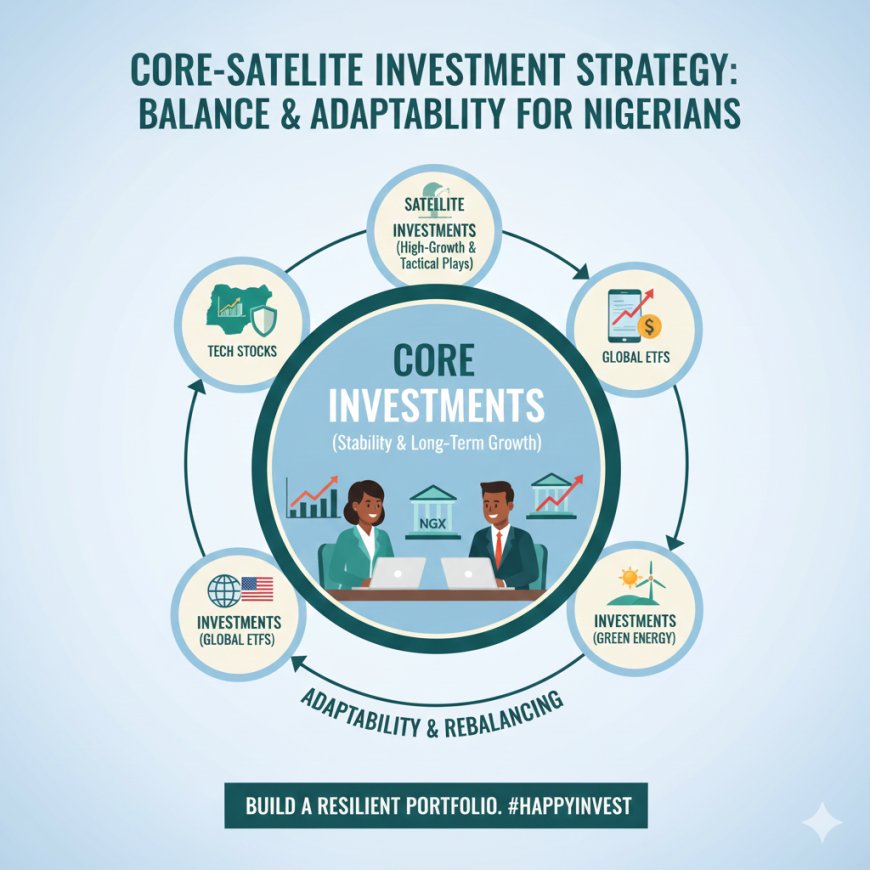
This is where the Core + Satellite strategy comes in.
The Core + Satellite Strategy (Simple Explanation)
Think of your investment like a solar system.
Core (Your Foundation)
This is the money you don’t touch often.
It focuses on:
-
Long-term growth
-
Stability
-
Compounding
Examples (Nigeria & Global):
-
NGX 30 ETF
-
Banking ETFs
-
Bond ETFs
-
S&P 500 ETF
-
Global tech ETFs
This part grows quietly over the years.
Satellite (Your Opportunity Bucket)
This is where you take calculated risks.
It focuses on:
-
Short-term opportunities

-
Trends
-
Tactical moves
Examples:
-
Individual NGX stocks
-
Dividend plays
-
Sector ETFs (AI, semiconductors)
-
Crypto (BTC, ETH, BNB small size)
This part gives flexibility and learning.
How This Solves the “Fear Problem”
Many people fear investing because:
-
“What if the market crashes?”
-
“What if I buy at the top?”
-
“What if I lose everything?”
With Core + Satellite:
-
Your core protects you
-
Your satellite allows experimentation
You’re not betting your future on one decision.
Nigerian Example (Real-Life)
Aisha earns ₦200,000 monthly.
She invests:
-
70% Core
-
NGX 30 ETF
-
Bond ETF
-
-
30% Satellite
-
Dividend stocks
-
One growth stock
-
When the market falls:
-
Core stays stable
-
Satellite gives learning
When the market rises:
-
Core compounds
-
Satellite boosts returns
No panic.
No regret.
Risk Balance Is the Real Goal
The goal of investing is not:
-
Maximum returns
-
Perfect timing
-
Always winning
The real goal is:
Staying invested long enough to win.
Balance helps you stay.
Why This Works Long-Term
✔ Reduces emotional decisions
✔ Allows flexibility
✔ Matches real life (salary, emergencies, goals)
✔ Builds discipline
You’re not forcing yourself into one box.
Investor Mindset Shift
Poor mindset:
“I must choose the best style.”
Rich mindset:
“I build a system that adapts.”
Markets change.
Your life changes.
Your strategy should, too.
Nigerian Portfolio Examples (Core + Satellite Strategy)
Rule of thumb:
Core = stability & long-term growth
Satellite = opportunity & learning
Example 1: Student Investor (₦5,000–₦20,000 Monthly)
Goal:
Learn investing early + grow slowly
Core (70%)
-
NGX 30 ETF
-
Money Market Fund (for safety)
Satellite (30%)
-
One dividend stock (e.g., Zenith Bank or GTCO)
-
Small exposure to crypto (BTC/ETH via a trusted platform like Binance, Gate.io, etc)
Why this works:
-
Core protects capital
-
Satellite keeps interest high
-
Perfect for beginners with small cash
Example 2: Salary Earner (₦50,000 Monthly)
Goal:
Build wealth + earn income
Core (65%)
-
NGX 30 ETF
-
Bond ETF / FGN Bond Fund
Satellite (35%)
-
1–2 dividend stocks (Banks, consumer goods)
-
Sector ETF (Banking or Industrial)
Why this works:
-
Stable base
-
Monthly income potential
-
Exposure to Nigerian growth sectors
Example 3: Growth-Focused Investor (₦100,000+ Monthly)
Goal:
Aggressive long-term growth
Core (60%)
-
NGX 30 ETF
-
Global ETF (S&P 500 or Global Equity Fund)
Satellite (40%)
-
High-growth NGX stocks
-
Tech/AI ETFs
-
Small crypto exposure
Why this works:
-
Combines local + global growth
-
Balances risk across assets
-
Uses trends without gambling
Example 4: Conservative Investor / Parent
🎯 Goal:
Capital protection + steady income
Core (75%)
-
Money Market Fund
-
Bond Fund / FGN Bonds
Satellite (25%)
-
Dividend-paying blue-chip stocks
-
REIT / Property-backed investment
Why this works:
-
Low volatility
-
Predictable income
-
Preserves capital against inflation
How to Adjust Over Time
As your:
-
Income increases
-
Knowledge grows
-
Risk tolerance improves
You can:
-
Reduce MMF
-
Increase equities
-
Add global exposure
Investing is not static.
Golden Rule
Core keeps you calm.
Satellite keeps you curious.
If your portfolio makes you anxious, it’s unbalanced.
Would you rather:
-
Sleep peacefully and grow slowly?
-
Or take smart risks with protection?
That’s what Core + Satellite solves.
Final Thought
You don’t need to be:
-
A trader forever
-
A long-term investor forever
-
A crypto person forever
You need to be strategic.
Core + Satellite gives you:
-
Stability
-
Growth
-
Learning
-
Peace of mind
CTA
Would you try this approach?
Core for peace. Satellite for opportunity.
Drop a “Yes” or “Not sure,” let’s talk.