What Happens Behind the Scenes of Stock Trading
What actually happens when you buy or sell a stock? Learn the behind-the-scenes process of stock trading, from order placement to settlement.
 Yahnic Chigozie
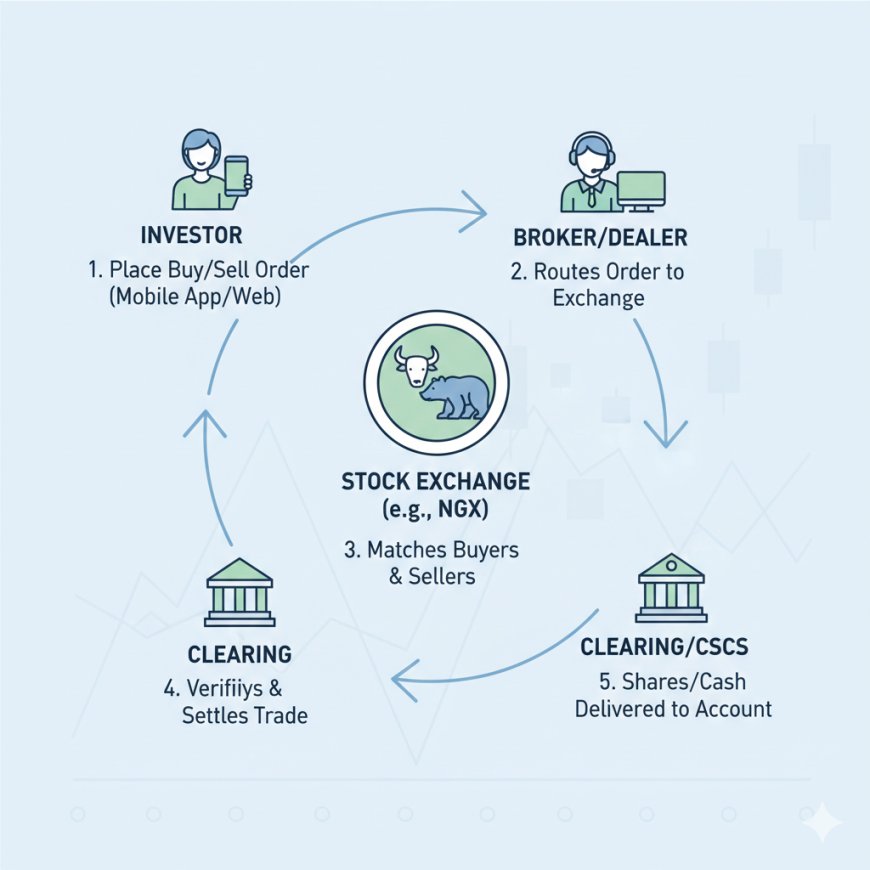
When you buy a stock, it feels simple.
You open an app.
You click Buy.
You see “Transaction Successful.”
But behind that single click, a complex system starts working in seconds.
Most investors, especially beginners, don’t understand what really happens after they place a trade. This lack of understanding creates fear, confusion, and unrealistic expectations.
In this article, we’ll break down what happens behind the scenes of stock trading, step by step, in plain language.
No jargon.
No confusion.
Just clarity.
Step 1: You Place an Order
Everything starts with your order.
When you place a trade, you are not buying directly from a company.
You are sending an instruction that says:
-
What stock do you want
-
How many shares
-
At what price (or market price)
Your broker receives this instruction immediately.
Step 2: Your Broker Sends the Order to the Market
Your broker is a middleman, not the market itself.
Once your order is placed:
-
The broker checks if you have enough money or shares
-
Confirms the order details
-
Sends the order to the stock exchange or a market maker
At this stage, nothing has been bought yet.
Step 3: Matching Buyers and Sellers
Stocks trade because:
-
Someone wants to buy
-
Someone else wants to sell
Inside the exchange is an order book:
-
Buy orders (bids)
-
Sell orders (asks)
Your order is matched when:
-
Your buying price matches someone’s selling price
-
Or you accept the current market price
No matching = no trade.
Step 4: Trade Execution
Once a match happens:
-
The trade is executed
-
A price is agreed
-
Shares are exchanged electronically
This usually happens in milliseconds.
At this point:
-
You are considered the new owner
-
The seller gives up ownership
But the process isn’t finished yet.
Step 5: Clearing the Trade ( CHN )
Clearing answers one question:
“Who owes what to whom?”
A clearing house steps in to:
-
Confirm the buyer and seller
-
Ensure money will be delivered
-
Ensure shares will be delivered
This reduces the risk of default.
You don’t see this, but it’s critical.
Step 6: Settlement (The Final Transfer)
Settlement is when:
-
Money officially moves from buyer to seller
-
Shares officially move from seller to buyer
Depending on the market, this happens in:
-
T+2 (two business days )
Even though your app shows the stock instantly, legal ownership finalizes during settlement.
Step 7: Custody and Record Keeping
After settlement:
-
Shares are stored electronically
-
Records are updated
-
Your portfolio reflects ownership
You don’t receive paper certificates.
Everything is digital.
Custodians ensure:
-
Safety
-
Accuracy
-
Transparency
Who Else Is Involved (Besides You)?
Behind one simple trade are:
-
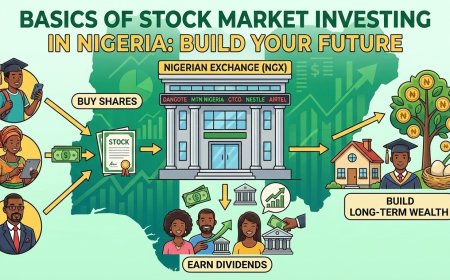
Stock exchange ( The Matchmaker: The Exchange (NGX)
-
Broker(The Gateway: Your Stockbroker )
-
Market makers
-
Clearing houses (The Inspector: The Clearing House (CSCS)
-
Custodians
-
Regulators
This system exists to:
-
Ensure fairness
-
Reduce fraud
-
Maintain trust
Why Prices Move So Fast
Stock prices move because of:
-
New buy or sell orders
-
News
-
Earnings
-
Economic data
-
Emotions (fear and greed)
There is no “hidden hand” controlling prices daily.
It’s supply and demand, happening in real time.
Common Myths About Stock Trading
❌ “My broker controls prices.”
❌ “Trades are delayed on purpose.”
❌ “The market is rigged against small investors.”
The system isn’t perfect, but it’s structured, regulated, and transparent.
Understanding it reduces fear.
Why This Knowledge Matters
When you understand what happens behind the scenes:
-
You panic less
-
You trade less emotionally
-
You invest more patiently
-
You stop chasing rumors
Confidence comes from understanding.
Stock trading looks simple on the surface
But beneath it is a well-organized system built on trust, speed, and rules.
You don’t need to master every detail, but you do need to understand the basics.
At Happyinvest.ng, we believe:
The more you understand how markets work, the better investor you become.