
How Market Liquidity Affects Stock Prices
Market liquidity plays a major role in how stock prices move and whether investors can enter or exit trades successfully. This article explains liquidity in simple terms and why it matters more than many investors realize.
 Yahnic Chigozie
Most people think stock prices move because of news or company performance.
That’s only half the story.
Behind every price movement is something far more important and often ignored: market liquidity.
Liquidity determines how easily a stock can be bought or sold without causing major price changes. If you don’t understand liquidity, you can make “paper profits” that you can’t actually cash out, especially in markets like Nigeria.
Let’s break this down simply.
What Is Market Liquidity?
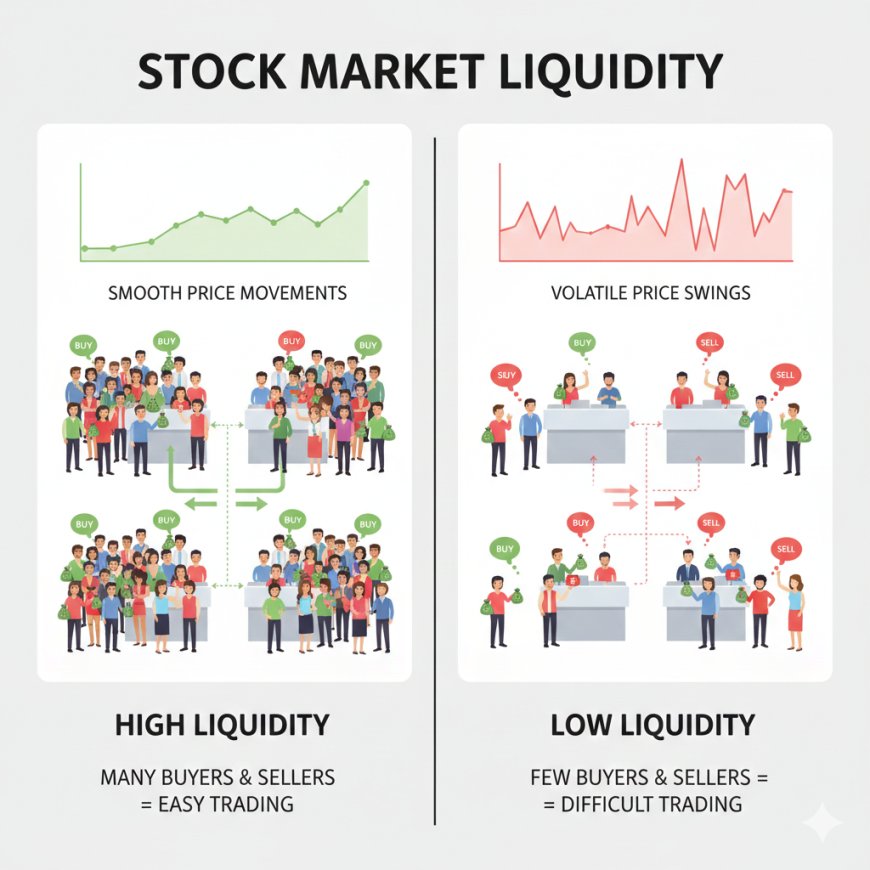
Market liquidity refers to how quickly and easily an asset can be converted to cash at its current price.
In simple terms:
-
A liquid stock has many buyers and sellers
-
An illiquid stock has few buyers and sellers



The more active the trading, the more liquid the stock is.
Why Liquidity Matters More Than You Think
Liquidity affects:
-
Price stability
-
Speed of buying and selling
-
Your ability to exit a trade
-
How much profit (or loss) you actually realize
A stock can look cheap or appear to be rising, but without liquidity, you may not be able to sell it when you want.
How Liquidity Moves Stock Prices
1. High Liquidity = Smoother Price Movement
When a stock has many buyers and sellers:
-
Orders are filled quickly
-
Prices change gradually
-
Big trades don’t distort the market
This is common with:
-
Blue-chip stocks
-
Large-cap companies
-
Stocks heavily followed by institutions
2. Low Liquidity = Sharp, Unpredictable Price Swings
In low-liquidity stocks:
-
A single large buy can push the price up sharply
-
A single large sell can crash the price
-
Price gaps appear easily
This is why many penny stocks:
-
Spike suddenly
-
Collapse just as fast
-
Trap investors inside
Liquidity vs Price: A Common Trap
Many investors focus on cheap prices:
“This stock is only ₦2, I can buy plenty.”
But price alone is meaningless without liquidity.


A ₦2 stock with no buyers is more dangerous than a ₦200 stock with heavy daily trading.
Liquidity determines whether your profit is real or just numbers on a screen.
How Liquidity Affects Your Buying Power
When liquidity is low:
-
You may buy higher than expected
-
Your order may be partially filled
-
You may wait days or weeks to sell
When liquidity is high:
-
You get close to the market price
-
Orders are executed instantly
-
Exit is easy
Bid-Ask Spread: The Hidden Cost
Liquidity directly affects the bid-ask spread:
-
Bid = price buyers are offering
-
Ask = price sellers want
In liquid markets:
-
Spread is small
-
Transaction cost is low
In illiquid markets:
-
Spread is wide
-
You lose money immediately after buying
This is a silent loss that many investors don’t notice.
Nigerian Market Reality
In the Nigerian Stock Exchange:
-
Some stocks trade daily with strong volume
-
Others may go days without a single trade
Low liquidity stocks often:
-
Show artificial price increases
-
Attract retail investors
-
Become exit traps
Smart investors always check:
-
Daily trading volume
-
Number of active buyers and sellers
-
Consistency of trades
Liquidity Is Why Big Investors Move Markets
Institutional investors care deeply about liquidity because:
-
They trade large volumes
-
They need fast exits
-
They avoid stocks that can’t absorb their trades
If institutions avoid a stock, liquidity stays low, and risk stays high.
Key Takeaway
Price tells you what a stock is worth today.
Liquidity tells you whether you can actually turn it into cash.
If you ignore liquidity:
-
You may be right about the stock
-
But still lose money
Smart investing is not just about what to buy, but how easily you can sell.