How to Review Your Finances Like a CEO
Learn how to review your finances like a CEO with KPI dashboards, structured review cadences, and hard questions that drive real results. A guide for Nigerian investors. Most people manage their money by feeling. CEOs manage by data, metrics, and structured reviews. This comprehensive guide gives you the exact framework, weekly, monthly, quarterly, and annual, to review your personal finances with CEO-level discipline. Includes a personal KPI dashboard, a budget audit template, CEO hard questions, and a complete review checklist tailored for Nigerian investors.
 Yahnic Chigozie
Like a CEO
Every great company runs on data, strategy, and regular performance reviews. Your personal finances deserve and demand the exact same rigour. Here's how to run your money like the best-managed business you'll ever own.
Think about what makes a truly great CEO. They don't run a company by instinct alone. They don't guess whether sales are up or costs are down. They don't wait until the company is in crisis before looking at the numbers. Instead, they review performance data consistently, track key metrics ruthlessly, ask hard questions, make strategic adjustments, and plan deliberately for the future.
Now think about how most people manage their personal finances. They earn money. They pay bills. They spend what's left. They check their bank balance occasionally, usually when they're worried. They review their investments almost never. They don't know their net worth, their savings rate, or their debt-to-income ratio. They manage their money by feeling rather than by fact.
The gap between these two approaches is not intelligence or income; it is the framework. CEOs have a management system: regular reviews, clear metrics, structured planning, and accountability. Most individuals have none of these things applied to their personal finances.

This article will give you that framework. By the end, you will know exactly how to review your personal finances with the discipline, clarity, and strategic intelligence of a world-class CEO and why doing so consistently is one of the highest-return activities available to any investor.
Before diving into the mechanics of financial review, let's establish the right mental frame. You are not just a person who earns and spends money; you are the Chief Executive and Chief Financial Officer of a personal enterprise that has revenues, expenses, assets, liabilities, profit margins, and a strategic plan.
Your personal enterprise has stakeholders: your family, your future self, and your dependents. It operates in a competitive environment shaped by inflation, interest rates, currency fluctuations, and the labour market. It faces risks: job loss, health emergencies, and market downturns. It has growth targets: a net worth goal, a retirement income target, and an investment portfolio milestone.
The best-run companies in the world don't leave their performance to chance. They measure, they analyse, they adjust, and they plan. Your personal finances deserve the same structured attention. And the vehicle for that attention is the regular financial review.
|
CEO Principle: What gets measured gets managed. What gets managed gets improved. The single most effective habit you can develop for your financial life is a consistent, structured review of the numbers that matter. Not because numbers are exciting — but because clarity about your financial reality is the precondition for improving it. |
2. Setting Up Your Personal Financial Dashboard
Every CEO operates from a dashboard: a curated set of Key Performance Indicators (KPIs) that give a real-time, comprehensive view of the business's health. You need one too. Your Personal Financial Dashboard should track the metrics that matter most to your financial well-being.
Here are the eight essential KPIs for your personal financial dashboard, along with what they measure and how to calculate them:
KPI 1: Net Worth
Net Worth = Total Assets – Total Liabilities. This is the single most important number in your financial life. It is the scoreboard. Everything else, income, savings rate, investment returns, ultimately shows up in this number. Calculate it by listing every asset you own (investments, property, savings, business equity, pension value) and subtracting every debt you owe (mortgages, loans, credit card balances). Track this quarterly and watch it grow over time.
KPI 2: Savings Rate
Savings Rate = (Monthly Amount Saved & Invested ÷ Monthly Net Income) × 100. This is your financial fuel efficiency ratio. A 10% savings rate is the minimum; 20% is solid; 30%+ is exceptional and will dramatically accelerate your path to financial independence. If your savings rate is below 10%, this is your most urgent area for improvement.
KPI 3: Debt-to-Income Ratio
DTI = (Total Monthly Debt Payments ÷ Gross Monthly Income) × 100. This measures how much of your income is committed to debt repayment before you even begin living your life. A healthy DTI is below 36%. Above 50% is a danger zone that limits your ability to invest, save, or weather financial shocks. Reducing your DTI should be a priority if it's elevated.
KPI 4: Emergency Fund Coverage

Coverage = Liquid Savings ÷ Monthly Essential Expenses. This tells you how many months you could survive a complete income loss without touching your investments. Below 3 months is inadequate. 3–6 months is the target. In Nigeria's volatile economic environment, 6 months is strongly recommended.
KPI 5: Investment Portfolio Growth Rate
Growth Rate = (Current Portfolio Value – Previous Period Value) ÷ Previous Period Value × 100. This tracks whether your investments are actually growing. Compare your portfolio's return to two benchmarks: Nigeria's inflation rate (if your returns don't beat inflation, you're losing real purchasing power) and the NGX All-Share Index or S&P 500 (depending on where you're invested), as a market comparison.
KPI 6: Income Diversification Score
How many distinct income streams do you have? One (salary only) scores 1. Two (salary + investment dividends) scores 2. Three (salary + dividends + rental income) scores 3. The goal is to add at least one new income stream every 12–18 months, reducing dependence on any single source and accelerating the rate of wealth accumulation.
KPI 7: Insurance Coverage Ratio
Life Insurance Coverage ÷ Annual Income. Most financial planners recommend life cover of 10–12 times your annual income. This ensures your family can maintain their financial position for a decade if you die prematurely. Review this annually, particularly when your income increases, when you have children, or when you take on significant debt.
KPI 8: Financial Independence Percentage
FI% = (Monthly Passive Income ÷ Monthly Essential Expenses) × 100. This is the CEO's ultimate performance metric — the measure of how close you are to true financial freedom. At 100%, your investments and passive income streams cover all your essential living costs without requiring you to work. This number, tracked annually, gives your entire financial strategy its north star.
Your Personal Financial KPI Dashboard
|
KPI / Metric |
What It Measures |
Healthy Benchmark |
Review Cadence |
|
Net Worth |
Total assets minus total liabilities |
Growing YoY |
Quarterly |
|
Savings Rate |
% of income saved & invested |
20%+ of net income |
Monthly |
|
Debt-to-Income Ratio |
Monthly debt payments ÷ gross income |
Below 36% |
Monthly |
|
Emergency Fund Coverage |
Months of expenses covered by liquid savings |
3–6 months |
Quarterly |
|
Investment Growth Rate |
% growth of investment portfolio YTD |
Beats inflation |
Quarterly |
|
Income Diversification |
Number of active income streams |
2+ streams |
Annually |
|
Insurance Coverage |
Life cover as a multiple of annual income |
10x annual income |
Annually |
|
Financial Independence % |
Passive income ÷ monthly expenses × 100 |
Target: 100% |
Annually |
Benchmarks are general guidelines. Adjust based on your specific income level, family situation, and financial goals.
3. The CEO Review Calendar: Four Cadences of Financial Review
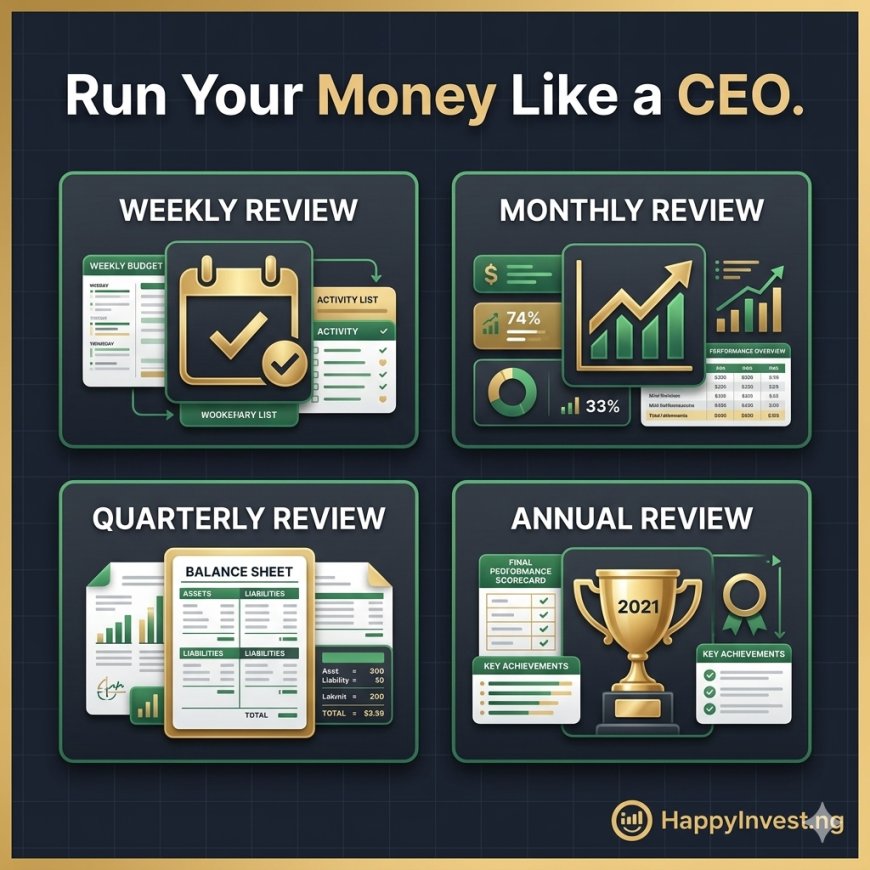
Successful CEOs don't review all business metrics at the same frequency. Operational metrics are reviewed daily or weekly; strategic metrics are reviewed quarterly or annually. Your personal finance review should follow the same logic — different questions at different frequencies, each serving a distinct purpose.
|
W WEEKLY |
The Cash Flow Check 5–10 minutes every Sunday evening to stay on top of day-to-day money flow |
The weekly review is your operational pulse check. It should take no more than 10 minutes and cover:
▸ Review all transactions from the past week and spending categories on track with your budget?
▸ Check your bank account balance. Is your cash position comfortable heading into the new week?
▸ Flag any unexpected expenses that need to be accounted for in the month's budget.
▸ Confirm that any scheduled automatic savings or investment transfers executed successfully.
▸ Note any financial tasks that need action in the coming week (upcoming bill payments, a pending investment, a financial decision to be made).
|
Tool for Nigerian Investors: Use your mobile banking app's transaction history, or a simple spreadsheet/notes app to log weekly spending. Apps like Cowrywise and Piggyvest also show your savings activity, making the weekly check quick and visual. |
|
M MONTHLY |
The Income Statement Review 30–45 minutes on the last day of each month to review your personal P&L |
The monthly CEO review is your Personal Profit & Loss statement, the equivalent of what any well-run business produces every month. It answers the critical question: Did I earn more than I spent this month, and by how much?
Monthly Review Agenda:
▸ Total all income received this month, salary, freelance, dividends, rental income, business distributions, everything.
▸ Total all expenses by category using the budget audit template below.
▸ Calculate your Monthly Surplus (Income – Expenses). This number must be positive. If it's negative, you consumed more than you produced, a crisis signal.
▸ Verify your savings rate. Did you hit your target? If not, why not, and what adjustments are needed next month?
▸ Review debt balances: Are you making progress? Note any changes in outstanding loan balances.
▸ Check progress on any specific financial goals you're working toward this month.
Monthly Budget Audit Template
|
Category |
Budgeted Amount |
Actual Spend |
Variance |
|
Housing (rent/mortgage) |
₦___,___ |
₦___,___ |
₦___,___ |
|
Food & Groceries |
₦___,___ |
₦___,___ |
₦___,___ |
|
Transportation |
₦___,___ |
₦___,___ |
₦___,___ |
|
Utilities (electricity, data, etc.) |
₦___,___ |
₦___,___ |
₦___,___ |
|
School Fees / Education |
₦___,___ |
₦___,___ |
₦___,___ |
|
Healthcare |
₦___,___ |
₦___,___ |
₦___,___ |
|
Savings & Investments |
₦___,___ |
₦___,___ |
₦___,___ |
|
Debt Repayments |
₦___,___ |
₦___,___ |
₦___,___ |
|
Discretionary (entertainment, dining) |
₦___,___ |
₦___,___ |
₦___,___ |
|
TOTAL |
₦___,___ |
₦___,___ |
₦___,___ |
|
�� Nigerian Inflation Adjustment: With Nigeria's inflation running at elevated levels, your monthly review must account for the fact that the same budget amounts buy less every month. Adjust category budgets quarterly to reflect current prices rather than waiting until the end of the year to discover a large shortfall. |
|
Q QUARTERLY |
The Balance Sheet Review 2–3 hours every quarter to assess your full financial position and portfolio performance |
The quarterly review is where you zoom out from cash flow and look at the big picture — your total financial position, your investment portfolio's performance, and your progress toward your annual goals. This is the equivalent of a company's quarterly earnings report.
Quarterly Review Agenda:
▸ Calculate your current Net Worth, list all assets and liabilities, and compute the difference. Compared to last quarter. Is it growing? By how much?
▸ Review your investment portfolio — calculate your total return for the quarter across all accounts (NGX stocks, mutual funds, dollar investments, bonds). Compare to your benchmark and to inflation.
▸ Assess your asset allocation — have market movements caused any asset class to drift significantly from your target allocation? Does rebalancing need to occur?
▸ Review your emergency fund — is it still adequately funded? Has your monthly expense level changed, requiring a larger buffer?
▸ Evaluate your debt position — are you on track with debt elimination? Have interest rates changed in ways that affect your loans?
▸ Check your insurance coverage — any life changes (new child, salary increase, new property) that require updating your coverage?
▸ Assess progress toward annual financial goals — are you on track? What adjustments are needed for the remaining quarters?
|
Investment Review Framework: For each investment, ask three questions: (1) Is this investment performing in line with my expectations for this asset class? (2) Has the fundamental case for this investment changed? (3) Does the size of this holding still align with my target asset allocation? Only sell based on reasoned answers to these questions never based on short-term emotion. |
|
A ANNUALLY |
The Strategic Financial Plan Review Half-day dedicated to comprehensive review and planning for the year ahead |
The annual review is your CEO's strategic planning session — the equivalent of the board-level annual review that sets direction for the entire coming year. This is the most important financial exercise you will do all year and deserves dedicated, uninterrupted time. Block out half a day. Take it seriously.
Annual Review Agenda:
▸ Full Year Net Worth Calculation — compare your net worth at year-start vs year-end. This is your annual score. How much did your net worth grow in absolute and percentage terms?
▸ Annual Savings Rate — what percentage of your total annual income did you save and invest? Compare to your target and to previous years.
▸ Investment Portfolio Deep Dive — review each holding. Examine annual returns, dividend income received, and whether each position still deserves its place in your portfolio.
▸ Goal Achievement Review — assess every financial goal you set at the start of the year. Which did you achieve? Which did you miss? Why? What does this tell you about your goal-setting and execution?
▸ Life Change Assessment — what changed in your life this year (job change, marriage, children, relocation, inheritance) and how should your financial strategy reflect these changes?
▸ Tax Review — did you optimise your tax position this year? Are you maximising any available tax reliefs (pension contributions, business expenses)? Consider consulting a tax professional.
▸ Financial Goal Setting for the New Year — set specific, measurable financial goals for the coming 12 months across all areas: income growth, savings rate, net worth target, investment milestones, debt elimination progress.
▸ Estate Planning Check — Is your will current? Are beneficiary designations updated? Is your insurance adequate? Are your loved ones aware of your financial assets and wishes?
|
Annual CEO Principle: At your annual review, do not just look backward at last year's performance — use it as intelligence to build a better financial plan for the year ahead. The most valuable output of the annual review is not the assessment of what happened; it is the clear, specific plan for what you will do differently and better in the coming year. |
4. The CEO's Hard Questions: What to Actually Ask Yourself
The most powerful part of any review for a business or a personal financial life is not the numbers themselves but the questions those numbers provoke. Here are the CEO-level questions every Nigerian investor should ask at their reviews:
Questions About Income
▸ Is my income growing faster than inflation? If not, my real purchasing power is declining. What am I doing about it?
▸ What percentage of my income comes from sources other than my job? Is this percentage growing over time?
▸ Am I being paid what I'm worth in the market? When did I last research market rates for my skills and experience?
▸ What is the next income stream I plan to build, and what concrete step will I take this month toward it?
Questions About Spending
▸ Which spending category showed the largest variance from budget this month, and why?
▸ Which subscriptions or recurring expenses am I paying for that no longer deliver proportional value to my life?
▸ Am I spending on things that represent my actual priorities, or am I spending by default and habit?
▸ What is the single largest 'lifestyle inflation' cost I've taken on in the past year, and was it worth it?
Questions About Investing
▸ Is my portfolio growing faster than Nigeria's inflation rate? If not, I am losing real wealth even as the numbers grow.
▸ Am I investing consistently every month, or only when I remember and feel like it?
▸ Does my current asset allocation still match my risk tolerance and time horizon?
▸ Am I holding any investment out of emotion or loyalty rather than rational conviction in its future performance?
Questions About Risk
▸ If I lost my job tomorrow, how long could my family maintain our current lifestyle without any income?
▸ If I died tomorrow, would my family be financially protected? Is my will current? Are my beneficiaries designated?
▸ What is the single biggest financial risk in my life right now, and what am I doing to mitigate it?
Questions About Progress
▸ Am I financially further ahead today than I was one year ago? By how much?
▸ At my current trajectory, when will I reach financial independence? Is that timeline acceptable?
▸ What is the single most impactful financial change I could make in the next 90 days?
|
⚠️ The Uncomfortable Truth: Most people avoid reviewing their finances precisely because the numbers tell uncomfortable truths — debts they'd rather not face, savings rates that reveal lifestyle-over-wealth priorities, investment returns that expose poor decisions. But the discomfort of awareness is always preferable to the disaster of ignorance. A CEO who refuses to look at the company's financial data is not protecting themselves from bad news; they are guaranteeing it. |
5. Building Your Personal Financial Review System
Knowing what to review is only half the battle. The other half is building a system that ensures you actually do it, consistently, over years and decades. Here's how to structure your review system:
Step 1: Create Your Financial Hub
Consolidate all your financial information in one place, a dedicated spreadsheet, a financial management app, or a simple folder. This hub should contain: a list of all accounts and their current balances, your net worth tracker (updated quarterly), your monthly budget vs. actual tracker, your investment portfolio summary, and your financial goals with progress tracking.
The specific tool matters less than the consistency. A well-maintained spreadsheet beats a sophisticated app that you never open. Start simple and upgrade as your needs grow.
Step 2: Schedule Your Reviews Like Meetings
Calendar blocking is not optional: it is the mechanism that transforms intention into action. Right now, open your calendar and block:
▸ 10 minutes every Sunday evening — Weekly Cash Flow Check
▸ 45 minutes on the last Sunday of each month — Monthly P&L Review
▸ 3 hours on the last Sunday of March, June, September, and December- Quarterly Balance Sheet Review
▸ Half a day in the first week of January — Annual Strategic Financial Plan
Treat these appointments with the same seriousness you give to work meetings or doctor's appointments. They are non-negotiable commitments to your financial future.
Step 3: Create Accountability
The most successful personal finance practitioners don't work in isolation. They have accountability structures, a financially aligned spouse who reviews together, a trusted friend or sibling who checks in on goals, a financial advisor who conducts formal reviews, or a community of like-minded investors who share progress and challenges.
In Nigeria's context, financial accountability structures can include investment clubs, cooperative societies, or online communities of investors. HappyInvest.ng's community provides exactly this: a space where investors share strategies, hold each other accountable, and celebrate progress together.
Step 4: Conduct Reviews Without Self-Judgment
This is perhaps the most psychologically important principle. The purpose of a financial review is not to make you feel guilty about past choices: it is to gather accurate information that enables better future decisions. Look at bad news with the same objective curiosity you bring to good news. A month of overspending is data. An underperforming investment is information. Process these facts analytically, adjust your strategy, and move forward.
The CEO who spends board meetings berating themselves for last quarter's performance is not a CEO; they're a liability. The effective CEO acknowledges what happened, understands why, and directs all energy toward what comes next.
6. The Nigerian Context: Special Considerations for Your Review
Reviewing your finances as a Nigerian investor requires awareness of some specific factors that don't appear in standard Western personal finance frameworks:
Inflation-Adjusted Thinking
Nigeria's inflation rate has persistently run at 20–35% in recent years. This means that any investment returning less than the prevailing inflation rate is a losing investment in real terms, even if the nominal return is growing. Your review must always compare investment returns and net worth growth against the inflation rate, not just in absolute terms. The question is not 'Did my portfolio grow?' It is 'Did my portfolio grow faster than inflation?'
Currency Risk Management
The naira's depreciation against major currencies is a structural feature of the Nigerian economic environment that your financial review must account for. Quarterly reviews should assess your portfolio's dollar exposure what percentage of your assets are in naira vs. dollar-denominated investments? A CEO managing a Nigerian company with international revenues would track currency exposure carefully; you should too.
Extended Family Financial Obligations
Nigerian cultural expectations around family financial support contributions to relatives' needs, ceremonies, and emergencies are a real and significant part of many households' financial lives. A realistic Nigerian financial review must include a dedicated budget line for family support obligations, tracked honestly. Pretending this cost doesn't exist leads to chronic budget 'surprises' that undermine even well-designed financial plans.
Sector Concentration Risk
Many NGX investors hold portfolios heavily concentrated in banking stocks or a handful of large-cap companies. Your quarterly investment review should assess sector concentration: if more than 30% of your equity portfolio is in any single sector, or more than 10% in any single stock, you carry significant concentration risk. Diversification across sectors — banking, telecoms, consumer goods, industrial, and agriculture is a key review action item.
|
The Nigerian CEO's Edge: Many sophisticated global investors consider Nigeria an 'investable' emerging market, meaning that well-positioned Nigerian investors, with local knowledge and access, can generate returns that are difficult for foreign investors to replicate. Your regular financial review is the mechanism that allows you to exploit this edge intelligently, moving capital toward opportunities as they emerge and away from positions that have run their course. |
Your Complete CEO Financial Review Checklist
Print this. Post it where you'll see it. Use it at every review:
Weekly (10 minutes)
▸ Reviewed all transactions spending on track
▸ Confirmed automatic transfers executed
▸ Noted upcoming financial tasks for the week
Monthly (45 minutes)
▸ Calculated total income vs. total expenses
▸ Computed monthly surplus is positive
▸ Verified savings rate hit target (or adjusted plan if missed)
▸ Reviewed all debt balances for progress
▸ Completed budget audit by category
▸ Flagged any financial decisions required next month
Quarterly (3 hours)
▸ Calculated updated Net Worth compared to the prior quarter
▸ Reviewed investment portfolio performance vs. inflation and benchmark
▸ Assessed asset allocation, rebalanced if needed
▸ Confirmed emergency fund is adequately funded
▸ Reviewed debt elimination progress
▸ Checked insurance coverage for adequacy
▸ Assessed progress toward annual goals, adjusted plan if off track
Annually (Half day)
▸ Full-year Net Worth calculation and year-on-year comparison
▸ Annual savings rate calculation compared to target and prior years
▸ Investment portfolio deep dive reviewed each holding
▸ Goal achievement review analysed hits and misses
▸ Life changes assessment and strategy adjustment
▸ Tax position review identified any optimisation opportunities
▸ New year financial goals set specific, measurable, time-bound
▸ Estate planning check will, beneficiaries, insurance, all current
Final Thoughts: The Review Is the Strategy
There is a common misconception that financial success comes from making one or two brilliant decisions: the perfect investment, the perfectly timed property purchase, the business that takes off. In reality, sustained financial success is the cumulative result of hundreds of ordinary decisions made consistently well over many years.
The financial review is the mechanism that keeps all those ordinary decisions pointed in the right direction. It is the feedback loop that tells you when you're drifting off course before the drift becomes a crisis. It is the discipline that turns good intentions into measurable progress. It is, ultimately, the difference between hoping your finances improve and ensuring that they do.
The best-managed businesses in the world review their performance relentlessly not because the founders are obsessed with spreadsheets, but because they understand that the map is not the territory, and without regular navigation checks, even the best strategies go off course.
Your financial life deserves the same attention. Not because money is the most important thing in life, it isn't, but because financial security, freedom, and the ability to provide for your family and pursue what matters to you are enormously important. And those things don't happen by accident.
Schedule your first CEO financial review this Sunday. Even if it's imperfect. Even if the numbers are uncomfortable. Especially then.
At HappyInvest.ng, we are here to help you build the knowledge, tools, and habits that make financial mastery not just possible but inevitable. The CEO of your financial life starts their first review today.
© HappyInvest.ng — Empowering Nigerians to Invest Smarter