Fundamental Analysis: How to Use EPS, P/E, P/B and Financial Metrics to Pick Stocks
Master fundamental analysis with this beginner guide. Learn how to use EPS, P/E, P/B, and other metrics to pick winning stocks.
 Yahnic Chigozie

If you want to stop guessing in the stock market and start making informed decisions, you need to understand fundamental analysis.
This is the method smart investors use to answer one key question:
“Is this company worth buying?”
What Is Fundamental Analysis? (Simple Definition)
Fundamental analysis is the process of evaluating a company’s financial health and performance to determine its true value.
In simple terms:
You study the business, not just the stock price.
Key Metrics Every Investor Must Understand
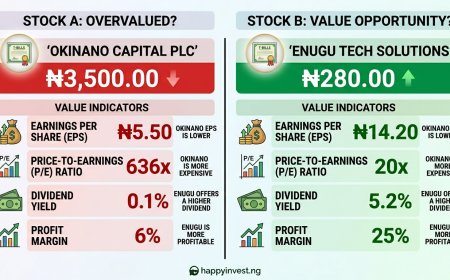
1. Earnings Per Share (EPS)
What It Means
EPS shows how much profit a company makes per share.
Formula
EPS = Net Income/Total Shares
How to Use It
-
Higher EPS = more profitable company

-
Growing EPS over time = good sign


Red Flag
-
Declining EPS = business may be struggling
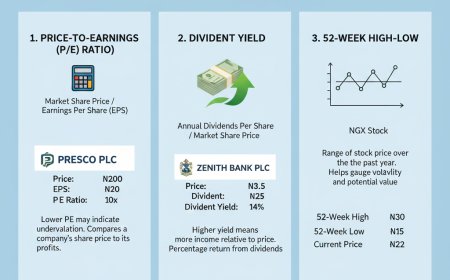
2. Price-to-Earnings Ratio (P/E)
What It Means
P/E tells you how expensive a stock is relative to its earnings.
Formula
P/E = Price per Share/Earnings per Share
How to Use It
-
Low P/E → may be undervalued
-
High P/E → may be expensive (or high growth)
Important Tip
Always compare:
-
Companies in the same industry
3. Price-to-Book Ratio (P/B)
What It Means
P/B compares the stock price to the company’s net assets.
Formula
P/B = Price per Share/Book Value per Share
How to Use It
-
P/B < 1 → possibly undervalued
-
P/B > 1 → market values the company above its assets
Best Used For
-
Banks
-
Asset-heavy companies
4. Dividend Yield & Payout Ratio
Dividend Yield
Shows how much income you earn from dividends.
Dividend\ Yield = \frac{\text{Annual Dividend}}{\text{Price}} \times 100%
Payout Ratio
Shows how much profit is paid as dividends.
Payout\ Ratio = \frac{\text{Dividends}}{\text{Net Income}}
How to Use Them
-
High yield → good for income investors
-
Moderate payout ratio → sustainable dividends
Red Flag
-
Very high payout ratio → may not be sustainable
5. Revenue, Net Income, EBITDA
Revenue
-
Total money the company earns
Net Income
-
Profit after expenses
EBITDA
(Earnings Before Interest, Taxes, Depreciation, Amortization)
-
Shows operational performance
How to Use Them
Look for:


-
Consistent growth in revenue
-
Increasing profits
-
Strong operating performance
How to Use These Metrics to Pick Stocks
Step 1: Check Profitability
Ask:
-
Is the company making money?
Look at:
-
EPS
-
Net income
Step 2: Check Growth
Ask:
-
Is the company improving over time?
Look at:
-
Revenue growth
-
EPS growth
Step 3: Check Valuation
Ask:
-
Is the stock overpriced or undervalued?
Look at:
-
P/E ratio
-
P/B ratio
Step 4: Check Income Potential
Ask:
-
Does it pay dividends?
Look at:
-
Dividend yield
-
Payout ratio
Step 5: Compare with Competitors
Never analyze a stock in isolation.
Compare with:
-
Similar companies
-
Industry averages
How to Tell If a Stock Is Doing Well or Bad
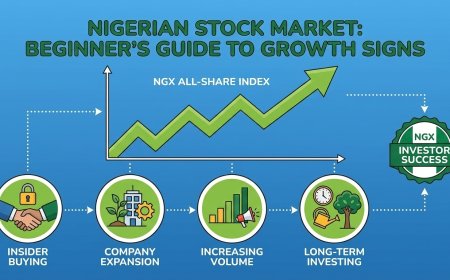
Signs of a Good Stock
-
Growing revenue
-
Increasing EPS
-
Reasonable P/E ratio
-
Strong dividend history
-
Stable or growing profits
Warning Signs of a Bad Stock
-
Declining earnings
-
Falling revenue
-
Very high or very low P/E without a reason
-
Unsustainable dividends
-
Poor financial performance
Simple Real-Life Example
Company A
-
Revenue: Growing
-
EPS: Increasing
-
P/E: Reasonable
-
Dividends: Stable
Likely a good investment candidate
Company B
-
Revenue: Falling
-
EPS: Negative
-
P/E: Very high
-
Dividends: None
Likely a risky or weak company
Beginner-Friendly Strategy
Rule 1: Focus on Earnings
Profit drives stock value.
Rule 2: Look for Growth
Growing companies create wealth.
Rule 3: Don’t Overpay
Use P/E and P/B to judge value.
Rule 4: Combine Metrics
Never rely on one number alone.
Rule 5: Think Long-Term
Ignore short-term noise.
Common Mistakes to Avoid
-
Looking at only the stock price
-
Ignoring financial statements
-
Chasing high dividends blindly
-
Not comparing companies
Numbers Tell the Real Story
The stock price is just the surface.
But the real story is in the numbers:
-
Earnings
-
Growth
-
Value
Because in the end:
Successful investing is not about guessing; it is about understanding the business behind the stock.