Why Asset Allocation Matters More Than Stock Picking
Learn why asset allocation, not stock picking, drives 90%+ of investment returns. A practical guide for Nigerian investors on building a balanced, profitable portfolio. Most investors obsess over which stocks to buy — but research shows that over 90% of your long-term investment returns are determined by how you divide your money across asset classes, not by which individual stocks you pick. This in-depth guide explains asset allocation, why it works, and exactly how Nigerian investors can build a smarter, more resilient portfolio today.
 Yahnic Chigozie
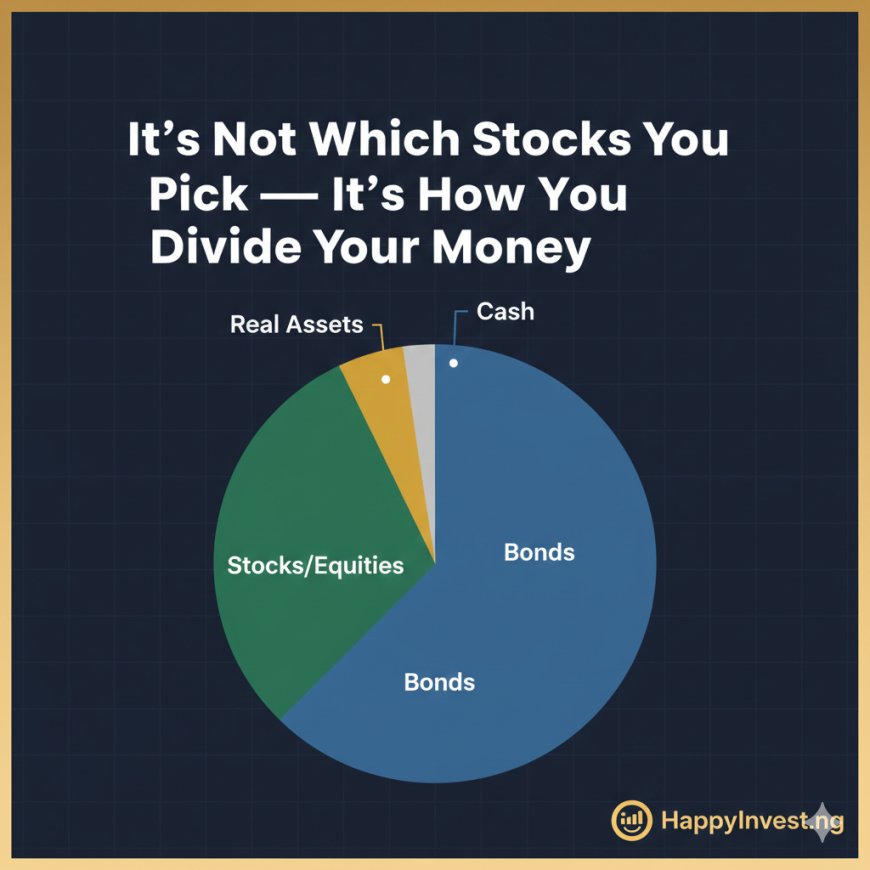
The single most important investment decision you'll ever make has nothing to do with which stocks you choose — and everything to do with how you divide your money.
Ask most people what makes a successful investor, and they'll tell you: picking the right stocks. Finding the next Dangote Cement before it doubles. Getting into BUA Foods early. Spotting the next Airtel Africa before the institutional money floods in.
It's a compelling story. And it's almost entirely wrong.
Decades of academic research and the lived experience of the world's most successful investors consistently show that how you divide your money across different asset classes matters far more than which specific investments you choose within those categories. This is the principle of asset allocation, and it may be the most important investment concept you'll ever learn.
Let's dig into why.
In 1986, three financial economists — Gary Brinson, L. Randolph Hood, and Gilbert Beebower — published a landmark study in the Financial Analysts Journal. Their research analysed 91 large US pension funds over a 10-year period and asked a simple but profound question: what actually determines a portfolio's returns?
Their conclusion was striking: approximately 91.5% of the variation in a portfolio's returns over time was explained by its asset allocation policy, the broad decision about how much to put in stocks, bonds, and other asset classes. Only a tiny fraction was explained by individual security selection (stock picking) or market timing.
|
The Brinson Study (1986) found that over 90% of long-term investment returns are determined by asset allocation decisions, not by which specific stocks or bonds you pick. This finding has been replicated in studies across multiple countries and time periods. |
This study, and the many that followed, confirming its findings, fundamentally transformed how professional investment managers think about portfolio construction. The message is clear: before you ever think about which stock to buy, you need to decide what kinds of assets to own, and in what proportions.
2. What Is Asset Allocation, Exactly?
Asset allocation is the process of dividing your investment portfolio among different categories of assets — typically referred to as asset classes. The major asset classes are:
▸ Equities (Stocks) — Ownership stakes in companies. Highest potential returns, but also highest volatility. Examples: NGX-listed stocks, US stocks, global ETFs.
▸ Fixed Income (Bonds) — Loans you make to governments or corporations in exchange for regular interest payments. Lower returns than stocks, but more stable. Examples: Nigerian government bonds (FGN Bonds), Eurobonds, corporate bonds.
▸ Real Assets — Physical or tangible assets: real estate, commodities (gold, oil, agricultural products), infrastructure. Provide inflation protection and diversification.
▸ Cash & Cash Equivalents — Treasury bills, money market funds, high-yield savings. The most liquid and safest, but with the lowest returns.
▸ Alternative Investments — Hedge funds, private equity, venture capital, cryptocurrency. Higher risk, potentially high reward, but limited accessibility for most retail investors.
The key insight is that these asset classes behave differently under different economic conditions. When one zigs, another often zags — and this is the core of why asset allocation is so powerful.
3. The Magic of Non-Correlation: Why Mixing Assets Works
Here's a concept that sounds technical but is actually beautifully simple: different asset classes tend not to move in the same direction at the same time. In investment language, they have low or negative correlation.
Consider what happens in different economic environments in Nigeria:
▸ When the economy is booming, and corporate profits are strong, → Stocks perform well; bonds may lag as investors prefer higher-risk assets.
▸ When the CBN raises interest rates to fight inflation, → Existing bond prices typically fall, but new bonds offer better yields; stocks often struggle.
▸ When naira depreciates sharply → Dollar-denominated assets (Eurobonds, US stocks via platforms like Bamboo or Chaka) surge in naira terms; local stocks may struggle.

▸ When inflation spikes → Real assets like gold, real estate, and commodities tend to hold their value or appreciate; cash loses purchasing power rapidly.
By holding a mix of these asset classes, you ensure that when one part of your portfolio is suffering, another part is likely performing well. The overall result is a smoother ride, lower volatility, more consistent returns, and critically, fewer catastrophic losses.
|
This is the only 'free lunch' in investing. Diversification across asset classes can reduce your risk without necessarily reducing your expected returns. It's the mathematical foundation of portfolio theory, pioneered by Nobel Prize-winner Harry Markowitz. |
4. Why Stock Picking Is Harder Than You Think
Now let's talk about why stock picking, the activity most retail investors spend 90% of their time on, matters so much less than you'd expect.
The Odds Are Against You
Research consistently shows that the vast majority of professional fund managers — people who dedicate their entire careers to analysing stocks, with teams of analysts, proprietary data, and sophisticated tools — fail to beat simple index funds over the long term. In the US, over a 20-year period, more than 90% of actively managed large-cap funds underperform the S&P 500 index. If professionals with all their resources struggle to pick winning stocks consistently, what does that say about the odds for individual investors?
The Winner-Takes-All Reality
A fascinating study by Hendrik Bessembinder found that from 1926 to 2019, just 4% of all US stocks accounted for the entire net wealth creation of the stock market. The other 96% collectively produced returns no better than treasury bills. The implication: to beat the market through stock picking, you need to identify in advance which tiny minority of companies will generate outsized returns. That is extraordinarily difficult.
Behavioural Biases Work Against You
Human psychology is poorly suited to stock picking. We buy what's been going up (chasing performance), sell what's going down (panic selling), hold losers too long (loss aversion), and overweight familiar companies (home bias). These tendencies predictably lead to buying high and selling low — the exact opposite of good investing.
|
Nigerian Context: Many NGX retail investors concentrate heavily in just 3–5 well-known stocks — often MTN Nigeria, Dangote Cement, Zenith Bank, and Guaranty Trust Holding. While these are strong companies, this concentration means that if one underperforms, it can devastate the portfolio. Asset allocation addresses this structural vulnerability. |
5. How to Think About Your Own Asset Allocation
The right asset allocation for you depends on three interconnected factors:
▸ Time Horizon — How long before you need the money?
This is the most important factor. If you're 25 years old, investing for retirement at 60, you have a 35-year time horizon. This means you can afford to take more risk (hold more stocks) because you have time to recover from market downturns. If you're saving to buy a house in 3 years, you should hold mostly stable, capital-preserving assets like bonds and money market funds.
▸ Risk Tolerance — How much volatility can you stomach emotionally?
This is separate from your ability to take risk financially — it's about your psychological comfort. If watching your portfolio drop 30% during a market crash would cause you to sell everything in panic (locking in losses), then an aggressive allocation is wrong for you even if your time horizon is long. Be honest with yourself about this.
▸ Financial Goals — What are you investing for?
Retirement? Children's education? Buying land? Starting a business? Each goal has a different time horizon and different flexibility requirements, which should drive different allocation decisions. Many sophisticated investors maintain multiple portfolios — each with its own allocation — matched to each specific goal.
Sample Asset Allocation Frameworks by Investor Profile
|
Investor Profile |
Stocks / Equities |
Bonds / Fixed Income |
Real Assets |
Cash |
|
Aggressive (Young, Long Horizon) |
70% |
15% |
10% |
5% |
|
Moderate (Mid-Career) |
50% |
30% |
15% |
5% |
|
Conservative (Near Retirement) |
25% |
50% |
15% |
10% |
|
Very Conservative (Retired) |
10% |
60% |
20% |
10% |
Note: These are illustrative frameworks only. Always consult a qualified financial advisor for personalised allocation advice.
6. The Nigerian Investor's Asset Allocation Toolkit
A common misconception among Nigerian investors is that asset allocation is something only wealthy or international investors can implement. This is not true. As a Nigerian investor today, you have access to a broader range of asset classes than ever before:
Equities
▸ NGX-listed stocks (via stockbrokers or platforms like Trove, Bamboo, or your bank's investment arm)
▸ US and global stocks (via Bamboo, Chaka, Risevest — legally accessible to Nigerians)
▸ Exchange-Traded Funds (ETFs) — the NGX now lists ETFs tracking the NGX 30 and other indices
Fixed Income
▸ FGN Bonds (sold via DMO auctions or the secondary market through stockbrokers)
▸ Nigerian Treasury Bills (T-Bills) — short-term government securities, currently offering attractive yields
▸ Corporate bonds listed on the NGX
▸ US Treasury bonds and investment-grade bonds (via international platforms)
Real Assets
▸ Direct real estate (residential or commercial property)
▸ Real Estate Investment Trusts (REITs) — UPDC REIT is listed on the NGX
▸ Gold (via physical bullion, gold savings plans, or international ETFs like GLD)
▸ Agricultural commodities (through structured products from some Nigerian financial institutions)
Cash & Near-Cash
▸ Money market mutual funds (offered by ARM, Stanbic IBTC, Meristem, and others currently yielding 18–22% per annum in some cases)
▸ High-yield savings accounts and fintech savings products (Piggyvest, Cowrywise, etc.)
▸ Dollar-denominated savings (legal USD accounts or dollar-yield products)
|
Pro Tip for Nigerian Investors: Given naira volatility, a deliberate allocation to dollar-denominated assets, even just 20–30% of your portfolio, provides critical protection against currency depreciation. This is a form of asset allocation specific to the Nigerian context. |
7. Rebalancing: The Discipline That Maintains Your Allocation
Over time, different asset classes will grow at different rates, causing your allocation to drift from your original targets. For example, if stocks have a great year and bonds have a flat year, you might find your portfolio has shifted from 60% stocks / 40% bonds to 70% stocks / 30% bonds, making you more exposed to stock market risk than you intended.
Rebalancing is the process of periodically selling assets that have grown above their target weight and buying assets that have fallen below their target, to restore your intended allocation. This disciplined process has an important side effect: it enforces buying low and selling high, the opposite of what most emotional investors do.
Most financial advisors recommend rebalancing once or twice a year, or whenever an asset class drifts more than 5–10 percentage points from its target allocation.
|
Real Example: An investor who maintained a 60/40 stock/bond portfolio and rebalanced annually through the 2008 financial crisis would have automatically bought more stocks when they were cheapest (during the crash) and recovered significantly faster than an investor who panicked and sold everything. |
8. When Stock Picking Still Has a Role
To be clear: this article is not arguing that you should never research or select individual stocks. Within your equity allocation, thoughtful stock selection can add value, especially if you:
▸ Have deep knowledge of a specific industry or sector
▸ Are willing to invest significant time in fundamental analysis
▸ Understand the difference between a good company and a good investment
▸ Can maintain emotional discipline during market downturns
The key is sequencing and proportion. First, establish your asset allocation framework. Decide how much goes to stocks vs. bonds vs. real assets vs. cash. Then, within your equity portion, you can apply stock selection. The asset allocation decision sets the parameters within which stock picking operates — and it matters far more to your ultimate outcome.
|
A useful mental model: think of asset allocation as the architecture of your financial house, and stock selection as the interior decoration. You can have beautiful furniture in a poorly designed house — but you can't make a well-designed house work with no furniture at all. Architecture comes first. |
9. Practical Steps to Build Your Asset Allocation
Here's how to get started today:
▸ Step 1: Define your goals and time horizons. Write them down, specifically 'Retire at 60 with ₦50 million in today's purchasing power' is more useful than 'save for retirement.'
▸ Step 2: Honestly assess your risk tolerance. If you're not sure, complete a risk tolerance questionnaire (most Nigerian investment platforms offer one).
▸ Step 3: Choose a broad target allocation using the framework table above as a starting point. Adjust based on your specific circumstances.
▸ Step 4: Identify the specific instruments you'll use for each asset class from your Nigerian toolkit above.
▸ Step 5: Invest consistently: don't try to time the market. Set up automatic contributions if possible.
▸ Step 6: Review and rebalance at least once a year. Set a calendar reminder.
▸ Step 7: As your life changes: new job, marriage, children, approaching retirement, revisit and adjust your allocation accordingly.
Final Thoughts: Build the Foundation First
The financial media is obsessed with stock picking because it makes for exciting stories. 'I bought XYZ and made 200%!' grabs attention in a way that 'I maintained a disciplined 60/40 portfolio and rebalanced annually' never will. But the boring truth is that the latter approach, executed consistently, beats the former for most investors over a lifetime.
Asset allocation won't make you rich overnight. It won't give you the adrenaline rush of a successful stock tip. What it will do applied with patience and discipline over the years, is help you build real, durable wealth. It is the difference between gambling and investing.
At HappyInvest.ng, we believe that financial intelligence is the foundation of financial freedom. And the most intelligent thing you can do as an investor is not to search for the next great stock, it's to get your asset allocation right, and let time and compounding do the rest.
Build the foundation. The rest will follow.
© HappyInvest.ng — Empowering Nigerians to Invest Smarter