Inflation vs Your Savings: How the Invisible Tax Is Reducing Your Money
Discover how inflation affects your savings in Nigeria and learn how to protect your money using treasury bills and money market funds.
 Yahnic Chigozie
Many people believe that saving money automatically makes them financially secure.
But there is a silent force working against your savings every day:
Inflation.
If you do not understand how inflation works, you may think your money is growing when, in reality, it is losing value.
What Is Inflation? (Simple Definition)
Inflation is the increase in the prices of goods and services over time.
In simple terms:
Your money buys less than it used to.
What Is the “Invisible Tax”?
Inflation is often called an invisible tax because:
-
You don’t see it deducted from your account

-
But it reduces your purchasing power

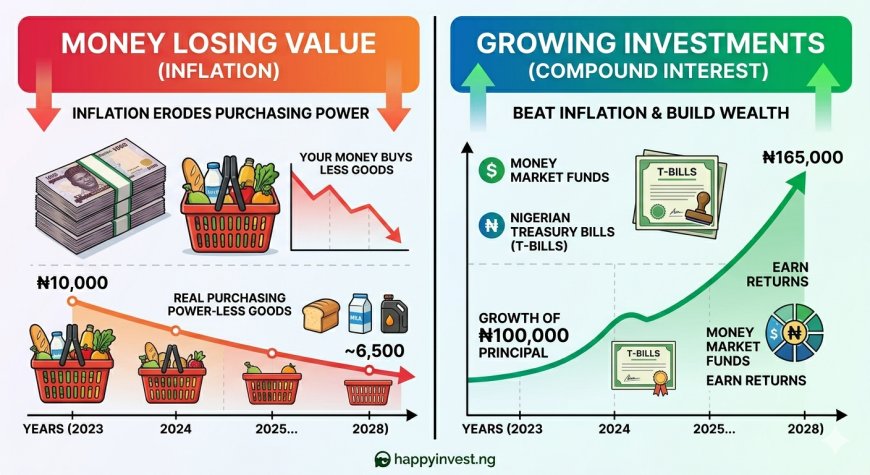
You still have the same ₦ amount…
But it can buy fewer things.
Recent Inflation Data in Nigeria (NBS Insight)
According to the National Bureau of Statistics, Nigeria has experienced persistently high inflation in recent years, with rates often ranging between 25% and 30%+ in 2024–2025.
What This Means
If inflation is 25%:
-
Something that costs ₦100 today may cost ₦125 next year
Real-Life Example: How Inflation Eats Your Savings
Let’s say:
-
You saved ₦1,000,000
-
You kept it in a regular bank account, earning 2% interest
After one year:
-
Your money becomes: ₦1,020,000
But if inflation is 25%:
-
Your real purchasing power drops significantly
Reality
Even though your money increased slightly,
You are actually poorer in real terms.
Simple Illustration
| Scenario | Amount |
|---|---|
| Savings after interest | ₦1,020,000 |
| Value adjusted for inflation | Much less in real buying power |
This is the invisible tax.
Why Idle Cash Is Risky
Keeping money idle:
-
In savings accounts
-
As cash at home
Leads to:
-
Loss of value
-
Reduced financial power
How to Protect Your Money from Inflation
To fight inflation, your money must:
Grow at a rate equal to or higher than inflation.
This is where low-risk investment options come in.
1. Treasury Bills (T-Bills)
What Are Treasury Bills?
Treasury Bills are short-term government securities issued by the Central Bank of Nigeria.
In simple terms:
You lend money to the government and earn interest.
Key Features
-
Low risk
-
Fixed returns
-
Short-term (91, 182, 364 days)


Why They Help Against Inflation
-
Offer higher returns than regular savings
-
Help reduce the impact of inflation
Best For
-
Conservative investors
-
Short-term goals
-
Capital preservation
2. Money Market Funds
What Are Money Market Funds?
Money market funds are investment funds that invest in low-risk instruments like treasury bills and short-term securities.
Key Features
-
Professionally managed
-
Higher returns than savings accounts
-
Easy to access
Why They Help Against Inflation
-
Typically offer competitive returns
-
Better at preserving value than idle cash
Best For
-
Beginners
-
Emergency funds
-
Flexible investing
Where to Access Them
Platforms like:
-
PiggyVest
-
Cowrywise
Provide easy access to money market funds.
Inflation vs Investment: Simple Comparison
| Option | Typical Return | Inflation Protection |
|---|---|---|
| Savings Account | Low | Poor |
| Cash at Home | 0% | Very Poor |
| Treasury Bills | Moderate | Better |
| Money Market Funds | Moderate | Better |
Important Reality
Even with these options:
-
You may not fully beat inflation
-
But you reduce its damage significantly
Simple Strategy to Protect Your Savings
Step 1: Keep Only Necessary Cash
-
For daily expenses
-
For emergencies
Step 2: Move Idle Cash
Transfer excess money into:
-
Treasury bills
-
Money market funds
Step 3: Stay Consistent
-
Invest regularly
-
Review periodically
Step 4: Combine with Growth Investments
For the long-term:
-
Add stocks or mutual funds
Real-Life Comparison
Person A
-
Keeps ₦1,000,000 in savings
-
Earns low interest
-
Loses value to inflation
Person B
-
Invests in money market funds
-
Earns better returns
-
Protects purchasing power
After a year:
-
Person A is poorer in real terms
-
Person B is financially smarter
Common Mistakes to Avoid
-
Keeping too much idle cash
-
Ignoring inflation
-
Chasing only safety without growth
-
Not diversifying
Don’t Let Inflation Quietly Steal Your Wealth
Inflation is unavoidable.
But losing money to it is not.
If you:
-
Understand how it works
-
Take simple action
-
Use the right tools
You can protect your money and grow it.
Because in the end:
Saving money is not enough; your money must grow faster than inflation.