Opportunity Cost Explained Simply
Learn what opportunity cost means in simple terms and how understanding it can help you make smarter money, spending, and investment decisions.
 Yahnic Chigozie
Every financial decision you make comes with a hidden cost.
Not the money you spend
But the opportunity you give up.
This hidden cost is called opportunity cost, and understanding it can completely change how you handle money, spending, saving, and investing.
Let’s explain it simply.
What Is Opportunity Cost?
Opportunity cost is what you give up when you choose one option over another.
Because you can’t choose everything at once, every choice closes the door on another choice.
In simple terms:
Opportunity cost = the best alternative you didn’t choose

It applies to:
-
Money
-
Time
-
Energy
-
Attention
A Simple Example
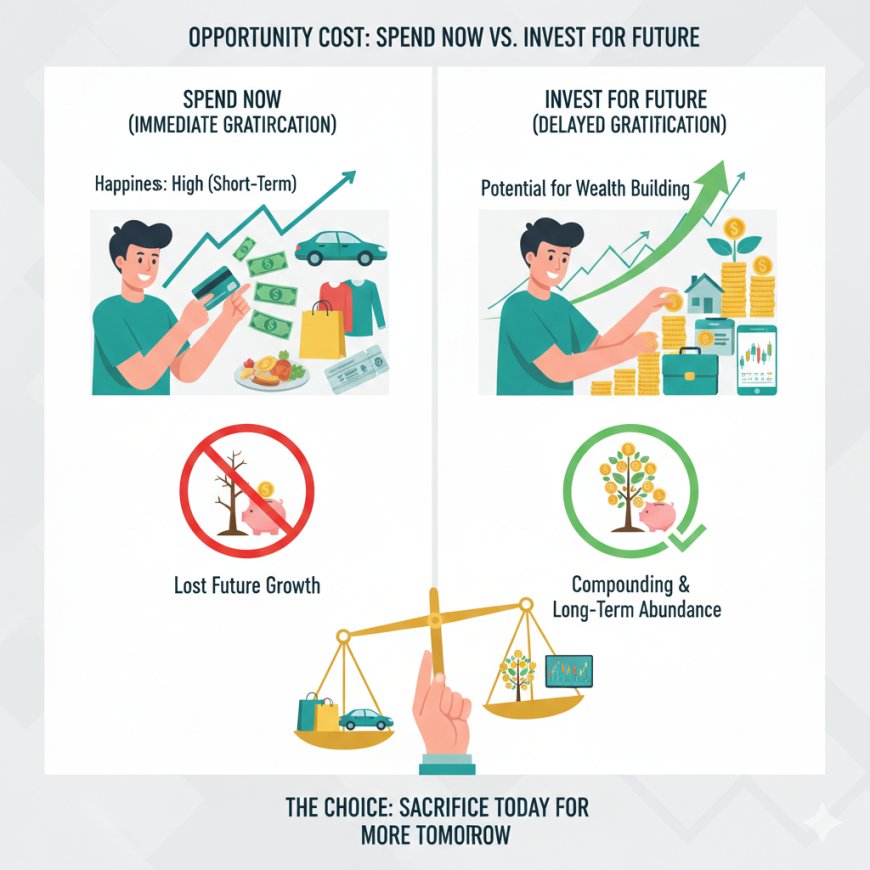
You have ₦100,000.
You can either:
-
Spend it on a new phone
OR -
Invest it
If you buy the phone, the opportunity cost is what that investment could have grown into.
If you invest the money, the opportunity cost is the enjoyment or usefulness of the phone.
There is no “free” choice, only trade-offs.
Opportunity Cost Is Not Always About Money
Many people think opportunity cost is only financial.
It’s not.
Time Example
If you spend 4 hours scrolling social media:
-
You give up learning a skill
-
You give up resting properly
-
You give up earning opportunities
Time wasted has an opportunity cost, too.
Why Opportunity Cost Matters in Personal Finance
Understanding opportunity cost helps you:
-
Spend more intentionally
-
Avoid impulsive decisions
-
Prioritize long-term benefits
-
Make smarter trade-offs
It shifts your thinking from:
“Can I afford this?”

To:
“What am I giving up by choosing this?”
Opportunity Cost in Investing
Investing decisions are full of opportunity costs.
Examples:
-
Investing in one stock means not investing in another
-
Keeping money in cash means missing potential growth
-
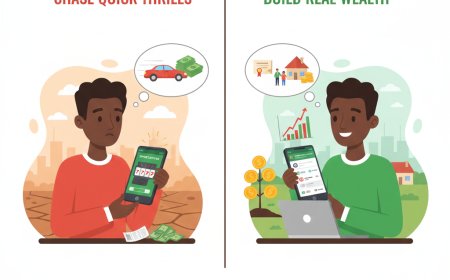
Chasing quick profits means giving up long-term compounding
Smart investors always ask:
“Is this the best use of my money right now?”
Opportunity Cost and Lifestyle Choices
Lifestyle inflation has a high opportunity cost.
Spending more as income grows can mean:
-
Delayed financial freedom
-
Less capital for investments
-
Fewer future options
Sometimes the biggest cost of luxury is lost future flexibility.
The Nigerian Reality
In Nigeria:
-
Inflation reduces the value of idle money
-
Income growth can be uncertain
-
Financial mistakes are harder to recover from
This makes opportunity cost even more important.
Choosing consumption over investment today may cost:
-
Business ownership tomorrow
-
Asset ownership later
-
Financial security in the future
How to Use Opportunity Cost in Daily Decisions
Before spending or investing, ask:
-
What am I giving up by choosing this?
-
Is this choice helping my future or only my present?
-
Will I regret this trade-off later?
You don’t need to avoid enjoyment, just choose consciously.
Opportunity cost reminds us that:
-
Money is limited
-
Time is limited
-
Choices matter
You don’t need to make perfect decisions.
You just need to make aware decisions.
When you understand opportunity cost, your money starts working with intention, not impulse.