How to Achieve Financial Freedom Even on a Low Income
Think financial freedom is only for people who earn big? Think again. Learn how to achieve financial freedom in Nigeria on a low income with practical steps, real ₦ examples, and simple investing tips you can start today.
 Yahnic Chigozie

Making Money Simple. Building Wealth Daily.
Let me ask you something real quick.
Have you ever looked at your salary alert, maybe ₦60,000, ₦80,000, ₦150,000, and thought, "There's no way I'm ever going to be financially free with this kind of money"?
You're not alone. Millions of Nigerians feel the same way every single month.
But here's what I want you to understand today: financial freedom is not about how much you earn. It's about what you do with what you have.
I know that sounds like one of those motivational quotes that sound good but don't help you buy rice. So let me break it down properly with real numbers, real steps, and real Nigerian context. No fluff.
First, Let's Define What Financial Freedom Actually Means
A lot of people think financial freedom means having millions in the bank, owning properties on the Island, or never working again. That's one version of it, but it's not the only version.
Financial freedom simply means: your money works for you, not just the other way around.


It means you're not living from alert to alert. It means an unexpected ₦30,000 expense doesn't destroy your whole month. It means you have choices you can say no to a toxic job, take a break, invest in yourself, or start a business.
There are actually different levels of financial freedom, and you can start working toward them right now, regardless of your income:
- Level 1 — No debt, small savings. You owe nobody. You have a small cushion.
- Level 2 — Emergency fund. 3–6 months of expenses saved. You can handle a crisis.
- Level 3 — Investments are growing. Money is working for you while you sleep.
- Level 4 — Multiple income streams. Your salary isn't your only lifeline.
- Level 5 — Full freedom. Your passive income covers your expenses. Work becomes a choice.
You don't jump to Level 5 overnight. But you absolutely can move from Level 1 to Level 2 on a ₦60,000 salary. And from Level 2 to Level 3. One step at a time.
Why Most Nigerians Never Get There
Let me be honest with you, because I'm not here to stroke your ego — I'm here to help you build wealth.
Most people stay broke not because of low income, but because of three things:
1. They spend first, save later. They get their salary, pay rent, buy data, eat out a few times, do some small shopping, and then try to save whatever is left. Spoiler: there's never anything left.
2. They think they need more money before they can start. "Let me get a better job first." "When I'm earning ₦300k, I'll start saving." That day never comes, because lifestyle inflation is real. If you can't manage ₦80,000, you won't manage ₦300,000 either.
3. They don't track their spending. Where did your money go this month? If you can't answer that question clearly, you have a visibility problem, and you can't fix what you can't see.
These are behavioral problems, not income problems. The good news? They're fixable.
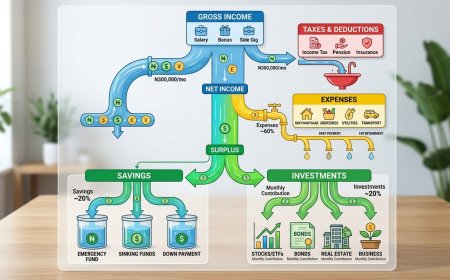
Step 1: Know Your Numbers (The Foundation of Everything)
Before you do anything else, you need to know:
- How much comes in every month
- How much goes out
- Where exactly does it go
Sit down with your phone. Go through your last 30 days of transactions at GTBank, Opay, Kuda, Moniepoint, wherever. Group your spending into categories:
- Fixed costs: rent, data subscription, transport, school fees
- Variable costs: food, airtime, outings, shopping
- Debt payments: loans, buy-now-pay-later
- Savings/investments: (this should be on your list!)
Once you see the breakdown, you'll probably be shocked. A lot of people discover they're spending ₦8,000–₦15,000 on "small small things" that they couldn't even name: ₦500 here, ₦1,200 there, a random transfer, an impulse buy.
This is your money map. You need it before you can plan.
Step 2: Cut the Bleeding (Stop the Leaks)
After mapping your spending, the next question is: What can I cut or reduce without destroying my life?
Let me give you a real example.
Say you earn ₦80,000/month. Here's a typical breakdown for many young Nigerians:
| Expense | Monthly Cost |
|---|---|
| Rent | ₦25,000 |
| Food | ₦15,000 |
| Transport | ₦8,000 |
| Data/Airtime | ₦5,000 |
| Netflix/DSTV/Spotify | ₦4,500 |
| Outings/Fun | ₦8,000 |
| Clothes/Shopping | ₦6,000 |
| Random transfers | ₦5,000 |
| Total | ₦76,500 |
That leaves ₦3,500 to "save." Which basically means nothing gets saved.
Now let's cut smartly, not painfully:
- Netflix: share with 2 friends → save ₦3,000
- Outings: reduce from 4 times to 2 times a month → save ₦4,000
- Random transfers: be more intentional → save ₦2,500
- Shopping: pause impulse buys → save ₦3,000
That's ₦12,500 freed up without touching your rent, food, or transport.
The goal isn't to punish yourself. It's to be intentional with your money.
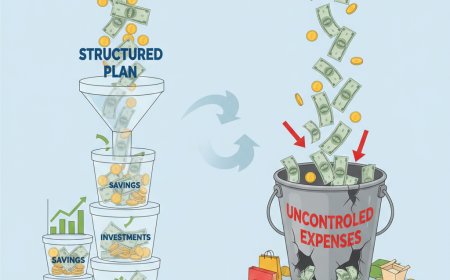
Step 3: Pay Yourself First (This Changes Everything)
Here's the rule that wealthy people live by, and most broke people have never heard of:
Save before you spend. Not after.
The moment your salary hits, move a fixed percentage to savings before you pay for anything else. Treat savings like rent. Non-negotiable.
If you earn ₦80,000 and you commit to saving just 10%, that's ₦8,000/month. In 12 months, that's ₦96,000. That's your emergency fund right there.
Can't do 10%? Start with 5%. ₦4,000/month. The amount matters less than the habit. You're training your brain to live on less, and that skill compounds over time just like interest does.
Practical tip: Open a separate savings account that isn't on your main banking app. Put your monthly savings in there. Make it slightly inconvenient to access so you don't touch it impulsively.


Piggyvest, Cowrywise, or even a fixed savings plan with your bank are all great tools for this.
Step 4: Build Your Emergency Fund Before You Do Anything Else
Before you invest, before you hustle, before you do anything, you need a cushion.
Why? Because life in Nigeria is unpredictable.
Your phone screen cracks. Your generator spoils. Someone in the family needs money urgently. Your company delays salary. If you have no buffer, these things send you into debt, and debt is the enemy of financial freedom.
Your emergency fund target: 3 months of your total expenses.
If you spend ₦60,000/month, your emergency fund goal is ₦180,000.
On ₦8,000/month savings, you'll hit that in about 23 months, less than 2 years. Or faster if you add hustle income.
Once this is in place, you have a shield. Now you can play offense.
Step 5: Start Investing, Yes, Even With Small Money
This is where a lot of people freeze. They think investing is for "big people." They think you need ₦500,000 to start.
You don't.
Here's what ₦5,000/month invested consistently can do for you:
If you invest ₦5,000/month into a dollar-denominated mutual fund or a Nigerian stock portfolio averaging 15% annual return over 10 years, you could be looking at over ₦2 million. That's from ₦5,000 a month.
Now imagine you do ₦10,000/month. Or ₦20,000.
Where can you invest as a Nigerian beginner?
- Money market funds (via Cowrywise, Stanbic, ARM): Safe, liquid, earning about 17–22% per year in naira currently. Great for parking your emergency fund, too.
- Nigerian Stock Exchange (via Chaka, Bamboo for US stocks, or your stockbroker): Ownership in real companies. Long-term play.
- Dollar investments (via Bamboo, Trove, Rise): Protects you from naira devaluation. Even $10/month matters.
- Treasury Bills & Bonds: Lower risk. You lend to the government and earn interest.
- Real estate crowdfunding (like Coreum or similar platforms): You can co-invest in property with small amounts.
The keyword is start. Not "start big." Just start.
Step 6: Grow Your Income (Because There's a Limit to Cutting)
Here's something nobody says enough: you can only cut expenses so much. At some point, the real lever is earning more.
But before you go chasing every shiny business idea, ask yourself what skills or value can I offer that someone will pay for?
Some real examples for everyday Nigerians:
- Graphics design (Canva or Adobe): Businesses need logos, flyers, and social media graphics daily. ₦5,000–₦30,000 per project.
- Content writing: Companies need blog posts and social media captions. ₦10,000–₦50,000/month per client.
- Mini importation: Source products from China or the UAE, and sell locally. ₦50,000 capital can return ₦80,000+.
- Social media management: Manage Instagram/Facebook for small businesses. ₦20,000–₦60,000/month per client.
- Tutoring: If you're good at any subject, tutor secondary school or university students. ₦5,000–₦15,000/hour.
- Reselling: Foodstuff, data, airtime, fashion. Low capital, high volume.
Even an extra ₦20,000–₦30,000/month from a side hustle changes the game dramatically. That's money that goes straight to investing untouched.
The Mindset Piece Nobody Wants to Talk About
Financial freedom is 80% behavior, 20% information.
You can know everything I've said above and still do nothing. And that's actually the most common story.
So let me speak to you directly.
Stop comparing your Chapter 3 to someone else's Chapter 20. Your colleague who drives a car might be in debt. Your friend who travels every month might have nothing in savings. Instagram is a highlight reel, not a financial statement.
Start before you're ready. You will never feel 100% ready to save, invest, or start a hustle. The comfort zone feels safe, but it's costing you years.
Be patient but stay consistent. Wealth is not built in one month. But it's destroyed by inconsistency. Show up every month, even when it feels small, especially when it feels small.
One of the richest men in the world, Warren Buffett, made 97% of his wealth after age 65. Not because he got lucky. Because he stayed consistent for decades, you don't need 65 years. But you do need time. And time starts now.
A Simple Monthly Action Plan
Here's what you can do starting from this month:
Week 1: Track your spending for the past 30 days. Know your numbers.
Week 2: Create a simple budget. Assign every naira a job before the month starts.
Week 3: Set up automatic savings at least 10% of income, moved the day the salary hits.
Week 4: Research one investment option (Money market fund is the safest start) and deposit something even ₦2,000.
Next month: Add one income stream idea to work on. Just one.
Do this consistently for 6 months, and your financial life will look different. Not rich but different. Moving. Building.
Final Word
Financial freedom on a low income is not a fantasy. It's a process.
It won't happen because you prayed hard or because you want it badly. It happens because you make small, consistent, intentional decisions day after day, month after month.
You don't need to earn ₦500,000 to start. You need to start where you are, with what you have.
The best time to start was 5 years ago. The second-best time is today.
At Happyinvest, our job is to walk this road with you and make sure you're never confused about what to do next.
Making Money Simple. Building Wealth Daily.