Primary vs Secondary Markets: Understanding IPOs and Stock Trading
Understand primary vs secondary markets. Learn how IPOs work and how stock trading happens on the NGX.
 Yahnic Chigozie
When people talk about “buying stocks,” they are usually referring to one part of a bigger system.
The capital market has two main segments:
-
The primary market
-
The secondary market
Understanding the difference helps you know:
-
Where your money goes
-
How companies raise capital
-
How investors make money


What Is the Primary Market? (Simple Definition)
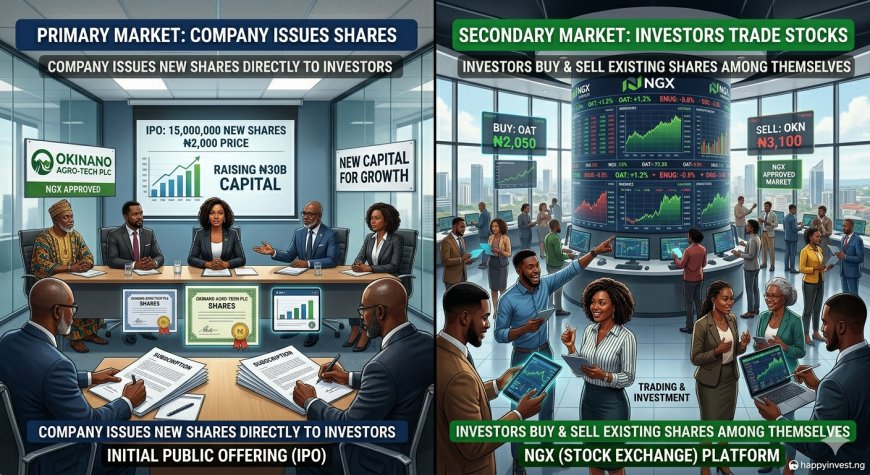
The primary market is where new securities are created and sold to investors for the first time.
In simple terms:
It is where you buy directly from the company.
What Happens in the Primary Market
Companies use the primary market to:
-
Raise money from investors
-
Fund expansion and growth
Common Primary Market Activities
1. Initial Public Offerings (IPOs)
An IPO is when a company:
-
Sells shares to the public for the first time
Example:
-
A private company becomes publicly listed on the
Nigerian Exchange Group
2. Public Offers / Rights Issues
Existing companies may:
-
Issue new shares to raise additional funds
3. Bond Issuances
Governments and companies:
-
Issue bonds to investors
For example:
-
Bonds issued by the Debt Management Office of Nigeria
Key Feature of the Primary Market
Money flows from investors → directly to the company or issuer
What Is the Secondary Market? (Simple Definition)
The secondary market is where investors buy and sell securities among themselves.
In simple terms:
It is where trading happens after the initial sale.
What Happens in the Secondary Market
-
Investors trade shares with each other
-
Prices change based on demand and supply
Where This Happens in Nigeria
Trading takes place on the
Nigerian Exchange Group
Key Feature of the Secondary Market
Money flows between investors, not to the company
Primary vs Secondary Market: Side-by-Side Comparison
| Feature | Primary Market | Secondary Market |
|---|---|---|
| Purpose | Raise capital | Trade securities |
| Buyer | Investors | Investors |
| Seller | Company/Government | Other investors |
| Money goes to | Issuer | Seller (investor) |
| Example | IPO | Daily stock trading |
Simple Example
Primary Market Scenario
A company launches an IPO:
-
You buy shares at ₦100
-
Your money goes to the company
Secondary Market Scenario
Later:

-
You sell your shares at ₦150 to another investor
Now:
-
You make a profit
-
The company does not receive this money
Why the Primary Market Matters
1. Supports Business Growth
Companies raise funds to:
-
Expand operations
-
Invest in projects
2. Creates Investment Opportunities
Investors get early access to:
-
New companies
3. Drives Economic Development
Capital raised helps:
-
Businesses grow
-
Jobs increase
Why the Secondary Market Matters
1. Provides Liquidity
You can:
-
Sell your investments when needed
2. Determines Price
Prices reflect:
-
Supply and demand
-
Market sentiment
3. Enables Wealth Creation
Investors:
-
Buy low
-
Sell high
How Both Markets Work Together
The system flows like this:
-
The company raises money in the primary market
-
Shares move to the secondary market
-
Investors trade shares continuously
Key Players Involved
1. Securities and Exchange Commission Nigeria
-
Regulates both markets
2. Nigerian Exchange Group
-
Facilitates trading
3. Stockbrokers
-
Help investors buy and sell
4. Central Securities Clearing System
-
Keeps records of ownership
Common Mistakes Beginners Make
-
Thinking that all stock purchases support companies directly
-
Not understanding IPO risks
-
Ignoring how market demand affects prices
Which Market Should You Focus On?
Primary Market
Best for:
-
Early investment opportunities
-
Long-term investors
Secondary Market
Best for:
-
Daily trading
-
Flexibility
-
Liquidity
Simple Strategy for Beginners
-
Start with the secondary market
-
Learn how stocks move
-
Gradually explore IPOs and public offers
-
Always research before investing
Know Where Your Money Is Going
Understanding the difference between primary and secondary markets gives you clarity.
Because in the end:
-
The primary market builds companies
-
The secondary market builds investors
And knowing how both work helps you:
Make smarter, more confident investment decisions.