Financial Success Tips Nobody Tells You
The money secrets nobody taught you in school. Learn how everyday Nigerians can build real wealth step by step, in simple language.
 Yahnic Chigozie

The truth about money that they kept out of your school syllabus
Let me ask you something.
You went to school, maybe even university. You studied hard, got a degree, and started working. But did anyone at all sit you down and say, "Here's how money actually works"?
No? Me neither.
That's the problem. Most of us grew up learning how to earn money, but nobody taught us how to keep it, grow it, or make it work for us. And then we wonder why we're always broke by the 25th of the month, even with a decent salary.
Today, I'm going to share the financial success tips that nobody told you. The real stuff. Not the textbook theory. The things that actually separate people who build wealth from people who just survive month to month.
Grab a seat. Let's talk.
1. Your Salary Is Not Your Wealth — It's Your Starting Point
Here's a hard truth: earning ₦300,000 a month does not make you rich.
Ask yourself if your salary stopped today, how long would you survive? One month? Two months? If the answer is less than six months, you're living paycheck to paycheck, no matter how "big" your salary looks.
Wealth is not what you earn. Wealth is what you keep and grow.
There's a man somewhere in Lagos earning ₦150,000 a month who is wealthier than someone earning ₦500,000 a month. How? Because the ₦150,000 earner saves ₦40,000 every month, invests it consistently, and spends within his means. The ₦500,000 earner spends ₦520,000 every month on rent, car loans, "keeping up appearances," and impulse spending.
One is building. One is drowning in style.
Your action step: Calculate your Net Worth today. Add up everything you own (savings, investments, property) and subtract everything you owe (loans, debts). That number, not your salary, is the real picture of where you stand financially.
2. Nobody Gets Rich From Saving Alone
"Save your money" is the most incomplete financial advice ever given.
Don't get me wrong, saving is essential. You need an emergency fund. You need to be disciplined. But saving alone? In Nigeria? Is inflation eating at your naira every year? That's a slow financial death.
Here's what's happening: If you save ₦1,000,000 in a regular savings account at 4% interest, but inflation is running at 15.38%, your money is losing 11% of its purchasing power every year.
You saved ₦1 million. In real terms, next year it feels like ₦800,000.
The tip nobody tells you? You have to invest. You have to put your money where it grows faster than inflation eats it. Treasury Bills, Money Market Funds, stocks, and real estate are the tools that let your money fight back against inflation.
Saving gives you security. Investing gives you wealth.
Think of saving as building a wall. Investing is when you put a gate in that wall and let money walk through and come back with friends.
3. The "Broke Feeling" Is Often a Spending Problem, Not an Earning Problem
Real talk — how many times have you said, "If I just earned more, everything would be fine"?
Most people believe their problem is that they don't earn enough. But here's what actually happens when most people get a raise: their expenses go up too. New iPhone. Better apartment. More "flexing."
This is called lifestyle inflation — and it's silently killing financial dreams everywhere from Abuja to Aba.
I know someone who was earning ₦80,000 and broke. They got promoted to ₦200,000. Still broke. Then ₦400,000. Still broke. Why? Because every time income went up, lifestyle went up by the same amount.
The financial success tip here is simple but uncomfortable: You need to control your expenses before you increase your income. Otherwise, more money just means more ways to be broke.
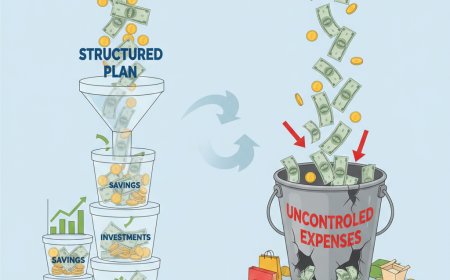
A practical way to think about this is the 50-30-20 Rule:
- 50% of your income goes to needs (rent, food, transport)
- 30% goes to wants (enjoyment, lifestyle)
- 20% goes to savings and investments
If you earn ₦200,000: ₦100,000 for needs, ₦60,000 for wants, ₦40,000 for your future. Simple. Structured. Powerful.
4. Debt Is Not Always the Enemy — But Consumer Debt Will Destroy You
Here's something most people get wrong about debt.
There are two types of debt:
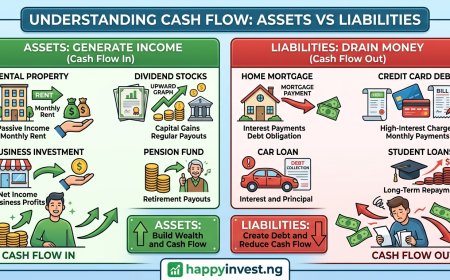
- Good debt — borrowing to build or buy something that generates more money (a business loan, a mortgage on a property you'll rent out)
- Bad debt — borrowing to consume (buy-now-pay-later for a TV, borrowing to travel, BNPL for clothes)
The dangerous debt that nobody warns you about isn't the big one. It's the small, everyday kind.
"Let me use BNPL for this phone." "Let me collect a small loan to sort this month." "My credit card will cover this."
Before you know it, you're working every month just to pay interest. You're not building anything. You're renting your own salary to a lender.
The rule: If a debt is not connected to an asset that will grow in value or generate income, think twice. Then think again.
5. Multiple Income Streams Are Not a Luxury — They're a Necessity
Let me paint a picture for you.
Imagine a three-legged stool. If one leg breaks, the whole stool falls. Now imagine a stool with five legs. One breaks? You're still sitting.
Your finances should work the same way.
A single salary is a single-legged stool. One company decision, one economic crisis, one health emergency, and everything collapses.
The people who survive financial shocks in Nigeria (and everywhere else) almost always have more than one stream of income. It could be:
- A side hustle (freelancing, mini-importation, catering)
- Passive income (dividends from stocks, interest from T-Bills)
- A small business run alongside your 9-to-5
- Digital income (selling courses, YouTube, content)
You don't have to start five things at once. Start with one extra stream. Even an extra ₦20,000–₦50,000 a month can be invested, and over time, those investments become their own stream.
The goal is this: One day, your investments should earn more than your salary. That's when you know you're building real wealth.
6. Time Is Your Greatest Financial Asset — And You're Probably Wasting It
This one stings a little. But I say it with love.
Most young Nigerians between 18 and 35 are sitting on a goldmine and don't even know it.
Here's what compound interest does (this is the most powerful force in personal finance, and most people only discover it when they're 50):
If you invest just ₦10,000 a month starting at age 25, at a 15% annual return (very achievable with Nigerian mutual funds and stocks), by age 55, you would have accumulated over ₦70 million.
Wait and start at 35 instead? You'd have around ₦15 million.
Same ₦10,000. Same discipline. Just 10 fewer years and you lose ₦55 million.
That's the tip they should be screaming in every secondary school in Nigeria. Start early. Even small. Consistency over time beats large amounts started late every single time.
7. Financial Education Is the Best Investment You'll Ever Make
You won't hear this often, but hear me today:
The return on learning about money is infinite.
Every hour you spend understanding how stocks work, how to read a budget, how compound interest builds wealth, or how to evaluate a business opportunity, that knowledge has the power to change your entire financial trajectory.
One book can change your financial life. One article. One concept you finally understand.
You're reading this article right now. That already puts you ahead of most people your age who are spending those same minutes scrolling past things that won't make them a kobo richer.
Keep learning. Stay curious about money. It will pay you back in ways you can't even imagine yet.
The Summary: What They Never Taught You
Let's bring it home. Here's the short version of what we covered today:
- Your salary ≠ is your wealth. Build your net worth, not just your paycheck.
- Saving is essential, but investing is how you grow. Don't let inflation eat your money quietly.
- Lifestyle inflation is the hidden wealth killer. Earn more, keep more not spend more.
- Consumer debt is a trap. Only take debt that creates, not consumes.
- Multiple income streams protect and grow your finances. Don't sit on one leg.
- Time is your most powerful asset. Start investing now; even small amounts matter.
- Financial education is priceless. The more you learn, the more you earn.
None of these are secrets. But they're treated like secrets because they're not taught where they should be in classrooms, in homes, in conversations between friends.
That's why Happyinvest exists. To simplify money. To make wealth-building accessible for every Nigerian student, salary earners, hustlers, and dreamers alike.
You now know what most people don't. The next step? Use it.
Got a question about anything we covered today? Drop it in the comments. Let's talk money together.