Stock Price vs Company Value: Why Price Alone Doesn’t Indicate Value
Understand the difference between stock price and company value. Learn how P/E ratio and earnings help identify good investments.
 Yahnic Chigozie
One of the biggest mistakes beginners make in investing is this:
Thinking a cheap stock is a good investment… and an expensive stock is a bad one.
But in reality:
Stock price and company value are not the same thing.
Understanding this difference is what separates smart investors from those who lose money chasing “cheap” stocks.
Stock Price vs Company Value (Simple Definition)
-
Stock Price = The current price of one share
-
Company Value = The actual worth of the entire business
In simple terms:
Price is what you pay. Value is what you get.

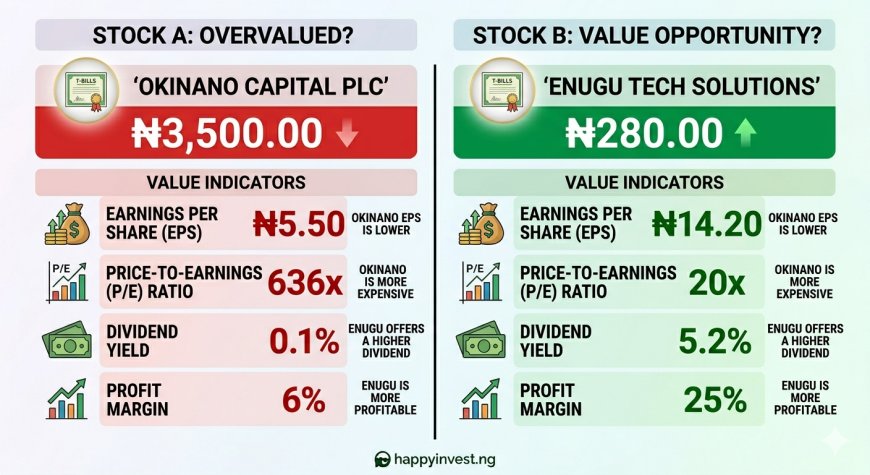
Why Stock Price Alone Is Misleading
Let’s compare two companies:
| Company | Price per Share |
|---|---|
| Company A | ₦50 |
| Company B | ₦5,000 |
At first glance:
-
Company A looks “cheap.”
-
Company B looks “expensive.”
But this tells you nothing about which is the better investment.
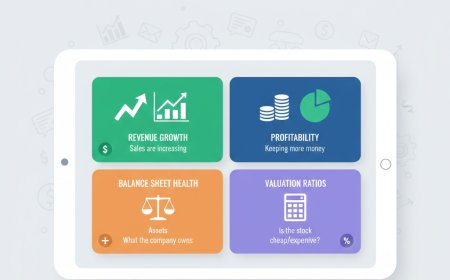
What Really Matters: Company Value
To understand value, you need to look at:
-
Earnings (profit)
-
Growth potential
-
Assets
-
Management quality
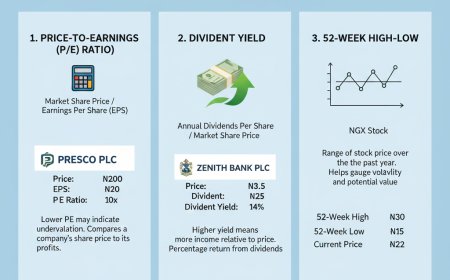
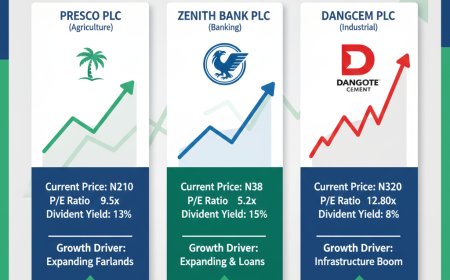
Key Tool: The Price-to-Earnings (P/E) Ratio
What is the P/E Ratio?
P/E = Price per Share/Earnings per Share
What It Means
The P/E ratio tells you:
How much investors are willing to pay for every ₦1 of a company’s earnings.
Example
Company A
-
Price = ₦50
-
Earnings per share = ₦2
-
P/E = 25
Company B
-
Price = ₦5,000
-
Earnings per share = ₦500
-
P/E = 10
Interpretation
-
Company A (₦50) is actually more expensive (P/E = 25)
-
Company B (₦5,000) is actually cheaper (P/E = 10)
This is why price alone is misleading.
What Determines a Company’s True Value
1. Earnings (Profitability)
Companies that:
-
Make consistent profits
Are generally more valuable.
2. Growth Potential
Investors pay more for companies that:

-
Are expected to grow
3. Industry Strength
Some industries naturally command higher valuations:
-
Banking
-
Telecom
-
Consumer goods
4. Management Quality
Good leadership:
-
Drives long-term success
5. Economic Conditions
Market conditions affect:
-
Investor sentiment
-
Valuation levels
Why “Cheap” Stocks Can Be Dangerous
Low-priced stocks are often:
-
Weak companies
-
Poor performers
-
Struggling businesses
This is called a value trap.
Example
A stock drops from:
-
₦100 → ₦20
It looks cheap.
But it may be:
-
Losing money
-
Poorly managed
Why “Expensive” Stocks Can Be Worth It
High-priced stocks may:
-
Have strong earnings
-
Be growing rapidly
-
Be industry leaders
Example
A stock at ₦5,000 may:
-
Generate strong profits
-
Pay dividends
-
Grow consistently
Stock Price vs Market Capitalization
Another key concept:
Market Capitalization
Market Cap = Share Price × Total Shares
Why It Matters
Two companies can have:
-
Same price
-
Different total value
Market cap shows:
The true size of the company
Real-Life Comparison
Investor A (Price-Focused)
-
Buys “cheap” stocks
-
Ignores fundamentals
-
Ends up with poor investments
Investor B (Value-Focused)
-
Studies earnings and P/E
-
Buys strong companies
-
Builds wealth over time
Simple Rules for Smart Investors
1. Don’t Judge by Price Alone
Always ask:
-
What am I getting for this price?
2. Look at Earnings
Profit drives value.
3. Use P/E Ratio
Compare:
-
Price vs earnings
4. Avoid Hype and Assumptions
Cheap ≠ good
Expensive ≠ bad
5. Focus on Long-Term Value
Short-term price means little.
Common Mistakes to Avoid
-
Buying low-priced stocks blindly
-
Ignoring company performance
-
Chasing “cheap” opportunities
-
Not understanding valuation
Value Is What Builds Wealth
Anyone can look at a stock price.
But real investors look deeper.
Because in the end:
Successful investing is not about buying cheap stocks; it is about buying valuable businesses at the right price.