The Money Mindset You Need to Build Wealth Fast
The real reason most Nigerians aren't building wealth isn't income; it's mindset. Discover the 8 core beliefs of a wealth-building mindset, 5 powerful mindset shifts, and the daily habits that separate people who build wealth from people who stay stuck. A deep, honest read by Happyinvest.
 Yahnic Chigozie
Making Money Simple. Building Wealth Daily.
Let me tell you about two people I want you to think about.
Kemi and Funke grew up in the same neighbourhood in Ibadan. Same public school. Same kind of family, middle class, not rich, not desperately poor. Both got decent jobs after school. Both earn around ₦95,000 a month.
Ten years later, Kemi has ₦3.8 million in investments, a side business bringing in ₦60,000 a month, and is seriously thinking about buying land. She's not anxious about money anymore.
Funke is still living paycheck to paycheck. Not because bad things happened to her, she's healthy, employed, and stable. But every month, the money comes and goes. She's not sure where it goes. She has about ₦40,000 in savings. Life feels like a treadmill.
Same starting point. Same income. Ten years later, completely different financial lives.
I used to think the difference was luck, connection, or some special information Kemi had. But the more I studied people who build wealth and people who don't, the more I realized something uncomfortable:
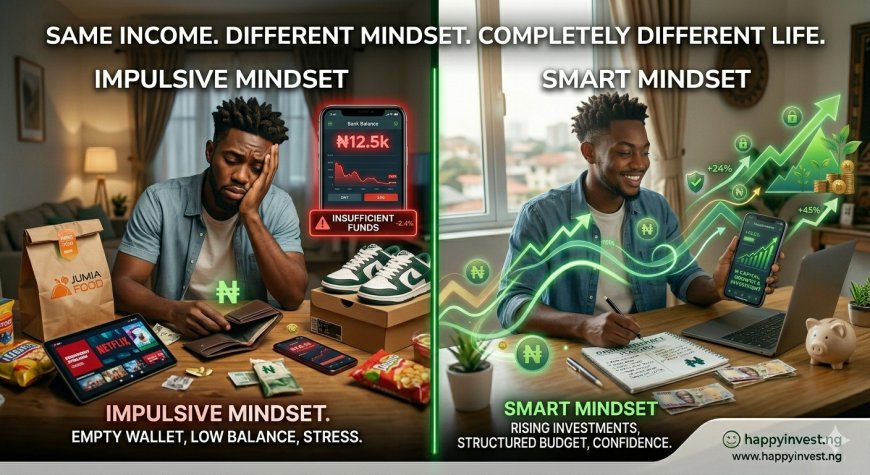
The difference is almost never the money. It's almost always the mindset.
Today, we're going to talk about that mindset, what it is, how it works, and most importantly, how you can build it even if you've spent years thinking about money the wrong way.
This is the article most finance pages won't write because it doesn't feel "technical" enough. But I promise you if you read this carefully and take it seriously, it will be the most valuable financial content you ever consume. Because strategy without the right mindset is just information you never act on.
Let's go.

What Is a Money Mindset and Why Does It Matter?
Your mindset is simply the collection of beliefs you hold about yourself, about the world, and about what's possible for you.
Your money mindset specifically is the set of beliefs you carry about money. How it works. Whether you can have it. What it means to have it or not have it. What rich people are like. Whether wealth is achievable for someone like you.
And here's the thing most people don't realize: your money mindset was formed long before you ever earned your first naira.
It was formed watching your parents argue or not argue about money at home. It was hearing phrases like "money is the root of all evil," "rich people are corrupt," or "we're not the kind of people who have money." It was formed by your church, your culture, your friends, your social media feed.
All of those beliefs are sitting in your subconscious right now, quietly shaping every financial decision you make what you buy, what you avoid, what you invest in, what you refuse to try.
The scary part? Most of those beliefs were never consciously chosen. They were absorbed. And many of them are actively working against your financial future.
The good news? You can change them. You can deliberately build the money mindset that wealthy people carry. And when you do, your financial actions will change almost automatically because you'll simply start thinking differently about every naira that passes through your hands.
The 8 Core Beliefs of a Wealth-Building Mindset
Belief 1: "I Can Build Wealth Regardless of Where I'm Starting"
This is the foundation. Everything else sits on top of it.
A huge number of Nigerians have already dismissed themselves from the wealth conversation before it even starts. They look at their ₦70,000 salary, look at the cost of living in their city, and conclude somewhere in the back of their mind that wealth is simply not for them. That's a Lekki thing. An Abuja big man thing. Not a "me" thing.
That belief is a lie. And it is an expensive one.
The evidence is everywhere around you if you look for it with honest eyes. There are people in Nigeria today who started with less than you have, in harder circumstances than you're in, and built genuine wealth through consistent, deliberate action over time. Not because they had a secret. Not because they were special. Because they believed it was possible for them, and they acted on that belief.
The first shift you need to make is from "wealth is for other people" to "wealth is the natural result of the right habits applied consistently." That shift sounds small. The financial implications of it are enormous.
Every time you catch yourself thinking "people like me don't invest" or "I can't afford to think about wealth right now," that's the belief talking. Recognize it. Challenge it. Replace it.
You can build wealth. Full stop.
Belief 2: "My Mindset About Money Is More Important Than My Income"
Here's something that will challenge you if you've always blamed your income for your financial situation.
Study after study, and frankly, just life observation in Nigeria, shows that people who suddenly receive more money without changing their mindset usually end up in the same or worse financial position within a few years.
You've seen it. Someone gets a big promotion or a windfall, and within 18 months, they're struggling again. The car payments ate the raise. The new apartment ate the bonus. The family obligations expanded to match the new income. Nothing actually changed.
On the other hand, people who build the right money mindset find ways to build wealth even on modest incomes. They squeeze value out of every naira. They find opportunities that others walk past. They make money decisions that compound over time.
This is not me saying income doesn't matter it absolutely does, and increasing your income is a key part of wealth building. But your income is only a tool. Your mindset is the hand that holds the tool. The most powerful tool in the world, in the wrong hands, produces nothing.
Stop waiting for a higher income to fix your financial life. Start working on the mindset that will make any income productive.
Belief 3: "I Pay Myself First Always"
Wealthy people don't save what's left after spending. They spend what's left after saving.
Read that again, slowly.
The broke mindset says: "I'll save whatever is left at the end of the month." The wealth mindset says: "I'll save a fixed amount the moment my money arrives, then manage my expenses from what remains."
This is not just a tactic, it's a belief. A belief that your financial future is the most important bill you pay every month. More important than Netflix. More important than a new outfit. More important than an outing with friends.
When you genuinely believe that your future is your most important financial obligation, paying yourself first stops feeling like a sacrifice and starts feeling like the most natural thing in the world.
Kemi from our opening story? The first thing that moved on every salary day was ₦15,000 to her investment account. Not because she was disciplined all the time, but because she had set it up automatically, and she genuinely believed that transfer was non-negotiable. It happened the same way her rent happened. Without internal debate.
Build this belief: My savings and investments are my most important monthly obligation. Everything else works around them.
Belief 4: "Every Naira Is Either Working for Me or Working Against Me"
This one will change how you shop, how you eat, how you subscribe to things, how you use your phone data, everything.
The wealth mindset treats money not as something to enjoy and spend, but as a resource that is either building your future or eroding it. There are only two directions for every naira: toward wealth or away from wealth.
This doesn't mean you never spend on enjoyment. Rest and enjoyment are important; burnout kills productivity and creativity, which ultimately kills your income. But it means that when you spend, you do it consciously, not carelessly. You know exactly what you're trading your money for, and you make peace with that trade.
The broke mindset is unconscious about spending. Money just... disappears. You look at your account at the end of the month and genuinely cannot account for where a significant portion of it went. Lunch here, delivery there, a few random transfers, some impulse purchases, and suddenly ₦20,000 is just gone.
The wealth mindset is conscious. Not obsessive conscious. You know roughly where every chunk of money is going, and you've made a deliberate decision about each category.
A useful question to ask before any non-essential purchase: "Is this taking me toward the life I want, or away from it?" You'll be surprised how often that single question is enough to pause an impulse to spend.
Belief 5: "I Am Responsible for My Financial Life Fully"
This one is tough. But it might be the most important belief on this entire list.
Nigeria gives us so many external things to blame for our financial struggles, and many of those things are genuinely real and genuinely unfair. Inflation. Unstable exchange rates. NEPA. Bad governance. Low wages. High cost of living. Family pressure. Ajo, who ran away with your money. The business partner who disappeared.
I'm not dismissing any of that. These are real obstacles. Nigeria is a genuinely difficult financial environment, and pretending otherwise would be dishonest.
But here's what I've observed: the people who stay stuck are usually the ones who use these external realities as a full explanation for their financial situation. "What can I do? This country is not working." And so they do nothing. They wait for the country to improve before they take action. That wait can last a lifetime.
The people who build wealth in Nigeria and thousands of Nigerians are doing it right now, in this same economic environment, are people who acknowledge the obstacles and then ask: "Okay. Given all of that, what CAN I control?"
They can control how much they spend. They can control whether they invest. They can control what skills they develop. They can control which side hustles they pursue. They can control how much financial education they consume. They can control their response to setbacks.
Full financial responsibility doesn't mean ignoring real systemic problems. It means refusing to use those problems as permission to stay passive.
The moment you take full responsibility for your financial life, not blame, not shame, but responsibility, you gain power. Because if it's your fault, you can fix it. If it's Nigeria's fault, you're helpless. Choose power.
Belief 6: "Delayed Gratification Is a Superpower"
The ability to choose a better tomorrow over a more comfortable today is genuinely one of the most financially powerful skills a human being can develop.
And in 2026, Nigeria is under serious attack.
Everywhere you look Instagram, TikTok, WhatsApp status, the streets of Lagos, there's pressure to appear successful right now. The right outfit. The right restaurant. The right holiday photo. The right car, even if it's financed at crushing interest rates. Looking wealthy has never been easier. Being wealthy has never required more patience.
The broken mindset crumbles under this pressure. It says: "I deserve to enjoy my money now. Tomorrow is not promised." And so it spends. And spends. And tomorrow it was not thinking about eventually arriving, looking exactly like today.
The wealth mindset is not joyless. It is not self-denial for its own sake. It simply understands that the best enjoyment is sustainable enjoyment, the kind that comes from genuine financial security, not from borrowed appearances.
When Tunde chooses to invest ₦15,000 instead of buying a new pair of Jordans, he's not punishing himself. He's paying for future freedom. When Amaka declines a fifth outing this month and moves that money to her Cowrywise account instead, she's not being boring. She's being strategic.
Delayed gratification is not about suffering now. It's about choosing a much bigger reward later. And when you genuinely believe in the reward, when you can see clearly what consistent investing and disciplined spending will produce over 5, 10, 15 years, the delay stops feeling like a sacrifice. It starts feeling like intelligence.
Belief 7: "Wealth Is Built, Not Stumbled Into"
The lottery mentality is one of the most destructive financial beliefs in Nigerian culture, and it shows up in more forms than actual lottery tickets.
It shows up as: waiting for a big contract to "blow." Putting money in an investment scheme that promises to double it in 30 days. Hoping a rich uncle abroad will send money. Expecting that one business deal to change everything. Believing that one day, somehow, things will just fall into place.
Now, windfalls happen. Big breaks happen. But building your financial plan around the hope of a windfall is like building a house on sand. Even when windfalls arrive, people without the right mindset tend to spend them quickly and end up back where they started.
Wealth is built, not stumbled into. It is the deliberate, consistent, patient accumulation of money, skills, assets, and knowledge over time. It is boring by design. It doesn't make for exciting Instagram content. It doesn't have a dramatic turning point you can point to.
It looks like ₦5,000 invested every month for three years. Like a skill developed steadily over 18 months until clients start coming. Like expenses tracked and reduced consistently until savings grow. Like compound interest, doing its invisible, powerful work in the background.
When you genuinely believe that wealth is built, not given, not stumbled into, not won, you stop waiting for the miracle and start showing up every day for the process.
Belief 8: "Rich People Are People Who Made Different Decisions, Not Different People"
This is a quiet belief that holds more Nigerians back than I think we realize.
There is a cultural narrative in many parts of Nigeria that says rich people are fundamentally different from "regular" people. Maybe they're more connected. Maybe they're more ruthless. Maybe they did something questionable to get there. Maybe they're just lucky. Whatever the story, the underlying message is that there's a category called "rich people" and a category called "people like us," and those categories don't mix.
This belief keeps people from even trying. Why work toward something that isn't for you?
The truth is this: with some real exceptions around inherited wealth and genuine privilege, most wealthy Nigerians you see around you made a series of different decisions from people who stayed broke. Not magical decisions. Not corrupt decisions. Just different ones. They saved when others spent. They invested when others watched. They learned when others scrolled. They built when others waited.
Rich people are not a different species. They're people who consistently made wealth-building decisions over time. Once you believe that truly believe it you start asking a completely different question. Not "what's wrong with me that I don't have wealth?" but "what decisions do I need to make differently starting today?"
That question has answers. Actionable, practical, immediately applicable answers. And that's where everything changes.
The 5 Mindset Shifts That Will Change Your Financial Life
Knowing the beliefs is one thing. Actually rewiring your brain is another. Here are five practical shifts you can start making right now.
Shift 1: From "I can't afford this" to "How can I afford this?"
This is directly from Robert Kiyosaki's "Rich Dad Poor Dad" still one of the most mindset-altering books on money ever written. "I can't afford it" is a statement that shuts down thinking. "How can I afford it?" is a question that opens the mind to solutions.
When you want something, a course that will build your skills, an investment you want to make, a tool for your business, instead of defaulting to "I can't afford that," ask: "How could I afford that? What would I need to cut? What could I sell? What could I earn?" You'll be surprised how often the answer appears when you actually ask the question.
Shift 2: From "I'll start when I'm ready" to "I'll start and get ready as I go."
Perfectionism kills wealth building. So many Nigerians spend months, sometimes years, learning about investing without ever investing. Reading about business without ever starting one. Planning a budget without ever writing one down.
Readiness is a feeling, not a reality. You will never feel 100% ready. The knowledge only becomes truly useful when you start applying it and making real decisions with real money. Start imperfectly. Adjust as you go. That is the way.
Shift 3: From surrounding yourself with spenders to finding builders
Your social circle shapes your financial behavior more powerfully than almost anything else. If your five closest friends spend every weekend at expensive outings, mock people who save, and treat financial discipline as boring, your financial habits will slowly drift toward theirs.
This doesn't mean abandoning your friends. But it does mean intentionally adding people to your life who think about money the way you want to think about it. Follow financial educators online. Join communities of people building wealth. Read content that reinforces the mindset you're trying to develop. Your environment shapes your beliefs, whether you notice it or not; make it work for you.
Shift 4: From seeing money as a scarce resource to seeing it as a tool
Scarcity mindset says: "There's never enough. If I give some away, I'll have less. If someone else has it, there's less for me." This mindset keeps people anxious, hoarding, and unable to invest because investing feels like "losing" money even though it's growing it.
Abundance mindset says: "Money is a tool. Used correctly, it multiplies. There is always more to be made. Others having wealth doesn't reduce what's available to me." This mindset allows you to invest freely, give generously, and take smart risks because you believe in your ability to create and grow money, not just protect whatever little you have.
Shift 5: From defining yourself by your current situation to defining yourself by your direction
Your current financial situation is a snapshot, a picture taken at one moment in time. It is not your identity. It is not your destiny. It is simply where you happen to be right now on a journey that can go in any direction from here.
The wealth mindset doesn't say "I am poor." It says, "I am building." Not "I am broke." But "I am on my way." The language you use about your financial life matters more than you think because it shapes the beliefs you carry, which shape the actions you take, which shape the outcomes you get.
You are not your bank balance. You are the direction you're moving in. Make sure it's the right one.
The Daily Habits of a Wealth Mindset
Mindset is not just a set of beliefs you hold, it's something you practice every day. Here are the habits that keep the money mindset sharp.
Read or listen to something about money, business, or personal development every single day. Even 10–15 minutes. Your mind needs consistent input to maintain a healthy financial perspective in an environment that constantly pushes consumption.
Track your spending weekly. Not to punish yourself but to stay aware. Awareness is the foundation of intentionality. You cannot make conscious decisions about money if you don't know where it's going.
Visualize your financial goals regularly. Not in a vague "vision board" way, in a specific, detailed way. Know your target numbers. Know what achieving them looks like. Know what your life feels like at each level. When the goal is vivid and real in your mind, the daily disciplines that build toward it feel meaningful rather than meaningless.
Celebrate small wins. Saved your target this month? That's a win, acknowledge it. Resisted an impulse purchase you would have made 6 months ago? That's growth, recognize it. Wealth building is a long journey. If you only celebrate when you've "made it," you'll burn out long before you get there.
Review your beliefs about money periodically. Ask yourself: what do I actually believe about money right now? Are those beliefs serving me? Where did they come from? This kind of honest self-examination, uncomfortable as it is, is how you catch and correct beliefs that are sabotaging your progress before they cost you years.
The Hard Truth About Mindset and Speed
The title of this article says "build wealth fast." Let me be honest about what that means.
A wealth mindset doesn't create overnight riches. Anyone who tells you that is selling you something. What a wealth mindset does is help you build wealth at the fastest rate genuinely available to you by eliminating the delays, detours, and self-sabotage that slow most people down.
The person without the wealth mindset might spend 5 years earning good money before they start taking their finances seriously. Then another 2 years making avoidable beginner mistakes. That's 7 years of wealth-building time lost to mindset problems.
The person who develops a wealth mindset early starts making good financial decisions from the very first month. Every year is productive. Every naira is working. The compounding starts earlier and runs longer.
That's what "fast" means here. Not a get-rich shortcut, a get-rich-sooner-because-nothing-is-slowing-you-down strategy.
The best investment you will ever make is not in any stock, property, or business. It's in your own thinking about money, about yourself, about what's possible. When that thinking is right, everything else tends to follow.
Your Mindset Challenge for This Week
Here's what I want you to do before this week is over. Not next month. This week.
Sit in a quiet place, even 20 minutes before bed, and write down five beliefs you currently have about money. Not the beliefs you think you should have. The ones you actually carry. The ones that have been shaping your financial behavior.
Then ask yourself this about each one: "Where did this belief come from? Is it serving me? Is it true?"
You'll probably discover that some beliefs you've never questioned are directly costing you money, time, and peace of mind.
Then write down the beliefs you want to carry instead. The ones from this article that resonated. The ones that would change how you show up financially if you actually, deeply held them.
That list is your mindset blueprint. Read it regularly. Act from it deliberately. Protect it from the noise of people around you who haven't yet done this work.
Your wealth starts in your mind. Build it there first.
At Happyinvest, we're here every step of the way.
Making Money Simple. Building Wealth Daily.