Portfolio Design for Different Income Levels
Learn how to design an investment portfolio based on your income level, risk tolerance, and financial goals for smarter and stress-free investing.
 Yahnic Chigozie
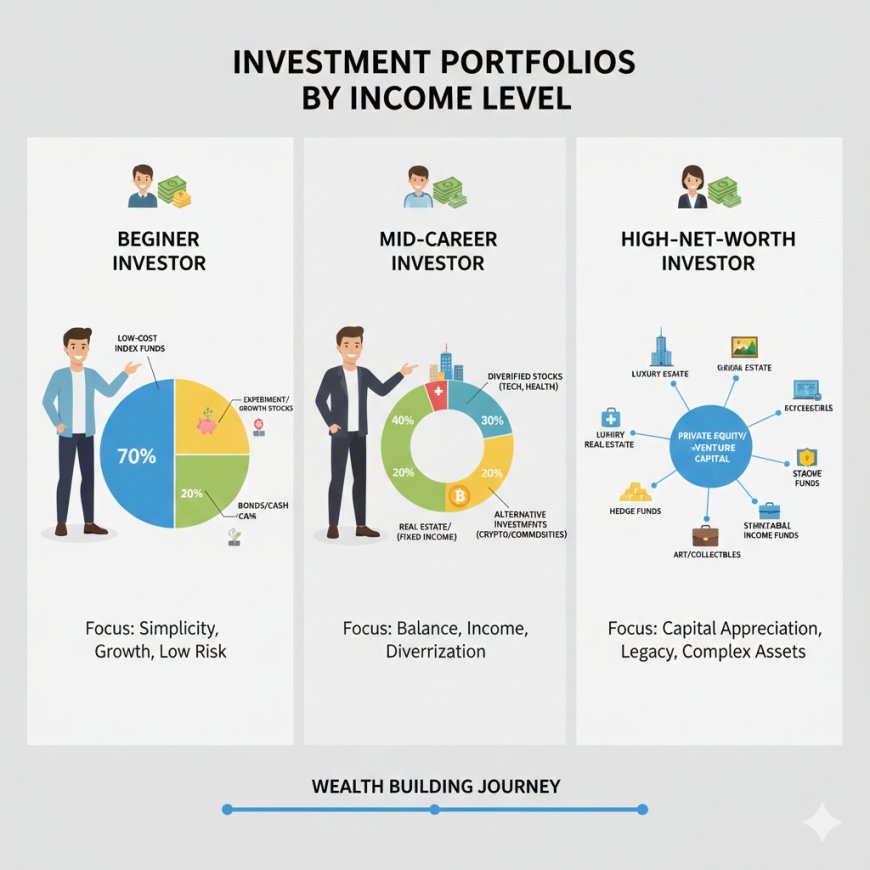
One of the biggest mistakes investors make is copying portfolios that don’t match their income.
Someone earning ₦150,000 monthly cannot invest the same way as someone earning ₦2 million monthly, and that’s okay.
Good investing is not about copying.
It’s about designing a portfolio that fits your income, lifestyle, and reality.
Let’s break this down clearly.
Why Income Level Matters in Portfolio Design
Your income affects:
-
How much can you invest consistently
-
How much risk can you handle
-
How fast can you recover from losses

-
How patient can you afford to be
Ignoring income level leads to:
-
Stressful investing
-
Forced selling
-
Poor decisions
A good portfolio should support your life, not fight it.
1. Low-Income Earners: Focus on Stability First
Who this applies to:
-
Students
-
Entry-level workers
-
Small earners with irregular income
Key Portfolio Goal
==> Capital protection and habit building
At this stage:
-
Losing money hurts more
-
Recovery is slow
-
Consistency matters more than returns
Portfolio Characteristics
-
Fewer investments (2–4)
-
Low-risk, familiar assets
-
High liquidity (easy access to cash)
Smart Focus Areas
-
Emergency savings
-
Stable income-generating assets
-
Learning before scaling
This stage is about building financial discipline, not chasing fast growth.
2. Middle-Income Earners: Balanced Growth
Who this applies to:
-
Salaried professionals
-
Small business owners
-
People with a predictable monthly income
Key Portfolio Goal
==> Balance growth and stability
At this level:
-
You can take some risks
-
You can diversify meaningfully
-
You can invest consistently
Portfolio Characteristics
-
4–8 investments
-
Mix of growth and stability
-
Sector and asset diversification
Smart Focus Areas
-
Long-term growth assets
-
Income-generating investments
-
Protection against inflation
This is where real portfolio structure begins.
3. High-Income Earners: Strategic Diversification
Who this applies to:
-
Executives
-
Large business owners
-
Professionals with strong cash flow
Key Portfolio Goal
==> Wealth preservation + intelligent growth
At this stage:
-
Risk is managed, not avoided
-
Capital protection is critical
-
Strategy matters more than excitement
Portfolio Characteristics
-
8–15 investments
-
Multiple asset classes
-
Clear allocation rules
Smart Focus Areas
-
Risk-adjusted returns
-
Long-term compounding
-
Global and sector exposure
Here, the focus shifts from making money to keeping and growing it wisely.
Why Copying Portfolios Fails
When people copy portfolios blindly:
-
They take risks they can’t afford
-
They panic during downturns
-
They sell at the wrong time
A good portfolio should:
-
Match your income
-
Match your emotional tolerance
-
Match your long-term goals
If it doesn’t, it will fail no matter how “smart” it looks.
Nigerian Reality Check
In Nigeria:
-
Income can be unstable
-
Inflation is high
-
Emergency needs often arise
This means:
-
Liquidity matters
-
Over-risking is dangerous
-
Simplicity often wins
Smart Nigerian investors design portfolios that survive reality, not theory.
A Simple Self-Test
Ask yourself:
-
Can I invest consistently with my income?
-
Can I hold this portfolio during tough months?
-
Will this portfolio stress me out?
If the answer is no, the portfolio needs redesigning.
The best portfolio is not the biggest.
It’s not the most complex.
It’s the one that fits your income and grows with you.
Design first. Scale later.