How to Build Assets for Your Family: Stocks, Property & Businesses
Learn how Nigerian families can build lasting generational wealth through stocks, property & business. Practical 3-pillar strategy with actionable steps for every income level. The greatest gift you can leave your children isn't school fees; it's a portfolio of income-generating assets. This in-depth guide walks Nigerian families through the three pillars of generational wealth: stocks and financial investments, real estate and property, and family businesses. Includes practical strategies, a three-generation wealth plan, and a 12-month action plan to start building today.
 Yahnic Chigozie

The greatest gift you can give your children is not tuition fees, school uniforms, or pocket money. It is a portfolio of income-generating assets that work long after you are gone.
There is a pattern that repeats across generations in Nigeria and across much of the developing world. One parent works hard, sacrifices enormously, and builds a modest level of prosperity. Their children inherit nothing of financial substance because the wealth was consumed by lifestyle or eroded by inflation. The next generation starts from zero. The cycle repeats.
Contrast this with the families you know that seem to have money in every generation. The Dangotes. The Otedolas. The Adenuga family. Internationally, the Rockefellers, the Waltons, the Rothschilds. These families did not stay wealthy by accident or simply because they had a lot of it once. They stayed wealthy because they built systems for acquiring, growing, and transferring assets across decades and generations.
The good news is that the principles behind generational wealth building are not secrets available only to the ultra-rich. They are learnable, applicable strategies that any Nigerian family, regardless of starting income, can begin implementing today.

This article is your comprehensive guide to building the three core pillars of family wealth: stocks and financial investments, property and real estate, and family businesses. Together, these three asset classes form a resilient, diversified foundation for generational prosperity.
First: The Mindset Shift That Changes Everything
Before we discuss specific assets, we need to address the single most important distinction in wealth building: the difference between building assets for consumption and building assets for transfer.
Most people build wealth to spend it on a nicer car, a bigger house to live in, and better holidays. These are consumption items. They may improve your quality of life, but they do not generate income, they do not grow in value reliably, and they cannot be transferred to your children as productive wealth.
Building family assets means intentionally acquiring things that generate income independently of your own labour, things that will continue working and compounding long after you stop. Every financial decision a wealth-building family makes runs through one filter: does this increase our income-generating assets, or does it consume them?
|
The Wealth Building Filter: Before any major financial decision, ask yourself, 'Does this purchase/investment increase or decrease my family's income-generating assets?' A car is usually consumption. A property that generates rental income is an asset. Stocks that pay dividends are assets. A business that generates profit when you're not there is an asset. |
With this mindset established, let's build your family's three-pillar asset portfolio.
|
PILLAR ONE: Stocks & Financial Investments The most accessible, liquid, and scalable wealth-building vehicle for Nigerian families |
Stocks represent ownership in businesses. When you buy shares of Dangote Cement on the NGX, you become a part-owner of one of Africa's most dominant companies, entitled to a share of its profits (dividends) and a proportional stake in its growing value. Over time, as the company grows, so does the value of your ownership stake.
For families building wealth, stocks offer several unmatched advantages: they require low starting capital (you can start with as little as ₦5,000 on most Nigerian platforms), they are highly liquid (you can sell them quickly if needed), they are infinitely scalable (you can own ₦10,000 or ₦10 billion worth), and they can be easily transferred to children and grandchildren through simple estate planning.
Building a Family Stock Portfolio on the NGX
A family-oriented stock portfolio should prioritise stability and dividend income over speculative gains. The goal is not to get rich quickly; it is to build a growing stream of dividend income and capital appreciation that compounds over decades. Look for companies with:
▸ Consistent dividend payment history Zenith Bank, Guaranty Trust Holding (GTCO), Stanbic IBTC, and Access Holdings have maintained strong dividend track records on the NGX.
▸ Strong market position and pricing power of companies like Dangote Cement and BUA Cement that dominate their sectors and can raise prices to protect margins.
▸ Diversified revenue streams: banks, telecoms (MTN Nigeria, Airtel Africa), and consumer goods companies (Nestlé Nigeria, Unilever Nigeria) that serve broad markets and are not dependent on a single product or customer.
▸ Good corporate governance companies with transparent management, regular investor communication, and a track record of treating minority shareholders fairly.
ETFs: The Family-Friendly Investment Vehicle
Exchange-Traded Funds (ETFs) are an ideal entry point for families building their first stock portfolio. Rather than picking individual stocks, an ETF tracks an entire index; for example, the NewGold ETF on the NGX provides exposure to gold prices. At the same time, the Lotus Halal ETF provides Sharia-compliant equity exposure. International ETFs like the S&P 500 index fund give your family ownership of 500 of the world's largest companies in a single purchase.
For families, ETFs offer instant diversification, low cost, professional management, and simplicity, all critical qualities for a long-term generational portfolio that doesn't require constant active management.
Investing in US and Global Stocks for Nigerian Families
One of the most powerful things a Nigerian family can do today is build a portion of their stock portfolio in dollar-denominated global equities. Platforms like Bamboo, Chaka, and Trove allow Nigerians to legally invest in US stocks and ETFs with naira, providing both equity growth and natural currency protection.
A family that holds $10,000 in US stocks sees that value automatically grow in naira terms when the naira depreciates, as it has consistently done over the past decade. This built-in currency hedge is enormously valuable for Nigerian families planning multigenerational wealth.
|
Family Stock Strategy in Practice: Consider opening a dedicated family investment account, setting up a monthly automatic contribution (even ₦20,000–₦50,000), and investing consistently into a diversified mix of NGX blue-chip stocks, a local ETF, and a US index fund via a dollar-investment platform. Do not touch this account for 20–30 years. The compounding will be extraordinary. |
Teaching Children to Own Stocks
One of the most powerful investments you can make for your children is not in their stock portfolio; it is in their financial education. Open a custodial or family investment account and include your children in the conversation from an early age. Show them how stocks work. Let them 'own' a share of a company they love. Celebrate dividend payments together. The financial habits formed in childhood are among the most durable a person will ever develop.
|
️ PILLAR TWO: Property & Real Estate The asset class Nigerians trust most and how to make it work harder for your family |
Why Property Is Central to Nigerian Family Wealth
In Nigeria, as in most of the world, real estate remains the most trusted and understood vehicle for family wealth building. It is tangible, visible, and culturally resonant in a way that stocks are not. When a Nigerian grandparent says, 'I have left something for my children,' they almost always mean land or a building.
And for good reason. Nigerian urban real estate, particularly in Lagos, Abuja, Port Harcourt, and increasingly secondary cities like Ibadan and Enugu, has historically delivered strong capital appreciation, with some areas seeing property values multiply 5–10 times over 20 years. Rental yields in urban areas typically range from 5–12% per annum, providing consistent cash flow in addition to capital gains.
But building property wealth for families requires more than simply buying a house to live in. It requires a strategic approach to property acquisition, financing, management, and transfer.
The Family Property Hierarchy
Think of family property wealth as a hierarchy of priorities:
▸ Level 1 — Family Home: Owning your primary residence is the foundation. It eliminates rent (a significant recurring expense), builds equity over time, and provides a stable, permanent base for your family. This is the first property priority — but understand that your family home is NOT an income-generating investment. It is a liability-eliminating consumption asset.
▸ Level 2 — First Rental Property: Once you own your home, the next step is acquiring a property that generates rental income — a second apartment, a commercial space, a short-let property. This transforms real estate from shelter into an income engine. Even a single well-located rental property generating ₦300,000–₦600,000 per month makes a significant difference to a family's financial position.
▸ Level 3 — Land Banking: Acquiring undeveloped land in areas with strong growth potential — peri-urban zones, industrial corridors, areas near planned infrastructure — and holding it for long-term capital appreciation. Land in areas like Ibeju-Lekki, Epe, and Mowe in Lagos State has appreciated dramatically over the past decade as the city expands.
▸ Level 4 — Commercial Real Estate: Offices, retail spaces, warehouses, and hospitality properties that generate higher rental yields than residential but require more capital and management sophistication. This is a goal for established family wealth portfolios.
Financing Property as a Family
One of the biggest barriers to property acquisition in Nigeria is the capital requirement. But families have an inherent advantage: the pooling of resources across multiple income-earners.
Strategic approaches for families include:
▸ Family mortgage pooling: Husband and wife combining incomes to qualify for a larger NHF (National Housing Fund) loan or commercial mortgage than either could qualify for alone.
▸ Extended family investment groups: Groups of siblings or cousins pooling resources to purchase and jointly own income-generating properties, sharing both costs and rental income. This must be accompanied by a clear legal agreement specifying ownership shares, decision-making processes, and exit mechanisms.
▸ Developmental savings: Dedicated family savings accounts where fixed monthly contributions accumulate over 3–5 years toward a property purchase down payment.
▸ Cooperative society memberships: Many Nigerian cooperative societies offer affordable housing loans to members worth investigating through your employer, church, or professional association.
|
Legal Protection is Non-Negotiable: All family property must be properly documented with a Certificate of Occupancy (C of O), Survey Plans, and a Deed of Assignment. Unregistered family land acquired by verbal agreement has been the source of catastrophic family wealth destruction across generations in Nigeria. Before purchasing any property, engage a qualified property lawyer and verify all documentation thoroughly. |
REITs: Property Investment Without the Headaches
Not every family has the capital for direct property purchase or the appetite for the responsibilities of being a landlord. Real Estate Investment Trusts (REITs) offer a powerful alternative: pooled investment vehicles that own and manage income-generating properties, paying out rental income to investors as dividends.
UPDC REIT, listed on the NGX, allows Nigerian investors to participate in professionally managed real estate from as little as ₦5,000. You get exposure to commercial and residential property rental income, professional management, and NGX liquidity without the ₦50 million needed to buy a commercial property outright.
Passing Property to the Next Generation
Real estate's biggest vulnerability as a family asset is the transfer process. Stories abound in Nigeria of properties that became battlegrounds for family disputes after the original owner died without proper estate planning.
To protect your family's property wealth across generations:
▸ Consider a Family Trust structure — a legal entity that holds family properties, governed by a trust deed, that continues operating regardless of individual family members' deaths or disputes.
▸ Register all properties in proper legal names with updated documentation.
▸ Have open, documented conversations with your heirs about what exists, where it is, and what you want done with it.
|
PILLAR THREE: Family Businesses The highest-potential asset class — and the most complex to build and sustain |
Why Family Businesses Are the Ultimate Wealth Creator
Study the wealthiest families in any country, and you will find that the primary engine of their initial wealth creation was almost always a business. The Dangote Group. Innoson Motors. The Zenith Bank origin story of Jim Ovia. MTN's initial investors. Behind every great family fortune is a business that generated extraordinary returns — returns that no stock portfolio or rental property alone could match.
A business, unlike a stock or a property, is an asset you can influence directly. You can innovate, pivot, expand, and optimise it. Its ceiling is not set by market conditions or property prices; it is set by the quality of your idea, your execution, and your team. The world's greatest wealth has been created through entrepreneurship, and this remains true in Nigeria today.
But family businesses are also the most complex assets to build and sustain. They require not just capital but leadership, culture, systems, and most critically, a thoughtful succession plan.
Starting a Family Business: The Asset Mindset from Day One
Many Nigerians start businesses to create a job for themselves, a source of income that replaces or supplements their salary. This is not a family asset; it's self-employment. A true family business asset can generate profit independent of your personal daily involvement, a business with systems, trained staff, repeatable processes, and a brand that exists beyond any individual.
From the very first day of building a business, the family wealth builder asks: 'How do I design this so that it can run without me?' This mindset drives the documentation of processes, the hiring and training of capable people, and the building of systems, all of which are what transform a personal hustle into a transferable family asset.
High-Potential Family Business Sectors in Nigeria Today
Nigeria's economic landscape in 2025 presents remarkable opportunities for family businesses across multiple sectors:
▸ Healthcare and Wellness: Nigeria's 220 million people are chronically underserved by healthcare infrastructure. Diagnostic centres, pharmacies, telemedicine platforms, dental clinics, and mental health services represent massive growth opportunities with strong recurring revenue models.
▸ Education and Skills Training: From private nursery schools to vocational training centres to online learning platforms, education businesses in Nigeria can be enormously profitable while solving a genuine social need. Education businesses also tend to be resilient people prioritise children's education even during economic downturns.
▸ Real Estate Development: Combining Pillar 2 (property) and Pillar 3 (business), a family real estate development company starting with small residential developments and growing over time is one of the clearest paths to significant family wealth in Nigeria's rapidly urbanising landscape.
▸ Technology and Digital Services: Software development, digital marketing agencies, fintech products, e-commerce. Nigeria's tech ecosystem is vibrant and growing. These businesses require lower capital than physical businesses and can scale nationally and internationally.
▸ Logistics and Supply Chain: As Nigerian e-commerce grows, demand for last-mile delivery, cold chain logistics, and supply chain management is exploding. A family business solving logistics problems at the local or regional level has a clear growth path.
Formalising Your Family Business
For a business to become a truly transferable family asset, it must be properly formalised. This means:
▸ CAC Registration: Register your business with the Corporate Affairs Commission. A registered company is a separate legal entity from you — it can own assets, enter into contracts, and continue operating after you are gone.
▸ Proper Bookkeeping and Accounting: A business whose finances are mixed with the owner's personal finances is not a transferable asset — it's a black box. Maintain clean, auditable financial records from day one.
▸ Intellectual Property Protection: Register your business name, trademark, and any unique processes. These IP assets can be among the most valuable parts of a business.
▸ Documented Processes and Systems: The operations manual, staff training materials, and documented workflows are what allow a business to run without you and to be handed to the next generation.
Family Business Succession: The Most Critical Conversation
The graveyard of Nigerian family wealth is littered with businesses that did not survive the death or retirement of the founder. Studies suggest that globally, only 30% of family businesses survive into the second generation and less than 12% into the third. The primary cause is rarely market forces; it is the failure to plan for succession.
Building a family business as a lasting asset requires explicit, early planning for who will lead the business next, how they will be prepared, and what role the founder will play in transition. This conversation is uncomfortable, but it is non-negotiable for families serious about generational wealth.
|
Succession Principle: The best time to plan your business succession is when you are healthy, the business is thriving, and your chosen successors are young enough to be properly developed. The worst time is in the middle of a health crisis or a business emergency, yet that is when most Nigerian business owners finally address it. |
Bringing It All Together: The Family Asset Portfolio
The most resilient family wealth portfolios don't rely on a single asset class. They combine all three pillars of stocks for liquidity and scalability, property for tangibility and rental income, and business for the highest return potential, creating a balanced, self-reinforcing system.
Here is how these three pillars interact to protect and grow family wealth:
▸ Business income funds stock and property purchases: Cash flows from the family business are systematically redirected into stock market investments and property acquisitions, diversifying the family's wealth base beyond the business.
▸ Stocks provide liquidity that property and business cannot: When a property deal falls through, or the business faces a cash flow squeeze, a liquid stock portfolio provides the financial buffer that prevents a crisis.
▸ Property provides collateral that enables business growth: Owned real estate can be used as collateral for business loans, allowing the family business to access affordable financing for expansion without diluting equity.
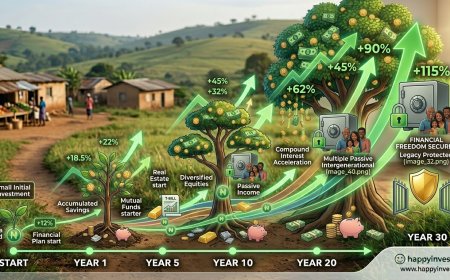
▸ All three compound over time: A family that has held diversified assets across all three pillars for 30 years will typically find their wealth has grown far beyond what any single asset class alone could have produced.
Family Asset Class Comparison at a Glance
|
Asset Class |
Potential Return |
Liquidity |
Entry Capital |
Family Suitability |
|
Stocks / ETFs |
High (12–20%+) |
High |
Low (₦1,000+) |
⭐⭐⭐⭐⭐ |
|
Residential Property |
Moderate (8–15%) |
Low |
High (₦5M+) |
⭐⭐⭐⭐⭐ |
|
REITs |
Moderate–High |
Medium |
Low (₦5,000+) |
⭐⭐⭐⭐ |
|
Family Business |
Very High (varies) |
Very Low |
Varies |
⭐⭐⭐⭐ |
|
FGN Bonds / T-Bills |
Low–Moderate |
Medium–High |
Low (₦50,000+) |
⭐⭐⭐⭐ |
|
Agricultural Land |
High (long-term) |
Very Low |
Moderate |
⭐⭐⭐ |
Returns are approximate and historical. Past performance does not guarantee future results. Consult a financial advisor for personalised guidance.
The Three-Generation Family Wealth Plan
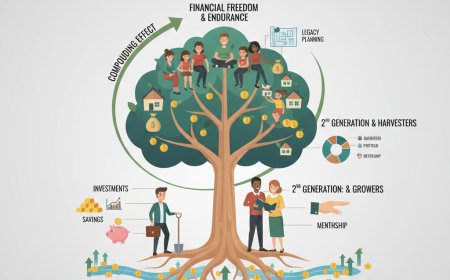
True family wealth is not built in a single generation it is built across generations, each one standing on the foundation laid by the one before. Here is a framework for thinking across three generations:
|
Phase |
Generation 1 (You) |
Generation 2 (Children) |
Generation 3 (Grandchildren) |
|
Build |
Earn income, invest systematically, buy property, start/grow business |
Benefit from family trust, receive education funding, and learn financial skills |
Inherit a diversified portfolio, business equity, and real estate |
|
Protect |
Life insurance, wills, business succession planning |
Continue family investment culture, manage inherited assets |
Maintain and grow a diversified family portfolio |
|
Transfer |
Estate planning: will, family trust, beneficiary designations |
Pass on assets efficiently via trust/inheritance structures |
Build on a foundation, fourth-generation wealth begins here |
|
The most important single step any Nigerian family can take toward generational wealth is this: draft a simple Family Financial Charter, a one-page document that states your family's wealth-building goals, the assets you are building, who is responsible for what, and how decisions will be made. This document, shared with your spouse and children, shifts a family from passive wealth consumption to intentional wealth building. |
Estate Planning: Making Sure Your Assets Outlive You
All the assets in the world mean nothing to your family if they are lost, disputed, or consumed by taxes and legal fees at your death. Estate planning is not a luxury for the ultra-wealthy — it is an essential component of any serious family wealth strategy.
At a minimum, every Nigerian adult building family assets should have:
▸ A valid, written Will specifying who inherits what. Without a will, the Administration of Estates Law determines how your assets are distributed, which may not reflect your wishes.
▸ Named beneficiaries on all financial accounts, investment accounts, pension RSAs, and insurance policies. These pass directly to named beneficiaries without going through probate.
▸ Life insurance — enough to replace your income for at least 5–7 years and pay off any outstanding debts, protecting your family's financial position if you die prematurely.
▸ A documented asset register, a simple spreadsheet or document listing all your assets (bank accounts, investments, properties, business interests) and how to access them. Keep this updated and store it somewhere your spouse can find it.
▸ Consider a Family Trust — for families with significant assets, a trust structure provides superior asset protection, privacy, and continuity compared to a simple will. Engage a qualified estate planning lawyer.
Your 12-Month Family Asset Building Action Plan
Building family wealth across three asset classes can feel overwhelming when viewed all at once. Break it into a 12-month action plan:
▸ Months 3–4: Start your family stock portfolio, open an investment account, and set up a monthly automatic contribution. Start with a diversified ETF or blue-chip NGX stocks. Simultaneously, open a dollar investment account (Bamboo or Chaka) for global equity exposure.
▸ Months 5–6: Property planning — if you don't own your home, create a property purchase plan with a timeline and savings target. If you own your home, research your first rental property or REIT investments.
▸ Months 7–8: Business assessment — if you have a business, conduct a formal business health check: Is it formalised? Are the finances clean? Does a succession plan exist? If you don't have a business, identify one sector from the list above that aligns with your skills and resources, and begin research.
▸ Months 9–10: Insurance review — ensure you have adequate life, health, and, if applicable, key-man business insurance. Close any gaps.
▸ Months 11–12: Review and optimise — assess your progress across all three pillars. Increase investment contributions where possible. Set targets for the following year.
Final Thoughts: Build What Lasts
There is a Yoruba proverb: 'Bi a ba n se ojo oni, a n se ojo ola', the way we live today shapes the tomorrow we will live in. For families, this truth extends across generations.
The assets you build today, the stocks you buy, the properties you acquire, the business you grow are not just for you. They are the foundation upon which your children will build, and your grandchildren after them. Every naira redirected from consumption into asset building is a vote for your family's future prosperity.
This is not easy work. It requires sacrifice, patience, financial discipline, and sometimes difficult family conversations. But the alternative, each generation starting from zero while wealth accumulates for those who choose to build, is far more difficult.
Start building your family's three pillars today. Not perfectly, just purposefully. The most important step is the first one, and the second most important is never stopping.
At HappyInvest.ng, we are committed to being your partner in this journey, providing the education, insights, and community that help Nigerian families build lasting, generational wealth.
Your family's wealthy future begins with a decision you make today.
© HappyInvest.ng — Empowering Nigerians to Invest Smarte