How to Design Your Personal Money System
Learn how to design a personal money system that helps you manage income, control spending, save consistently, and build long-term wealth. Create a powerful personal money system to manage your finances, save consistently, and build wealth. A simple guide for financial success.
 Yahnic Chigozie
Most people don’t have a money problem.
They have a money system problem.
They earn income…
They spend…
They try to save what’s left…
And at the end of the month, nothing remains.
If you want to build real wealth, you need more than motivation.
You need a system that manages your money automatically and consistently.
What Is a Personal Money System? (Simple Definition)
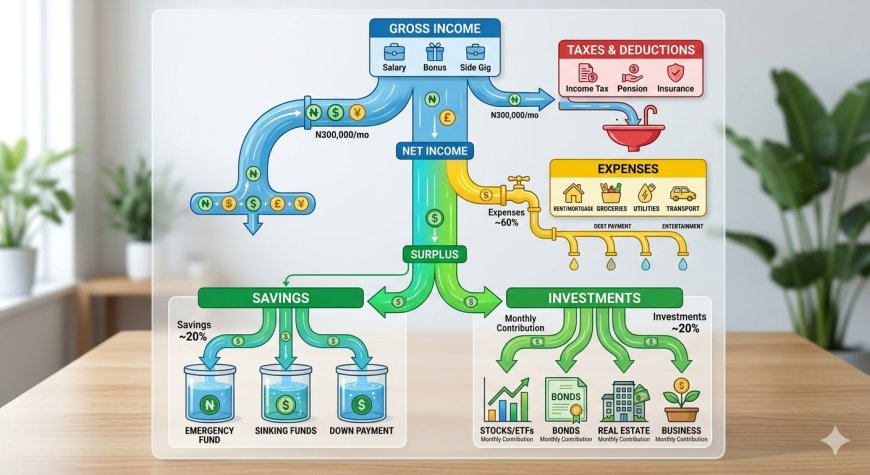
A personal money system is a structured way of managing your income, expenses, savings, and investments.
In simple terms:
It is how your money flows from when it enters your account to how it is used.
Why You Need a Money System
Without a system:


-
You rely on discipline alone
-
You make emotional decisions
-
Your money disappears without direction
With a system:
-
Your money has a plan
-
Your priorities are clear
-
Wealth-building becomes consistent
Step 1: Know Your Financial Numbers
You cannot build a system without clarity.
Start by identifying:
-
Monthly income
-
Fixed expenses (rent, food, transport)
-
Variable expenses (entertainment, shopping)
-
Current savings
Why This Matters
You need to know:
What is coming in and what is going out
Step 2: Define Your Financial Goals
Your system must be built around your goals.
Examples:
-
Emergency fund (3–6 months of expenses)
-
Buying a house
-
Investing for long-term wealth
-
Starting a business
Key Principle
Your goals determine how your money should be allocated.
Step 3: Create a Simple Allocation Structure
This is the foundation of your system.
A simple structure could be:
-
50% → Living expenses
-
20% → Savings
-
20% → Investments

-
10% → Personal spending


Adjust Based on Your Reality
Your percentages may differ, but the key is:
Every naira must have a purpose.
Step 4: Pay Yourself First
Do not save what is left after spending.
Instead:
-
Save immediately after receiving income
This ensures:
-
Your financial goals are prioritized
-
You build consistency
Step 5: Automate Your Money Flow
Automation reduces the need for discipline.
Set up:
-
Automatic transfers to savings
-
Scheduled investment contributions
Why It Works
-
Removes temptation
-
Builds consistency without effort
Step 6: Separate Your Accounts
One of the most effective strategies is account separation.
Use different accounts for:
-
Spending
-
Savings
-
Investments
Benefit
You avoid mixing money and overspending.
Step 7: Build an Emergency Fund
Before aggressive investing, build a safety net.
Target:
-
3–6 months of expenses
This protects you from:
-
Unexpected expenses
-
Selling investments at the wrong time
Step 8: Create a Simple Investment Plan
Your system should include investing.
Decide:
-
What to invest in (stocks, fixed income, etc.)
-
How often to invest
-
How much to invest
Key Rule
Consistency matters more than timing.
Step 9: Review and Adjust Regularly
Your system is not static.
Review:
-
Monthly spending
-
Savings progress
-
Investment performance
Adjust when necessary:
-
Income changes
-
Goals change
-
Life circumstances change
Step 10: Keep It Simple
A complex system is hard to maintain.
The best money system is:
-
Simple
-
Clear
-
Easy to follow
Example of a Simple Personal Money System
Income: ₦300,000/month
-
₦150,000 → Expenses
-
₦60,000 → Savings
-
₦60,000 → Investments
-
₦30,000 → Personal use
This system:
-
Creates balance
-
Ensures consistency
-
Supports long-term growth
Common Mistakes to Avoid
-
Not tracking income and expenses
-
Saving inconsistently
-
Mixing all the money in one account
-
Overcomplicating the system
-
Ignoring long-term goals
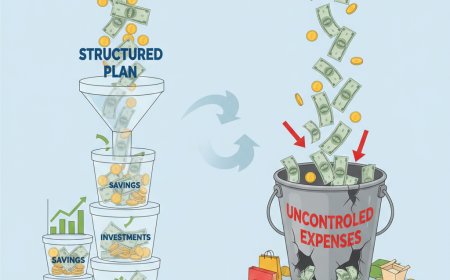
Real-Life Comparison
Person A (No System)
-
Spends first
-
Saves randomly
-
No investment structure
Person B (With System)
-
Follows a structured plan
-
Saves and invests consistently
-
Tracks financial progress
After a few years:
-
Person A struggles financially
-
Person B builds stability and wealth
Benefits of a Personal Money System
-
Financial clarity
-
Better decision-making
-
Reduced stress
-
Consistent wealth building
-
Control over your finances
Systems Create Results
Motivation comes and goes.
But a system:
-
Works every month
-
Builds discipline automatically
-
Creates long-term results
If you want to change your financial life:
Do not rely on willpower.
Build a system that works for you.