Long-Term Investing vs Short-Term Investing: Which Builds More Wealth?
Long-term investing vs short-term investing — which builds more wealth in Nigeria? Happyinvest breaks down both strategies with real naira examples, a full comparison across risk, returns, and effort, the best instruments for each in Nigeria, and a practical decision framework for beginners. Find out where your money really belongs
 Yahnic Chigozie
Making Money Simple. Building Wealth Daily.
Here's an argument I've watched happen in real life, maybe you've had a version of it too.
Two friends. Ade and Seun. Both 26. Both earn ₦120,000 a month. Both have decided to start investing.
Seun says: "I'm putting my money in treasury bills and money market funds. Safe, steady returns. I'm not in a rush."
Ade says: "Treasury bills? That's too slow. I'm trading forex and flipping stocks. Watch me double my money in 3 months."
One year later: Seun's portfolio is up 21%. Steady. Predictable. Growing. Ade has had two good months, three terrible months, lost ₦40,000 on a bad forex trade, and is back roughly where he started, exhausted and frustrated.
Five years later: Seun has accumulated serious, compounding wealth. Ade is still chasing the next big trade.
This story plays out every single day in Nigeria. And it illustrates the most important investing question most Nigerians never properly answer before they put their money anywhere:
Should I invest for the long term or the short term?
Today, we're going to settle this debate properly, honestly, and with a real Nigerian context. This is not a simple "one is good, one is bad" answer. Both strategies have legitimate roles. But most people are using them incorrectly, especially beginners.
By the end of this article, you'll know exactly which strategy deserves your money, when, and why.
Let's get into it.
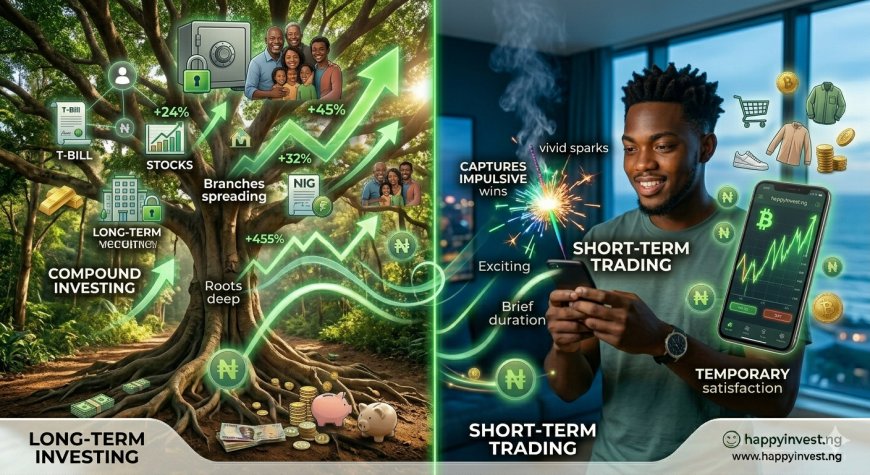
What Is Long-Term Investing?
Long-term investing means putting your money into assets with the intention of holding them for a minimum of 5 years and ideally much longer. You're not watching the price daily. You're not trying to sell next month when prices move. You're making a calculated bet that the asset you own will be significantly more valuable in the future than it is today.
Long-term investing is the strategy behind almost every genuinely wealthy person you can name. Warren Buffett has held some of his core stock positions for decades. Nigerian real estate investors who bought land in Lekki in the 1990s are sitting on 50x returns today. People who bought quality Nigerian bank stocks in the early 2000s and held through every crisis are wealthier than they could have imagined.
The engine powering long-term investing is one of the most powerful forces in finance: compound interest.
Here's what compound interest looks like in practice with Nigerian numbers.
If Chidera invests ₦10,000 every month into a diversified portfolio earning 20% annually, a realistic expectation for a mix of Nigerian stocks, dollar investments, and mutual funds, after 10 years, she has approximately ₦7.7 million. After 20 years, that number becomes approximately ₦77 million. After 30 years: over ₦600 million.
Same ₦10,000 a month. The only variable is time.
That's not a typo. That's compound interest doing exactly what it does when you leave it alone long enough. The longer you stay in, the more dramatically the numbers grow because you're earning returns not just on your original investment, but on every previous return too. The snowball gets bigger and faster the longer it rolls.
Long-term investing instruments for Nigerians include quality NGX-listed stocks like GTCO, Zenith Bank, and MTN Nigeria, US stocks and ETFs like the S&P 500 through platforms like Bamboo, Trove, and Risevest, equity and balanced mutual funds managed by firms like ARM and Stanbic IBTC, Real Estate Investment Trusts (REITs), and direct real estate ownership for those with larger capital.
What Is Short-Term Investing?
Short-term investing means putting your money to work for a defined period, typically anything from a few days to about 12 months, with the goal of earning returns quickly and then accessing your money again.
Now, the important distinction: short-term investing is not the same as short-term trading. This is where a lot of confusion happens.
Short-term investing includes things like treasury bills, money market funds, fixed deposits, and FGN savings bonds. These are structured, regulated, predictable instruments. Your money goes in, earns a known return over a known period, and comes back to you. Safe. Useful. Legitimate.
Short-term trading is different; it involves actively buying and selling financial instruments (stocks, forex, crypto) within short time frames, trying to profit from price movements. This requires significant skill, emotional discipline, and capital you can genuinely afford to lose. It is not investing in the traditional sense. It's speculation.
When most Nigerians say they want to "invest short-term," what they actually mean is one of two things. Either they have a specific goal they need money for within 12 months, such as school fees, rent advance, a business investment, and need a safe place to park their money and earn returns while they wait, or they want to trade forex, crypto, or stocks actively and generate quick profits. These two things are completely different in terms of risk, skill requirement, and realistic outcomes.
We'll address both, but we need to treat them separately.
Legitimate short-term instruments for Nigerians:
Treasury bills (T-bills) are currently yielding around 20–22% per annum and can be held for 91, 182, or 364 days. You know exactly what you'll earn. Your principal is protected by the federal government.
Money market funds through Cowrywise, ARM, and Stanbic IBTC are yielding 18–22% per annum and are fully liquid within 24–72 hours. Perfect for the money you might need at any time.
Fixed deposits at commercial banks offer lower but guaranteed returns for defined terms, typically 90 to 180 days.
FGN Savings Bonds, available through the DMO from as little as ₦5,000, pay quarterly interest over 2–3 year terms. Technically medium-term but accessible and government-backed.
These are all perfectly valid financial tools. They just serve a specific purpose, which we'll get to in the decision framework section.
The Real Wealth Question: Which Builds More?
Let me give you the honest, direct answer right now before we go deeper.
For building serious, lasting wealth over time, long-term investing wins. It is not closed.
Here's why, broken down across every dimension that matters.
On Returns: Compound Interest Is a Cheat Code
We already saw the ₦10,000/month example. But let me make it even more concrete with a direct comparison.
Imagine two people. Both have ₦500,000 to invest today.
Person A — Long-Term: Puts all ₦500,000 into a diversified portfolio of Nigerian stocks and US ETFs, earning an average of 20% per year. Adds ₦10,000/month. Does not touched it for 15 years.
After 15 years, Person A has approximately ₦68 million.
Person B — Short-Term: Puts ₦500,000 into treasury bills at 20% per annum. Rolls it over each year. Does not compound because they withdraw the interest and spend it.
After 15 years, Person B has earned ₦100,000/year in interest, ₦1.5 million in total interest payments over 15 years, and still has their original ₦500,000.
The difference? Compounding. Person A let their returns earn more returns, which earned more returns. Person B collected their returns and spent them.
This is the fundamental difference between wealth building and parking money. Long-term investing with compounding builds wealth. Short-term instruments preserve and incrementally grow capital but they don't compound into transformational wealth on their own.
On Risk: Time Is the Risk Reducer
A common misconception is that long-term investing is riskier because you're exposed to market fluctuations for longer.
The reality is the exact opposite.
Yes, in any given single year, the Nigerian stock market or the US stock market might drop 20%, 30%, or even 40%. That's real, and it happens. But here's what the data shows consistently: over any 10-year period, quality diversified stock portfolios have historically delivered positive, often strong returns. Time diversifies risk across economic cycles.
Short-term speculation, forex trading, crypto flipping, and short-term stock trading are actually the riskier activities. You're exposed to price movements over days or weeks where anything can happen: news events, policy changes, sudden currency moves, global economic shocks. Without deep skill and experience, most short-term traders lose money over time.
Studies from US markets consistently show that roughly 80–90% of active day traders lose money over a 12-month period. Nigerian retail forex traders face similar or worse statistics, particularly when dealing with unregulated brokers.
The longer your horizon, the more time works for you rather than against you.
On Effort: What Your Time Is Actually Worth
Long-term investing is extraordinarily low-effort once set up correctly.
You open accounts on Cowrywise, Bamboo, or your stockbroker. You set up automatic monthly contributions. You review quarterly. You rebalance annually. That's maybe 5–10 hours of active attention per year, while your money works 24 hours a day, 365 days a year.
Short-term trading — real trading, not just parking money in T-bills is a full-time job. Forex trading requires monitoring global news, central bank decisions, economic data releases, and chart patterns in real time. Stock trading requires earnings analysis, sector rotation understanding, and constant position management.
The question is: what is your time worth? If you're a doctor, engineer, teacher, business owner, or employee, your time spent becoming a world-class trader is time not spent becoming better at your actual profession, which is likely your most valuable income asset.
For most Nigerians, the right answer is to invest long-term in a way that requires minimal active management, and spend their most productive hours getting better at what they do and earning more, which they then invest more of. That combination accelerates wealth far faster than most trading approaches.

On Psychology: The Emotional Toll of Short-Term Trading
This one doesn't get talked about enough.
Short-term trading is psychologically brutal. Watching your position go red in real time, deciding whether to cut your losses or hold through a move, fear of missing out when a trade runs without you, the euphoria of a winning trade followed by overconfidence that leads to a bigger losing trade, these emotional cycles destroy most traders who haven't spent years developing the mental discipline to manage them.
Long-term investing is the opposite. You buy quality assets. You stop watching daily. You live your life. You check in quarterly. Your emotional energy is preserved for things that matter: your family, your career, your business, your health.
The best investors in the world are not glued to screens. They're patient, boring, and relentless. And they win because of it.
On Taxes: A Real Consideration
In many countries, short-term trading gains are taxed at higher rates than long-term investment gains. Nigeria's tax treatment of investment returns is still evolving, but this is a trend worth watching as Nigeria's financial regulatory environment matures. Long-term investors generally face simpler, more favorable tax treatment than active traders.
But Wait, Does Short-Term Investing Have Any Real Role?
Absolutely. And here's where I want to be genuinely balanced because dismissing short-term instruments entirely would be wrong and unhelpful.
Short-term investing has three completely legitimate, valuable use cases in your financial life.
Use case 1: Your emergency fund. Your 3–6 month emergency fund should NOT be in stocks. It needs to be liquid, accessible, and protected from market volatility. Money market funds and T-bills are perfect for this purpose. You earn 18–22% per annum while your safety net stays intact and accessible.
Use case 2: Saving for a specific near-term goal. If you need ₦500,000 for a business lease in 12 months, that money does not belong in stocks. It belongs in a T-bill or money market fund where it's safe and growing steadily while you count down to your goal. Short-term instruments serve specific-timeline savings beautifully.
Use case 3: Parking money between long-term opportunities. Sometimes you accumulate cash faster than you can deploy it wisely into long-term investments. While you research your next move, money market funds are the intelligent parking spot. You earn returns while you decide.
In all three cases, short-term instruments are playing a supporting role in a larger wealth strategy, not the lead role.
The Decision Framework: Which Strategy Is Right for You?
Let me give you a practical, honest guide for choosing where each naira belongs in your financial life. Think of this as a filter, not a formula.
Put money in long-term investments if: You won't need it for 5 or more years. You're investing for future wealth, retirement, financial independence, and long-term goals. You can handle seeing your portfolio value fluctuate without panicking. You want your money to compound into something substantial.
Put money in short-term instruments if: You need it within 12–24 months for a specific goal. It's your emergency fund; it needs to stay liquid and protected. You've already built a solid long-term portfolio and want a stable, accessible portion. You're between investments and need a safe holding place.
Be very cautious about short-term trading if: You're doing it with money you cannot genuinely afford to lose. You have less than 2 years of dedicated learning and practice in the specific instrument. You're doing it as a substitute for long-term investing rather than in addition to it. You're attracted to it because it feels exciting rather than because you have a tested, documented strategy. Someone on social media convinced you it's easy money.
The honest truth about forex and crypto short-term trading is that it rewards the few who develop genuine skill and punishes the majority who don't. It is not a reliable path to wealth for most people. The stories you hear about people making millions in forex in 3 months are survivor bias. For every one person making those returns, there are dozens who lost quietly and moved on.
This is not to say trading is impossible to master. Some Nigerians do it profitably and professionally. But it requires years of development, proper risk management, significant capital, and an iron psychological disposition. It's a career path, not a shortcut.
The Smartest Approach: Use Both Strategically
Here's the thing nobody tells you: the real answer isn't choosing one or the other. It's knowing how to use both properly within a single, coherent wealth strategy.
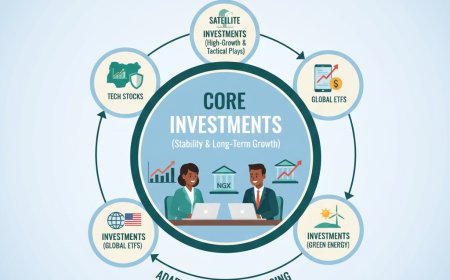
Here is what a smart Nigerian investor's allocation framework looks like:
The foundation of your wealth is long-term investments in quality Nigerian stocks, US ETFs, mutual funds, and dollar assets. This is where the majority of your investable money lives. You contribute to it every month. You leave it alone. You let compound interest do its work over years and decades.
A portion, roughly 15–25% of your portfolio, sits in short-term instruments. This is your emergency fund in a money market fund. This is money earmarked for specific near-term goals in a T-bill. This is the stable, liquid portion that gives you flexibility without derailing your long-term compounding.
If you choose to trade actively in forex, crypto, or stocks, use only money you've designated as a learning allocation. Never more than 5–10% of your total investable capital. Treat it as tuition while you develop skills. Never let trading losses force you to touch your long-term investments.
This framework gives you the best of both worlds: serious long-term wealth building powered by compound interest, short-term stability and liquidity for goals and emergencies, and a small, contained risk appetite for those drawn to active markets.
A Real-Life Nigerian Portfolio Example
Let me bring this to life with a concrete example you can actually relate to.
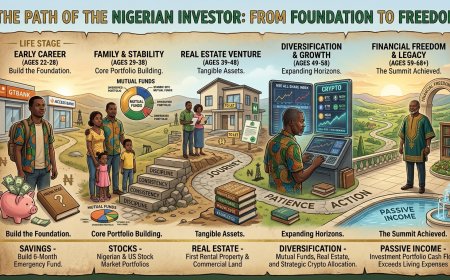
Meet Temi. 29 years old. Works at a tech company in Lagos. Earns ₦200,000/month. Has decided to invest ₦40,000/month.
Here's how Temi applies the framework:
₦20,000/month goes into a diversified long-term portfolio: ₦12,000 into Nigerian equity mutual fund (Stanbic IBTC or ARM), ₦8,000 into US stocks via Bamboo (S&P 500 ETF and 2 quality individual stocks). This is Temi's wealth engine. It does not get touched.
₦15,000/month goes into a money market fund on Cowrywise. Right now, Temi is building her emergency fund. Once that's complete (3 months of expenses = ₦300,000), she'll redirect this money into her long-term portfolio or toward a specific goal, perhaps a down payment for a property in 3 years.
₦5,000/month is Temi's "learning account." She's been interested in Nigerian stocks for a while and wants to practice picking individual companies. This small allocation lets her develop that skill and experience without risking her main wealth-building engine.
After 10 years of consistency, Temi's long-term portfolio, assuming 20% average annual return, is projected to be worth over ₦30 million. And she started with a ₦200,000 salary and ₦40,000/month invested.
That is what a smart, intentional strategy looks like. Not dramatic. Not exciting. Just consistent, structured, and devastatingly effective over time.
The Single Most Common Mistake: Getting These Backwards
Before we close, I need to name the mistake I see most often among Nigerian investors because it's costly and very common.
Most people put their wealth-building money in short-term instruments and their risk money in speculative trades.
They put ₦200,000 in treasury bills because it "feels safe" and then also put ₦50,000 in a forex scheme because "someone said it pays well." They end up with money that's not growing fast enough on one side and money that might disappear on the other.
The right order is: long-term investments first and biggest, short-term instruments in their proper supporting role, and high-risk activities last and smallest only after the first two are running well.
If your long-term investment portfolio doesn't exist yet, that is the first thing to build. Everything else, T-bills, money market funds, and trading serve that mission. Never let the supporting cast become the main character.
The Verdict
If you came here for a clear answer, here it is.
Long-term investing wins for building wealth. Not because short-term instruments are bad, they're excellent tools, but because compound interest over time is the most powerful wealth-building mechanism available to ordinary people. The longer you give it, the more violently it works in your favor.
Short-term instruments have their place: protecting your emergency fund, reaching specific near-term financial goals, and parking cash intelligently. They are not wealth builders on their own. They are wealth protectors and goal-savers.
The smart investor uses both in their correct roles, in the right proportions, with clear goals attached to each.
The question is not "long-term or short-term?" The real question is: "Have I assigned every naira in my investment life to the right strategy for its specific purpose?"
Answer that question honestly, apply the framework in this article, and your financial life will look dramatically different in 10 years.
At Happyinvest, we're here to make sure that question always has a clear, simple answer.
Making Money Simple. Building Wealth Daily.