The Complete Guide to Investing in Nigeria: Types of Investments, Investor Profiles, and the Best Strategy for Every Age
Learn everything about investing in Nigeria. Discover investment types, investor profiles, risk levels, and the best investment strategies for every age group to build long-term wealth.
 Yahnic Chigozie
Nigeria is a country full of opportunities.
Yet many Nigerians work hard for years without building significant wealth.
Why?
Because earning money and building wealth are not the same thing.
Most people focus on income.
Wealthy people focus on investing.
Whether you are a student in Enugu, a salary earner in Lagos, a business owner in Aba, or a professional working abroad and sending money home, understanding investing can completely change your financial future.
The good news?


You don't need millions of naira to start.
You don't need to be a financial expert.
You simply need to understand the different investment options available, know your investor profile, and choose a strategy that fits your age and goals.
At Happyinvest, we believe investing should be simple enough for anyone to understand and practical enough for anyone to start.
This guide will give you a complete roadmap.
What Is Investing?
Investing is the process of putting money into assets that have the potential to generate more money in the future.
Unlike saving, where your money mostly stays the same, investing allows your money to grow.
Think of it this way:
Saving protects money.
Investing grows money.
For example:
If you save ₦100,000 under your mattress for five years, you'll still have ₦100,000.
But because of inflation, that ₦100,000 may buy less than it does today.
Investing gives your money a chance to grow faster than inflation.
Why Every Nigerian Needs to Invest
Nigeria faces unique financial challenges.
These include:
-
Inflation
-
Naira depreciation
-
Rising living costs
-
Uncertain pension systems
-
Economic cycles
Simply saving money is often not enough.
Imagine this:
In 2015, ₦100,000 could do far more than ₦100,000 can do today.
Your money must grow if you want to preserve purchasing power.
Investing helps you:


-
Build wealth
-
Protect against inflation
-
Create passive income
-
Achieve financial freedom
-
Retire comfortably
Understanding Your Investor Profile
Before choosing an investment, understand yourself.
Different people have different risk tolerances.
Conservative Investor
You prioritize safety.
You dislike large losses.
You prefer stability.
Suitable investments:
-
Savings accounts
-
Money market funds
-
Treasury Bills
-
Fixed deposits
-
Bonds
Moderate Investor
You want growth but still care about safety.
Suitable investments:
-
Mutual funds
-
Balanced funds
-
Dividend stocks
-
REITs
-
Selected ETFs
Aggressive Investor
You are comfortable with volatility.
You seek higher returns.
Suitable investments:
-
Growth stocks
-
U.S. stocks
-
Cryptocurrency
-
Startups
-
Business investments
There is no right or wrong profile.
The goal is to choose investments that match your personality.
The Main Types of Investments in Nigeria
1. Savings Accounts
Risk Level: Very Low
Potential Return: Low
Suitable For:
-
Emergency funds
-
Short-term goals
Advantages:
-
Easy access
-
Safe
-
Simple
Disadvantages:
-
Often loses value to inflation
2. Money Market Funds
Risk Level: Low
Potential Return: Moderate
Suitable For:
-
Beginners
-
Emergency funds
-
Conservative investors
Advantages:
-
Better returns than traditional savings
-
Relatively low risk
-
Professional management
Many Nigerians start here.
3. Treasury Bills
Treasury Bills are government-backed investments.
Risk Level: Low
Advantages:
-
Government-backed
-
Predictable returns
Disadvantages:
-
Returns may not always beat inflation
4. Bonds
When you buy a bond, you're lending money to a government or company.
Risk Level: Low to Moderate
Advantages:
-
Regular income
-
Relatively stable
Suitable for:
-
Conservative investors
-
Retirees
5. Nigerian Stocks
The stock market allows you to own shares in companies.
Examples include companies in:
-
Banking
-
Telecommunications
-
Consumer goods
-
Agriculture
-
Industrial sectors
Risk Level: Moderate to High
Advantages:
-
Capital appreciation
-
Dividend income
-
Long-term wealth creation
Disadvantages:
-
Market fluctuations
6. U.S. Stocks
Many Nigerians now invest globally.
Examples include major international companies.
Risk Level: Moderate to High
Advantages:
-
Dollar exposure
-
Global diversification
-
Strong businesses
This can help protect wealth against Naira depreciation.
7. Exchange-Traded Funds (ETFs)
ETFs allow you to buy a collection of investments at once.
Risk Level: Moderate
Advantages:
-
Diversification
-
Lower risk than individual stocks
-
Beginner-friendly
8. Real Estate
Real estate remains one of Nigeria's favorite investments.
Examples:
-
Land
-
Residential property
-
Commercial property
Risk Level: Moderate
Advantages:
-
Rental income
-
Appreciation potential
Disadvantages:
-
Requires larger capital
9. REITs (Real Estate Investment Trusts)
REITs allow investors to benefit from real estate without buying property directly.
Risk Level: Moderate
Advantages:
-
Lower entry cost
-
Potential income
-
Diversification
10. Cryptocurrency
Examples include:
-
Bitcoin
-
Ethereum
Risk Level: High
Advantages:
-
High growth potential
Disadvantages:
-
High volatility
-
Regulatory uncertainty
Only invest money you can afford to leave invested long term.
11. Business Investment
Investing in your own business can produce exceptional returns.
Risk Level: High
Advantages:
-
Income generation
-
Scalability
-
Wealth creation
Disadvantages:
-
Significant effort required
The Three Buckets Every Nigerian Should Have
Instead of putting all your money in one place, divide it into three buckets.
Bucket 1: Protection
Purpose:
Financial security
Includes:
-
Emergency fund
-
Savings
-
Money market funds
Bucket 2: Growth
Purpose:
Wealth creation
Includes:
-
Stocks
-
ETFs
-
Mutual funds
-
REITs
Bucket 3: Opportunity
Purpose:
Higher returns
Includes:
-
Crypto
-
Business investments
-
High-growth opportunities
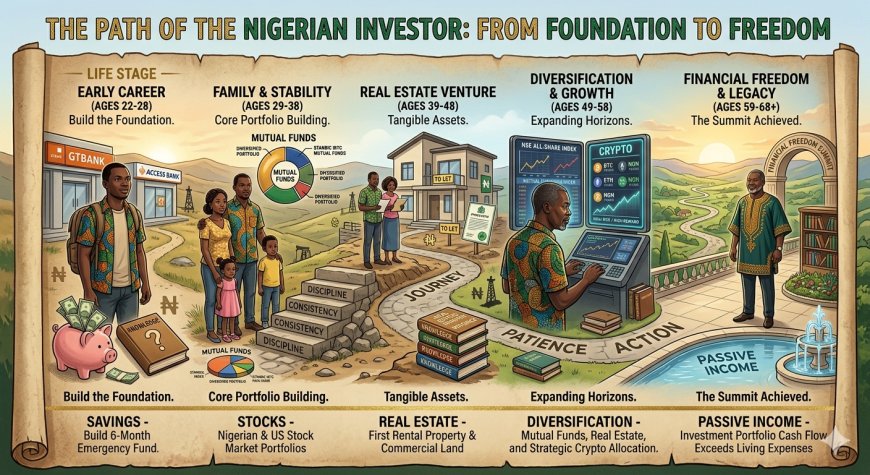
Best Investment Strategy by Age
Ages 18–25
Primary Goal:
Learning and habit building
Allocation Example:
-
20% Savings
-
60% Stocks/ETFs
-
10% REITs
-
10% Crypto
Focus on:
-
Financial education
-
Consistency
-
Long-term investing
Your biggest advantage is time.
Ages 26–35
Primary Goal:
Asset accumulation
Allocation Example:
-
15% Emergency Fund
-
60% Stocks
-
15% Real Estate
-
10% Crypto
Focus on:
-
Career growth
-
Income expansion
-
Aggressive investing
Ages 36–45
Primary Goal:
Wealth expansion
Allocation Example:
-
20% Safe Assets
-
50% Stocks
-
20% Real Estate
-
10% Alternatives
Focus on:
-
Family security
-
Retirement planning
Ages 46–60
Primary Goal:
Preservation and income
Allocation Example:
-
40% Bonds
-
30% Stocks
-
20% Real Estate
-
10% Alternatives
Focus on:
-
Income generation
-
Capital preservation
Age 60+
Primary Goal:
Financial stability
Allocation Example:
-
50% Bonds
-
20% Stocks
-
20% Real Estate
-
10% Cash
Focus on:
-
Stability
-
Income
-
Legacy planning
Common Investment Mistakes Nigerians Make
Waiting Until They Feel Rich
Many people delay investing.
Years pass.
Nothing changes.
Start where you are.
Chasing Quick Profits
If it sounds too good to be true, it probably is.
Avoid:
-
Ponzi schemes
-
Unrealistic promises
-
Guaranteed high returns
Investing Without Learning
Financial education comes first.
Invest second.
Following the Crowd
Never invest simply because everyone else is investing.
Understand what you're buying.
Ignoring Diversification
Don't put all your money into one investment.
Diversification reduces risk.
The Happyinvest Wealth Strategy
If you're unsure where to start, follow this simple framework:
Step 1
Build a 3–6 month emergency fund.
Step 2
Invest consistently every month.
Step 3
Focus on stocks and diversified funds.
Step 4
Increase investments as income grows.
Step 5
Avoid hype and think long term.
Step 6
Keep learning.
Step 7
Let compound growth work for decades.
Final Thoughts
The best investment is not necessarily the one with the highest return.
The best investment is the one you understand, can stick with, and fits your goals.
Whether you're a student investing your first ₦5,000 or a professional investing ₦500,000 monthly, the principles remain the same:
-
Start early
-
Invest consistently
-
Diversify wisely
-
Think long term
-
Continue learning
Financial freedom is not built through luck.
It is built through thousands of smart decisions made over many years.
And the best time to begin was yesterday.
The second-best time is today.