The NGX Market Breaker: Everything a Nigerian Stock Investor Must Know
What is the NGX Market Breaker, and how does the 10% circuit breaker rule work on the Nigerian Exchange? Happyinvest explains limit-up, limit-down, liquidity thresholds by price band, the history from 5% to 10%, advantages, disadvantages, and exactly what every Nigerian stock investor needs to know. Full guide with real ₦ examples.
 Yahnic Chigozie
Making Money Simple. Building Wealth Daily.
Let me paint you a scene.
It's a regular Tuesday morning. You're watching your Chaka app, and you notice that MTN Nigeria is flying; it's already up 8% from yesterday's close, and it's only 10:15 am. You think to yourself: "This thing is going to 15% today, let me just wait and see how high it goes."
By 11:00 am, it hits +10%. And then nothing. The stock just sits there. No more movement. A queue of buyers is forming. People want to buy more, but nothing is trading at a higher price. The stock seems stuck.
You're confused. What just happened?
What happened is the Market Breaker. And if you're investing in the Nigerian Exchange Group (NGX) without understanding this rule, you're navigating one of the most important features of the market completely blind.
Today, we're going to fix that completely. We're breaking down the NGX Market Breaker, what it is, where it came from, how it works, what it means for liquidity, what the advantages and disadvantages are, and most importantly, what you, as an investor, need to know to use it to your advantage instead of being caught off guard by it.


This is the kind of knowledge that separates informed Nigerian investors from people who just "buy stocks and hope." Let's get into it.
What Exactly Is the Market Breaker?
The market breaker, officially called a circuit breaker or price limit rule, is a regulation by the Nigerian Exchange Group that says:
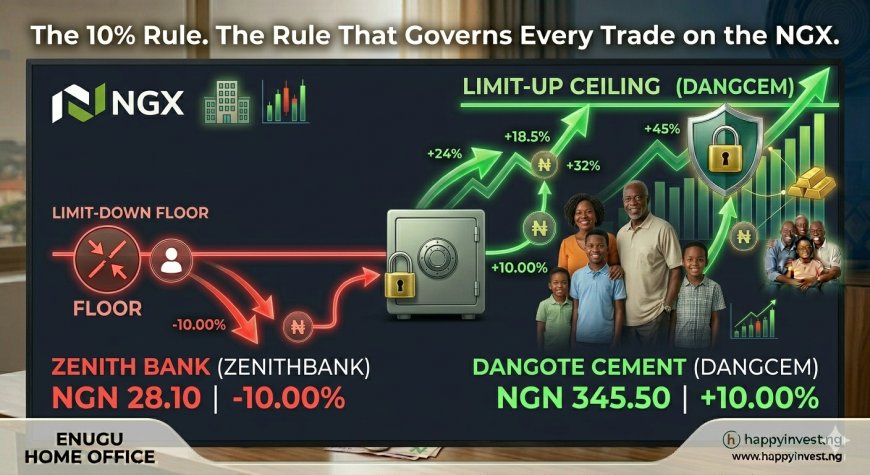
No stock listed on the NGX can rise or fall more than 10% from its previous day's closing price in a single trading session.
That's it, at the simplest level. A daily cap. A ceiling on how high a stock can go in one day, and a floor on how low it can fall.
Let's make it real with naira numbers.
Say Dangote Cement closed yesterday at ₦600 per share. Under the 10% Market Breaker rule, today the stock can only trade within this range:
Lowest possible price today: ₦540 (₦600 minus 10%) Highest possible price today: ₦660 (₦600 plus 10%)
It doesn't matter how exciting the news is. It doesn't matter if Dangote just announced a merger, a massive profit, or a special dividend. The price cannot go above ₦660 today. Period. If buyers want to pay more, they have to wait until tomorrow, when the new ceiling resets based on the new closing price.
This is the market breaker in action. A guardrail. A daily limit. And understanding it is fundamental to trading intelligently on the NGX.
The History: How We Got Here
The NGX market breaker didn't start at 10%. And understanding the history helps you understand why the rule exists at all.
The Wild Early Days No Cap
In the earliest era of the Nigerian Stock Exchange, back when it was still called the NSE before the rebranding, there were no formal daily price movement limits. Stocks could move 20%, 30%, or even 50% in a single day based on news, rumour, or plain market hysteria.
This created two enormous problems.
First, it made the market a playground for manipulation. A well-funded operator could buy large quantities of a thinly traded stock, create artificial demand and price movement, watch retail investors pile in out of FOMO, then sell everything at the top, leaving ordinary investors holding worthless shares. This happened. Repeatedly. And it destroyed trust in the market.
Second, it created violent panic. When bad news hit a company's collapse, a political shock, or a fraud revelation, stocks could crash 40–60% in a single day before any rational price could be established. Investors who needed to sell couldn't find buyers. The market could spiral completely out of control in hours.
The 5% Limit First Attempt at Order
Recognizing that the unregulated movement was destroying investor confidence and enabling manipulation, the Securities and Exchange Commission (SEC) Nigeria introduced a ±5% daily price limit. This was a significant step; it said a stock could only move 5% up or 5% down from its previous closing price in any single trading session.
The 5% rule brought order but created new problems. The ceiling was so tight that genuine price discovery became very slow. When major positive news hit a stock, a blockbuster earnings result, a strategic acquisition, or a large contract win, the 5% daily limit meant it could take a week or two of consecutive limit-up days just for the market to fully reprice that good news. Investors were frustrated. Market efficiency suffered.
Liquidity also became an issue. Foreign investors and institutional players, accustomed to more flexible markets, found the 5% limit too restrictive. It made the Nigerian market feel rigid and unattractive compared to peer markets in Africa and globally.
The 10% Expansion of the Current Rule
After significant industry consultation and pressure from market participants, the NGX expanded the daily price movement limit to ±10%. This was a carefully considered decision that tried to balance two competing needs:
Protect investors from extreme volatility and manipulation, hence keeping a limit on all.
Allow the market enough room to efficiently price in significant news events without requiring endless limit-up or limit-down sessions, hence expanding from 5% to 10%.
The 10% limit is where we are today. It represents the NGX's judgment about the right balance between protection and efficiency. And it's the rule every single investor on the Nigerian Exchange must understand cold.
How It Actually Works in the Market: A Full Walkthrough
Let me walk you through exactly how the market breaker plays out in practice, because understanding the mechanics in theory is different from understanding what you actually see in your brokerage app.
Scenario 1: The Limit-Up
It's earnings season. Access Holdings releases its full-year results, and they're absolutely blowout profit is up 80% year-on-year. The market was expecting maybe 40%. Access Holdings closed yesterday at ₦20.00 per share.
When trading opens today, buyers flood in. The demand is overwhelming. The price moves up rapidly. By 10:30 am, it has moved from ₦20.00 to ₦22.00, exactly 10% up. The stock hits its upper circuit breaker what traders call limit-up.
Now here's what happens: the price freezes at ₦22.00 for the rest of the day. No more upward movement is possible regardless of demand. But people still want to buy. So they queue at ₦22.00. If any existing shareholders decide to sell at ₦22.00, those queued buyers get filled in order of first-come, first-served.
Tomorrow morning, the new reference price is ₦22.00. Tomorrow's ceiling becomes ₦24.20 (₦22.00 + 10%). The stock could potentially go limit-up again. And again the day after. This is how a stock reprices from ₦20 to ₦26, ₦28, ₦30 over several days following major news, one limit-up session at a time.


Scenario 2: The Limit-Down
Flip the scenario. A company releases earnings that are deeply disappointing. Revenue collapsed. The CEO resigned under suspicious circumstances. The stock closed yesterday at ₦50.
Sellers flood the market at open. Panic sets in. The price falls rapidly. By 9:55 am, it has reached ₦45.00, exactly 10% down. The stock hits limit-down its lower circuit breaker.
Now the price is frozen at ₦45.00. Sellers want to sell lower; they want out at any price, but no trades can happen below ₦45.00 today. Sellers queue at ₦45.00 waiting for buyers willing to step in at that level. If there are few or no buyers, the stock just... sits at limit-down, with sellers frustrated.
Tomorrow, the new reference price is ₦45.00. Tomorrow's floor becomes ₦40.50 (₦45.00 minus 10%). The stock could go limit-down again for multiple days as the market processes truly devastating news.
Scenario 3: Normal Day
Most days, most stocks don't hit their circuit breakers at all. They trade within a normal range, maybe up 2%, maybe down 1.5%, moving organically based on supply and demand within the 10% bands. The circuit breaker exists but remains invisible until it's needed. On these days, you don't think about it. On the days it triggers, you'd better know what it is.
Liquidity Thresholds: The Rule Within the Rule
Now here's the part that catches most Nigerian investors completely off guard. The Market Breaker has a companion rule that most people have never heard about, but that shapes every single trade on the NGX.
Before a stock's price can change at all on a given day, a minimum number of shares must trade first. These thresholds vary by price band:
Stocks priced at ₦1,000 and above: At least 10,000 shares must be traded in a session before the price is allowed to move.
Stocks priced between ₦500 and below ₦1,000: At least 50,000 shares must be traded before the price can move.
Stocks priced below ₦500: At least 100,000 shares must trade before the price is allowed to move.
Think about what this means practically.
Take a penny stock, a stock trading at ₦2.50. Under the rule, at least 100,000 shares must change hands before that stock's price can move. That's 100,000 × ₦2.50 = ₦250,000 worth of trading volume required just to unlock price movement.
Now take a premium stock trading at ₦1,500. Only 10,000 shares need to trade before price movement is allowed. That's 10,000 × ₦1,500 = ₦15 million worth of trading volume needed.
Why does this logic exist?
For lower-priced stocks, the threshold is higher in share count because these stocks are often thinly traded with low market capitalization. A single large investor buying 10,000 shares of a ₦2 stock is ₦20,000, a tiny amount that could easily be used to artificially move the price. The 100,000 share threshold ensures that a meaningful amount of market activity has occurred before the price moves.
For higher-priced stocks, fewer shares need to trade because each share carries significant capital. 10,000 shares at ₦1,500 each represent ₦15 million, already a substantial market signal that genuine price discovery is happening.
What does this mean for you as an investor?
First, if you look at a stock and its price hasn't moved all day, even though some trades have happened, check whether the minimum volume threshold has been reached. The stock may simply not have traded enough shares yet for the price to change. This is not the same as the stock being uninteresting. The clock resets every day.
Second, when you see a low-priced stock start to move, it means a meaningful amount of shares has already traded. That's a signal that genuine market activity is happening, not just a single large order trying to move a thin market.
Third, understanding these thresholds helps you interpret intraday price data more accurately. A stock that hasn't moved isn't necessarily a stock with no buyer or seller interest; it might be a stock that simply hasn't hit its minimum volume threshold yet.
The Advantages: Why the Market Breaker Is a Genuinely Good Rule
Let me be balanced here. The market breaker gets criticized sometimes, but its advantages for Nigerian retail investors are real and significant.
It prevents single-day panic crashes. In markets without circuit breakers, bad news can trigger a self-reinforcing panic, prices fall, more people panic-sell, prices fall further, triggering more panic. The 10% floor breaks this cycle. Even the worst news can only cause a 10% drop on day one, giving the market and investors time to absorb information before more selling happens.
It protects you from manipulation. The liquidity threshold rules specifically protect against "pump and dump" schemes where someone rapidly buys a thinly traded stock to push the price up, then sells to incoming retail investors. The volume requirements mean you can't move a stock on tiny volume alone. Genuine market interest is needed.
It gives you time to think. When a stock hits limit-up or limit-down, you have time the rest of that day and through the night to think before you react. Markets without such rules don't give you that luxury. The circuit breaker forces a pause that often prevents emotionally driven decisions you'd regret.
It creates predictable daily trading ranges. The moment a stock opens, you can immediately calculate the absolute highest and lowest it can go today. This makes risk management dramatically easier. If you buy a stock at ₦50, you know your maximum possible loss today is ₦5 per share. You can plan around that certainty.
It builds market confidence. For a retail investor who is new to the stock market, knowing that extreme single-day volatility is capped makes the market feel safer. This has helped attract more everyday Nigerian investors to the NGX over time, which benefits everyone through deeper liquidity.
The Disadvantages: The Real Frustrations You'll Experience
Now, let's be completely honest about where the market breaker creates genuine problems.
You can get trapped. This is the biggest practical risk. Imagine you own shares in a company that just released terrible news, a fraud discovery, a catastrophic earnings miss, or a regulatory shutdown. The stock goes limit-down on day one. You want to sell, but there are no buyers willing to pay ₦45.00 when everyone knows the stock is going to ₦35.00 eventually. You're trapped at limit-down with a massive queue of sellers in front of you and almost no buyers. The stock goes limit-down again on day two. And day three. You may be stuck for a week trying to exit a position you desperately want out of.
Bad news takes days to fully price in. This is the flip side of the crash prevention advantage. When genuinely devastating news hits a company, the 10% daily cap means the market can't immediately reach the stock's true fair value. It drips lower day after day, which is actually more psychologically painful for investors watching their portfolio bleed slowly than a single sharp drop that then stabilizes.
Illiquid stocks are easily manipulated within the threshold system. A sophisticated player who understands the volume thresholds can engineer a situation where they reach the threshold with their own trades (or coordinated trades), then capture the price movement. With genuinely low liquidity stocks, the protections that the system is designed to provide can paradoxically enable certain forms of manipulation.
Limit-up frustration for genuine buyers. When a quality stock goes limit-up on genuinely exciting news, real investors who want to add more to their portfolio can't buy at market price. They have to queue. If they queue at ₦22.00 but existing shareholders don't want to sell at ₦22.00 (they're waiting for tomorrow's higher ceiling), the buyer can't get in. This is frustrating and can force investors to make suboptimal decisions.
Price discovery is slowed. Global financial markets operate on the principle of rapid price discovery prices should quickly reflect all available information. The NGX circuit breaker slows this process. When the "true" price of a stock after major news is significantly different from where it's trading, the market takes days to get there. This creates inefficiency that sophisticated traders exploit at the expense of retail investors who don't understand the mechanics.
What Every NGX Investor Absolutely Needs to Know
Let me give you the practical wisdom here, the things that will actually change how you invest.
Know Your Stock's Reference Price
Every morning before the market opens, know your key holdings' previous closing prices. Calculate the ceiling (previous close × 1.10) and the floor (previous close × 0.90). These are your stock's absolute boundaries for today. This takes 30 seconds and completely eliminates surprise about why a stock stopped moving.
Understand What Limit-Up Really Means
When a stock hits limit-up, the upper circuit breaker does NOT mean the stock is done. It means the market wants the stock to go even higher, but cannot today. It's a signal of overwhelming demand. Often, limit-up is the beginning of a multi-day repricing event, not the end of a move. Some of the best stock returns in Nigerian market history have come from stocks that went limit-up for 5, 7, even 10 consecutive sessions as the market repriced massive news.
If you see a stock you've been watching go limit-up and you missed the move today, don't assume it's over. Research why it's moving. If the fundamental reason is strong, there may be multiple more days of limit-up to come, and you can still enter the queue.
Understand What Limit-Down Really Means
When a stock hits the limit-down the lower circuit breaker again, this is not necessarily the end of the decline. If the news that caused it is severe, the stock may continue to trade limit-down for several sessions. Do not catch a falling knife just because a stock has already fallen 10% and you think it "can't go lower." It can go lower, just 10% at a time, per day, for as many days as the market requires to reprice it.
The discipline you need: research the cause before you buy a limit-down stock. Is this a temporary market overreaction to manageable news? Or is this the beginning of a legitimate repricing of bad fundamentals? Those two situations require completely opposite responses.
Watch Volume Before Watching Price
Because of the liquidity thresholds, never interpret zero price movement as zero market interest. Always check volume first. Has the stock reached its minimum threshold? If it's a stock under ₦500 and only 40,000 shares have traded so far today, the price literally cannot move yet. It has nothing to do with whether buyers and sellers want to trade it.
On the flip side, when you see a low-priced stock's price begin to move, the volume threshold has been reached. That's a meaningful signal that enough genuine activity has occurred that the market has established a new price. Pay attention to volume data as a leading indicator.
The Queue Is Where Strategy Lives
When a stock is at limit-up with a large buyer queue, the question becomes: who's going to sell at the ceiling? Existing shareholders who bought lower price are sitting on profits they might want to take some gains. Long-term holders might not want to sell at all. The dynamics of who is queued to buy and who is willing to sell at the limit determine when the stock actually trades.
Understanding this, some experienced NGX investors specifically target quality stocks in the early days of a limit-up run. They're not trying to flip for quick gain; they're accumulating shares with strong fundamental backing, while less sophisticated investors are focused on the ceiling price rather than the company's actual value.
Multi-Day Repricing Is Normal and Exploitable
This is one of the most actionable insights in this entire article. After a major positive catalyst, such as a blowout earnings result, a significant merger announcement, or a special dividend declaration, a quality stock may go limit-up for multiple consecutive days as the full impact is priced in.
Day one: news breaks, stock hits limit-up. Most retail investors who weren't already holding the stock miss day one entirely.
Day two: stock opens at new reference price (yesterday's ceiling), goes limit-up again. Some informed investors enter the queue early.
Day three: same process. The investor who understood the multi-day repricing dynamic and entered the queue on day two or three still captures meaningful returns, perhaps not the full 30% over three days, but 20% from their entry point.
The investor who panics on day four because "the stock already ran too much" and doesn't do the fundamental research, that investor misses the legitimate remainder of the repricing move.
Match Your Strategy to the Market Breaker's Rhythm
As a long-term investor, which is what we recommend for most Nigerians, the market breaker should rarely stress you out. You're not trying to exit in a single day. You're holding quality companies for years. The daily 10% caps are background noise for your strategy.
Where the market breaker matters most for long-term investors is on the entry side. If you want to buy a stock that has been going limit-up for several days, be patient. The repricing will eventually be completed, and the stock will trade normally. Chasing a limit-up stock in a panic almost always means paying the highest price of the repricing cycle. Let the dust settle. Buy when normal trading resumes if the fundamentals still justify it.

A Quick Practical Example Putting It All Together
Let me put everything from this article into one clean example, so it truly sticks.
Let's say you're watching Transcorp Hotels, which closed yesterday at ₦120.00 per share.
First, calculate today's limits: Ceiling: ₦132.00 (₦120 + 10%) Floor: ₦108.00 (₦120 - 10%)
Now check the price band for liquidity: ₦120 sits in the "₦500 and below" zone? No ₦120 is below ₦500 but above nothing specific, so it falls under the "below ₦500" band. A minimum of 100,000 shares must trade before the price can change.
Now imagine it's 10:00 am and you check your app: The price shows ₦120.00. Volume so far: 35,000 shares. The price hasn't moved. You now know exactly why not, because nothing is happening, but because the 100,000 share threshold hasn't been reached yet. You don't panic. You wait and watch volume.
By 11:30 am: Volume hits 100,000 shares. The price begins to move. A strong buy wave pushes it to ₦126.00 by noon, already up 5%.
By 2:15 pm: The price hits ₦132.00. Limit-up. The stock freezes there. You see a large buyer queue forming.
Now you have a decision: The company announced a strong earnings beat this morning. Should you queue to buy more at ₦132.00, hoping for continuation tomorrow? Or should you hold what you have?
You do your research. The earnings beat was genuine and material. The P/E, even at ₦132.00, is still reasonable. You queue to buy 5,000 additional shares at ₦132.00.
Tomorrow: reference price resets to ₦132.00. Ceiling is ₦145.20. If demand continues, the stock opens strong and moves toward the new ceiling. Your queue order from yesterday gets filled when a seller shows up at ₦132.00.
This is how understanding the market breaker gives you a genuine, practical edge over investors who don't understand it.
Final Word
The NGX Market Breaker is not an obstacle. It's a feature of the market you're investing in, and like every feature of any system you operate in, the people who understand it deeply have a significant advantage over those who don't.
You now understand what it is, where it came from, how it works mechanically, what the liquidity thresholds mean, why it exists (advantages), where it falls short (disadvantages), and exactly how to use that knowledge in your day-to-day investing decisions.
This is the kind of financial education that most Nigerian investors never get, and that costs them in real trades, real money, and real missed opportunities.
At Happyinvest, our job is to make sure you never lose money because of something you simply didn't know.
Now you know.
Making Money Simple. Building Wealth Daily.