Dividend Investing: Understanding Yield, Ex-Dividend Date, and Payment Process
Master dividend investing with this beginner's guide. Learn about dividend yield, ex-dividend date, and how to earn passive income from stocks.
 Yahnic Chigozie
Many people invest in stocks hoping for price growth.
But there is another powerful way to make money:
Dividends.
Dividend investing allows you to earn regular income while still owning shares in strong companies.
What Is Dividend Investing? (Simple Definition)
Dividend investing is a strategy where you buy stocks that pay regular income (dividends) to shareholders.
In simple terms:
You get paid for owning shares.
What Is a Dividend?
A dividend is:
-
A portion of a company’s profit

-
Paid to shareholders

Companies listed on the Nigerian Exchange Group often pay dividends:
-
Annually or semi-annually
Key Dividend Terms Every Investor Must Know
1. Dividend Yield
What It Means
Dividend yield shows how much income you earn relative to the stock price.
Formula
Dividend\ Yield = Annual Dividend/Price per Share \times 100%
Example
-
Share price = ₦100
-
Annual dividend = ₦10
Dividend yield = 10%
How to Use It
-
Higher yield → more income
-
Compare yields across similar companies
Important Tip
Very high yield can be:
-
A warning sign (unsustainable)
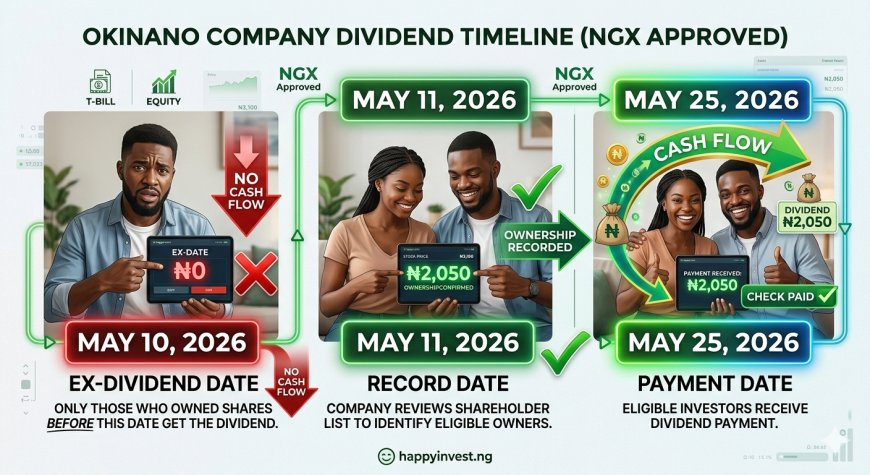
2. Ex-Dividend Date
What It Means
The ex-dividend date is:
The cutoff date to qualify for a dividend.
Simple Rule
-
Buy before the ex-dividend date → you get the dividend
-
Buy on or after → you don’t
What Happens to Price
On the ex-dividend date:
-
The stock price often drops slightly
-
Reflecting the dividend payout
3. Record Date
What It Means
The record date is:
The date the company checks its list of shareholders eligible for dividends.
Key Insight
You don’t need to buy on the record date.
What matters is:
-
Owning the stock before the ex-dividend date
4. Payment Date
What It Means
The payment date is:
When the dividend is actually paid to investors.

Summary of the Timeline
-
Buy shares before the ex-dividend date
-
Company confirms eligibility (record date)
-
You receive money (payment date)
NB dividend has 10% tax
How Dividend Investing Works in Practice
Example
-
You buy shares at ₦100
-
Company pays ₦10 dividend
You earn:
-
₦10 income per share
Even if:
-
Price does not increase
Why Investors Love Dividends
1. Passive Income
You earn money without selling your shares.
2. Stability
Dividend-paying companies are often:
-
Established
-
Profitable
3. Compounding Opportunity
You can:
-
Reinvest dividends
-
Grow wealth faster
4. Protection in Market Downturns
Even if prices fall:
-
You still earn income
How to Pick Good Dividend Stocks
1. Look for Consistency
Choose companies that:
-
Pay dividends regularly
2. Check Dividend Yield
-
Not too low
-
Not unrealistically high
3. Check Payout Ratio
A healthy payout ratio means:
-
The company can sustain dividends
4. Check Earnings Strength
Dividends come from profits.
Look for:
-
Strong earnings
-
Stable revenue
5. Industry Matters
In Nigeria, dividend-paying companies are often in:
-
Banking
-
Telecom
-
Consumer goods
Common Mistakes to Avoid
1. Chasing High Yield Only
High yield may signal:
-
Financial trouble
2. Ignoring Company Fundamentals
A company must:
-
Be profitable
3. Buying Just Before a Dividend Without a Strategy
Prices may adjust after payout.
4. Not Reinvesting Dividends
You lose compounding benefits.
Dividend vs Growth Investing
| Strategy | Focus |
|---|---|
| Dividend Investing | Income |
| Growth Investing | Price increase |
Best Approach
Combine both:
-
Income + growth
Simple Strategy for Beginners
-
Start with strong dividend-paying companies
-
Hold long-term
-
Reinvest dividends
-
Add growth stocks gradually
Real-Life Example
Investor A
-
Focuses only on price
-
Sells frequently
Investor B
-
Buys dividend stocks
-
Earns a steady income
-
Reinvests
Over time:
-
Investor A depends on market timing
-
Investor B builds consistent wealth
Let Your Investments Pay You
Most people work for money.
Dividend investors:
-
Make their money work for them
Because in the end:
The goal is not just to own assets, but to own assets that pay you consistently.