Understanding the NGX Market Cycle: How Smart Investors Position Themselves Throughout the Year
Learn how the Nigerian Exchange (NGX) typically behaves throughout the year. Understand earnings seasons, dividend cycles, profit-taking periods, and how investors can position themselves strategically.
 Yahnic Chigozie
"The stock market rewards preparation more than prediction."
One of the biggest mistakes new investors make in the Nigerian stock market is believing that stocks move randomly.
They don't.
While no one can predict the market perfectly, experienced investors understand that the Nigerian stock market follows certain seasonal patterns throughout the year.
These patterns are driven by:
-
Company earnings reports
-
Dividend announcements
-
Investor expectations

-
Economic policies
-
Government decisions
-
Global events
Understanding these cycles can help investors make better decisions about when to buy, hold, or take profits.
At Happyinvest, we believe investing becomes easier when you understand how the market behaves.
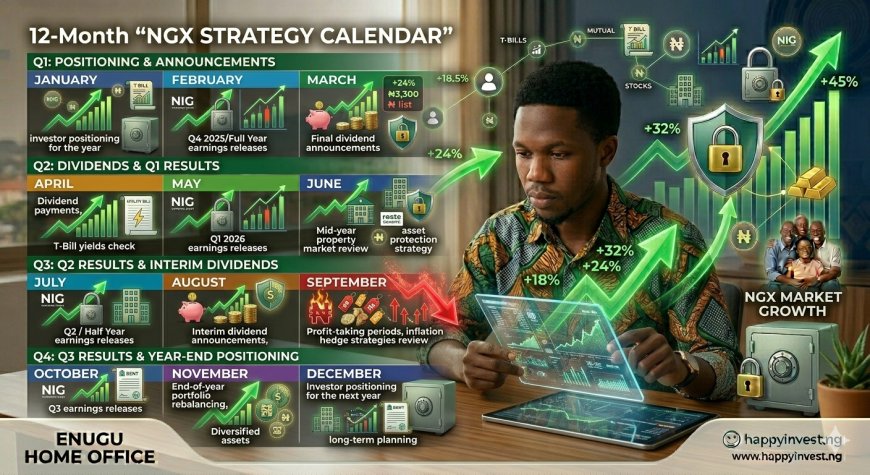
Let's walk through a typical year on the Nigerian Exchange (NGX) and see what opportunities each month may present.
Why Understanding Market Cycles Matters
Imagine walking into a football match in the 80th minute without knowing the score.
You would struggle to understand what's happening.
The same thing happens when investors enter the market without understanding where the market is in its yearly cycle.
The NGX tends to move through predictable phases:
-
Earnings anticipation
-
Dividend excitement
-
Profit-taking
-
Earnings reactions
-
Positioning for the next quarter
Knowing these phases helps investors avoid emotional decisions.
January: Earnings Season Begins
January marks the beginning of one of the most important periods in the Nigerian stock market.
Many companies begin releasing:
-
Unaudited Full-Year Results
-
Earnings Updates
-
Preliminary Performance Reports
Investors start analyzing:
-
Revenue growth
-
Profit growth
-
Dividend expectations
-
Future outlook

Questions investors ask:
-
Did the company grow profits?
-
Can it sustain performance?
-
Will dividends increase?
This often creates excitement, especially in banking and consumer goods stocks.
Smart Investor Move
Start reviewing companies with strong earnings potential before the crowd fully reacts.
February and March: Dividend Season Arrives
This is often one of the most exciting periods on the NGX.
Companies release:
-
Audited Financial Statements
-
Dividend Announcements
Investors now have confirmation of:
-
Earnings performance
-
Dividend payments
-
Business outlook
Stocks with attractive dividends often begin attracting more attention.
Many investors buy shares specifically to qualify for dividend payments.
Sectors to Watch
-
Banking
-
Consumer Goods
-
Agriculture
-
Industrial Goods
Smart Investor Move
Focus on dividend quality, not just dividend yield.
A sustainable dividend is often better than an unusually high one.
April: Dividend Positioning and Q1 Expectations
April is often characterized by investors positioning themselves for dividend qualification dates.
At the same time:
-
First Quarter (Q1) expectations begin building.
Investors start asking:
"Can this company continue its strong performance?"
The market often rewards companies expected to deliver solid Q1 numbers.
Smart Investor Move
Look beyond dividends.
Focus on businesses with growing earnings potential.
May: Q1 Results Drive Market Reactions
This is when many companies release their Q1 reports.
The market now receives actual data.
Not expectations.
Not rumors.
Facts.
Strong earnings often push stocks higher.
Weak earnings can trigger selling pressure.
What Investors Watch
-
Revenue growth
-
Profit margins
-
Cost management
-
Outlook for the rest of the year
Smart Investor Move
Focus on companies showing consistent earnings growth rather than one-off profits.
June: The Quiet Month
June is traditionally one of the quieter periods in the market.
Most dividend excitement has faded.
Q1 earnings have already been released.
Few major catalysts remain.
The result?
Profit-taking often increases.
Many investors lock in gains accumulated earlier in the year.
Market activity may depend largely on:
-
Government policy announcements
-
Acquisitions
-
Mergers
-
Economic reforms
-
Interest rate decisions
Smart Investor Move
Avoid panic when prices pull back.
Corrections often create opportunities.
July: Market Weakness Continues
July often continues the slower trend that begins in June.
Profit-taking may persist.
Investors begin shifting focus toward:
-
Half-Year (H1) Results
-
Second Quarter (Q2) Earnings
The market enters a waiting phase.
Smart Investor Move
Prepare a watchlist of quality companies before earnings season returns.
August: Q2 Results Revive Market Interest
August is another important earnings month.
Many companies release:
-
Q2 Results
-
Half-Year Results
Some companies may also announce:
-
Interim Dividends
This often reignites investor interest.
Strong results can trigger fresh buying.
Sectors That Often Benefit
-
Banks
-
Telecommunications
-
Consumer Goods
Smart Investor Move
Watch for companies growing both earnings and cash flow.
September: Cooling-Off Period
After the excitement of earnings season, markets often cool down.
Profit-taking returns.
Investors begin reassessing valuations.
Stocks that rallied strongly may experience pullbacks.
However, major economic developments can alter this pattern significantly.
Large projects such as the Dangote Refinery, major reforms, or significant policy announcements can create market-wide effects.
Smart Investor Move
Review portfolio performance and rebalance if necessary.
October: Waiting for Q3 Results
October often experiences another round of profit-taking.
Investors begin waiting for:
-
Third Quarter (Q3) Results
Market momentum may slow as investors await fresh information.
Toward the end of the month, some companies begin releasing Q3 numbers.
Smart Investor Move
Look for companies that have consistently exceeded expectations throughout the year.
November: Q3 Earnings Season
November is another major reporting month.
Companies release Q3 reports.
Investors analyze:
-
Nine-month earnings performance
-
Growth trends
-
Full-year expectations
Strong Q3 numbers often influence year-end positioning.
Smart Investor Move
Focus on businesses likely to finish the year strongly.
December: Calm Before the Next Cycle
December is usually quieter.
Many investors:
-
Lock in profits
-
Rebalance portfolios
-
Prepare for the following year
Attention gradually shifts toward:
-
Full-year performance
-
Dividend expectations
-
January earnings season
The cycle begins again.
Smart Investor Move
Use December to prepare, not speculate.
Research potential opportunities before the earnings season starts.
Factors That Can Change the Cycle
While the NGX follows certain patterns, no cycle is guaranteed.
The market can react strongly to unexpected developments.
Examples include:
Government Policies
-
Tax reforms
-
Exchange rate policies
-
Banking regulations
Interest Rate Decisions
Changes in interest rates can affect investor sentiment significantly.
Global Events
Examples include:
-
Wars
-
Oil price shocks
-
Global recessions
-
Trade disputes
Major Listings
Large companies entering the market can reshape investor attention.
Examples from history include major banking consolidations, telecom listings, and large industrial companies.
How Smart Investors Use the NGX Cycle
Successful investors don't use the market cycle to predict every movement.
Instead, they use it to understand:
-
Investor behavior
-
Market expectations
-
Earnings seasons
-
Dividend periods
The cycle helps answer an important question:
"What is the market currently paying attention to?"
Knowing that can give investors an edge.
The Happyinvest Perspective
At Happyinvest, we believe understanding the market cycle helps investors become more patient and strategic.
Many beginners buy when excitement is highest and sell when fear is greatest.
Experienced investors often do the opposite.
They understand:
-
January to May is often driven by earnings and dividends.
-
June and July can bring profit-taking.
-
August and November are earnings-driven periods.
-
December is often a preparation month.
Understanding these patterns doesn't guarantee profits.
But it helps investors make more informed decisions.
Final Thoughts
The Nigerian stock market is not random.
Every year, investors react to earnings reports, dividends, economic policies, and market sentiment.
Understanding the NGX market cycle can help you:
-
Stay patient
-
Reduce emotional investing
-
Identify opportunities
-
Position yourself strategically
Remember:
Successful investing is not about knowing what will happen tomorrow.
It's about understanding how markets typically behave and being prepared when opportunities appear.
Because in investing, preparation often beats prediction.
Check below, we have a gift for you, a PDF document