Financial Diagnosis: Everything You Need to Know Before You Start Investing
Thinking about starting to invest in Nigeria? Before you touch any app or transfer any money, read this. Happyinvest's complete financial diagnosis guide walks you through 6 critical self-assessment areas, 3 investor profiles, and 10 questions every Nigerian investor must answer first. Start investing the right way with full clarity about who you are and what you need.
 Yahnic Chigozie
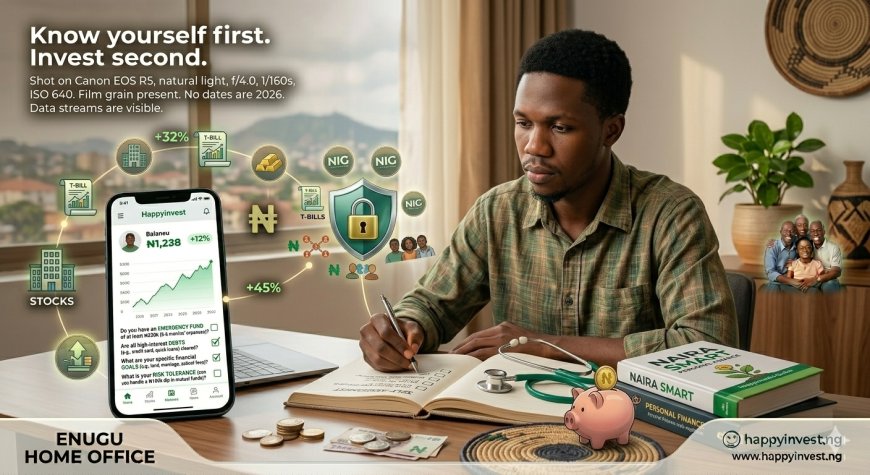
Making Money Simple. Building Wealth Daily.
So, you've decided to start investing.
Maybe you've been seeing posts on Instagram about people growing their money on Bamboo. Maybe your colleague mentioned their Cowrywise portfolio has been doing well. Perhaps you read one of our previous articles here on HappyInvest and something resonated.
Whatever brought you here, welcome. Genuinely. The fact that you want to invest is already one of the most important decisions you can make for your financial future.
But before you download any app, transfer any money, or buy any stock, I need to talk to you the way a big brother who knows money would. The way someone who has seen people make costly, avoidable mistakes would.
Because here's the truth, most investing content skips:
The biggest reason Nigerian beginners lose money when they start investing is not a bad market, not a bad platform, and not bad luck. It's starting before they are ready without first understanding themselves.
They didn't know their own financial situation. They hadn't defined their goals. They didn't understand the risk they were taking. They hadn't built the foundation. And so when things got rough, and markets always get rough, they panicked. They sold. They lost. And they concluded that investing was not for them.
It was for them. They just started without a diagnosis.
A doctor doesn't prescribe medicine before running tests. An architect doesn't build without blueprints. A coach doesn't develop a training plan without first assessing the athlete's fitness level.
And a smart investor doesn't invest without first running a financial diagnosis, an honest, clear-eyed assessment of where they stand, what they want, what they can handle, and who they are as an investor.
That's what we're doing today. Together.
Grab a pen. Some of these questions are going to make you write.
What Is a Financial Diagnosis?
A financial diagnosis is a structured self-assessment that every investor should complete before making their first investment.
It answers six crucial questions:
Where does my financial health actually stand right now? Why am I investing, and what exactly am I investing in? How much risk can I honestly handle? How much do I actually know about what I want to invest in? How much money do I genuinely have to invest? Do I have the time and discipline this requires?
Your honest answers to these questions determine everything that you should invest in, how much to start with, which platforms to use, how long to stay invested, and what type of investor you actually are.
Skip this, and you're investing blind. Do this, and you're investing with intention.
Let's go through each area.
Diagnosis Area 1: What Does Your Financial Health Actually Look Like Right Now?
Before we talk about investing a single naira, I need you to look honestly at your current financial situation. Because investing on top of a shaky financial foundation is like building a house on sand, it will collapse.
Let me ask you these questions directly. Sit with each one. Answer honestly, not how you wish things were, but how they actually are.
Do you have an emergency fund?
This is money set aside specifically for unexpected situations, such as a sudden medical bill, a job loss, a broken phone or car, or a family emergency. The standard recommendation is 3 to 6 months of your total monthly expenses.
If you earn ₦100,000 and spend ₦85,000 a month, your emergency fund target is ₦255,000 to ₦510,000. Does that exist somewhere accessible right now?
If the answer is no, and for many beginners it isn't, that doesn't mean you can't invest. It means building your emergency fund is your first investment priority. A money market fund on Cowrywise or ARM is perfect for this. It earns 18–22% per annum, it stays liquid within 24–72 hours, and it builds the financial cushion that protects every future investment you make.
Why does this matter so much? Because without an emergency fund, the first unexpected expense forces you to withdraw from your investments, often at the worst possible moment. You sell when prices are low, lock in a loss, and walk away thinking investing doesn't work.
It works. You just needed a cushion.
Do you currently have bad debt?
BNPL apps Carbon, FairMoney, Palmpay loans. Credit balances. High-interest personal loans. Borrowed money from family or friends you haven't cleared.
This is important because if you're paying 10–15% monthly interest on a loan while trying to earn 20% annual returns from investments, you are running a race while someone holds your legs. The math doesn't work in your favour. High-interest debt must be cleared before significant investing begins.
Note: I said bad debt deliberately. A low-interest mortgage or a business loan generating revenue is different. We're talking about consumer debt, money borrowed to spend, not to build.
Are your monthly bills consistently covered?
Not sometimes. Consistently. Rent paid on time. Food taken care of. Transport covered. Data subscription sorted.
If you're regularly falling short on basics before the end of the month, you're not in a stable position to invest. That doesn't mean never it means not yet. First, use the budgeting strategies we've covered in previous articles to stabilize your financial base.
Are you spending more than you earn?
If the money going out is consistently more than the money coming in, investing won't fix that problem. In fact, it might make it worse because you'll end up raiding investments to cover shortfalls, which defeats the entire purpose.
What does your Financial Health Score look like?
Score yourself honestly:
Emergency fund in place, yes or no. No bad consumer debt, yes or no. Monthly bills consistently covered, yes or no. Income exceeds expenses, yes or no.
If you scored 4 out of 4, your financial health is solid. You're ready to proceed with your diagnosis.
If you scored 2 or 3, you can start investing in small, safe amounts while actively fixing the gaps. Money market funds are appropriate at this stage.
If you scored 0 or 1, focus completely on financial stabilization first. Invest in your budget and emergency fund before you invest in any market. That is the most valuable thing you can do with your money right now.
Diagnosis Area 2: Why Are You Investing and What Are You Investing For?
Here's a question that sounds simple but is actually profound:
Why exactly do you want to invest?
Before you answer, let me tell you the wrong answers because they're more common than you'd think.
"Because everyone is doing it." Wrong reason. Investing based on social pressure leads to copying strategies that don't fit your situation.
"Because I want to make quick money." Wrong reason. Investing is not a get-rich-quick vehicle. If quick money is the goal, you'll make risky, impulsive decisions that cost you more than you make.
"Because someone on Twitter said it's good." Wrong reason. Someone else's strategy was built for their goals, their timeline, and their risk tolerance. It may be completely wrong for you.
Now, what are the right reasons?
Right reason 1: A specific goal. "I want to have ₦2 million saved for a down payment on land in 5 years." "I want ₦500,000 as a capital reserve for my business by December next year." "I want to build a retirement fund worth ₦50 million over 20 years."
These are specific, measurable, time-bound goals. When you invest with a specific goal, you know how much you need to invest monthly, which instruments to use, and how long to stay in. Everything becomes clearer.
Right reason 2: Beating inflation. If your money is sitting in a regular savings account earning 4–6% while inflation runs at 25–30%, your purchasing power is quietly declining every month. Investing in instruments that outpace inflation is a completely valid and important reason.
Right reason 3: Building long-term wealth. You want your money to compound over decades and give you financial freedom in your 40s or 50s rather than still working out of necessity. This is one of the best reasons anyone can have.
Right reason 4: Creating passive income. You want investments that pay you dividends from stocks, interest from bonds, and distributions from REITs. You want your money to generate income without you actively working for it.
Write down your real investment goal right now. Be specific. Include a target number and a target date. This goal is your compass; it will guide every investment decision you make from this point forward.
Diagnosis Area 3: How Much Risk Can You Actually Handle?
This is the area where more Nigerian investors go wrong than any other and where the consequences are most expensive.
Risk tolerance is your genuine ability to handle losing money temporarily, emotionally, psychologically, and financially, without making panic decisions that lock in losses.
Let me give you a real scenario to test yours.
Imagine you invest ₦200,000 into a Nigerian stock portfolio in January. By March, the market has dropped, and your portfolio is now showing ₦145,000. You've "lost" ₦55,000 on paper.
What do you do?
Option A: You feel uncomfortable, but you understand this is a normal market fluctuation. You continue contributing monthly. You wait it out. By November, the portfolio had recovered to ₦240,000.
Option B: You panic. The ₦55,000 loss haunts you. You can't sleep. You sell in March to "stop the bleeding." You lock in the ₦55,000 loss permanently and miss the recovery entirely.
Option C: You were using money you needed for rent, so you had no choice but to sell. The loss was not just financial; it disrupted your entire month.
Person A has high risk tolerance and an appropriate investment. Person B has low risk tolerance in a high-risk investment, a mismatch that caused real financial damage. Person C made the most dangerous mistake of all, investing money they needed regardless of their risk tolerance.
The risk tolerance diagnostic questions:
How would you genuinely feel if your portfolio lost 30% of its value in the next 6 months? (Be honest, not the brave answer, the real one.)
Do you have other sources of financial support that this investment is separate from? In other words, can you truly afford to leave this money alone even if it drops?
How many years before you need this money? The longer the timeline, the more risk you can absorb because time allows for recovery.
Are you drawn to investing because of excitement and the thrill of markets moving or because of genuine long-term wealth building? Excitement-driven investing typically leads to high-risk choices and emotional decision-making.
Which of the three risk profiles sounds like you?
Low risk tolerance (Conservative investor): You'd rather earn steady, predictable returns than take chances on big gains. A 20% loss in your portfolio would genuinely stress you out. You're probably investing for a specific goal within 3 years, or you simply can't afford to lose capital. Money market funds, T-bills, and FGN bonds are your world.
Medium risk tolerance (Balanced investor): You understand investing involves ups and downs, and you can handle moderate volatility without panicking, as long as your overall direction is upward. You're investing for 3–7 years. A mix of stocks, fixed income, and dollar assets makes sense for you.
High risk tolerance (Aggressive investor): You genuinely understand market cycles, you have a long timeline (7 years or more), you won't need this money for a long time, and you can see a 30% portfolio drop as a buying opportunity rather than a disaster. Quality stocks, US ETFs, and growth assets are appropriate.
The critical point here: there is no wrong risk profile. What is wrong is having a risk profile that doesn't match your investment choices. A conservative person in an aggressive portfolio will panic and sell. An aggressive person stuck in only money market funds will underperform their goals. Know who you are. Match your investments to that reality.
Diagnosis Area 4: What Do You Actually Know About What You Want to Invest In?
Let me ask you something directly.
If someone put ₦100,000 in front of you right now and said, "invest this in Nigerian stocks," could you explain, clearly and confidently, how those stocks make you money? Could you name three quality Nigerian stocks and explain why they're quality? Do you know what a dividend is and how it's paid? Do you know how to read a basic balance sheet or profit and loss statement? Do you know the difference between a money market fund and a mutual fund?
If the answer to most of those is "not really," that's completely okay. You're here to learn. But it does mean your first investment should be in safe, simple instruments while you build knowledge, not in stocks you don't understand or, worse, in forex or crypto without understanding the market.
Here's a principle I want you to carry forever:
Never invest in something you cannot explain in simple language to a friend.
If you can't explain how it works, you don't understand it. And if you don't understand it, you cannot make good decisions about when to add more, when to hold, when to be concerned, and when to exit. You're essentially flying blind.
The knowledge diagnostic:
Can you explain what a stock is and how you make money from it? Can you explain what a money market fund is and why it's safe? Can you explain what an ETF is and what the S&P 500 tracks? Do you know what inflation is and why it means your savings account is actually losing value? Can you describe at least two investment platforms available to you in Nigeria and what they offer?
If you can answer all five, you have enough basic knowledge to start with appropriate beginner investments and learn as you go. If you can't answer three or more, spend the next 2–4 weeks reading Happyinvest articles and learning before committing any money. The knowledge you build now will protect you from losses that cost far more than the time investment.
The dangerous knowledge traps to avoid:
Following an investment tip from a WhatsApp group without understanding what you're buying. Copying someone's investment strategy without knowing why they made those choices. Investing in crypto because "it's going up" without understanding the specific asset, its fundamentals, or its risks. Putting money in forex with someone who promises managed returns without understanding how forex actually works or verifying their credentials.
Knowledge is the single most protective thing you can have as a beginner investor. Invest in it generously.
Diagnosis Area 5: How Much Money Do You Actually Have to Invest?
This sounds like a simple question. It isn't.
The keyword is not "how much money do you have," it's "how much money do you have to invest."
There's an important distinction:
The money you have to invest is money that will not be needed for anything else during the investment period. It's truly surplus after your needs, wants, emergency fund, and debt repayments are handled.
The money you need is money that's required for bills, food, rent, family obligations, or near-term goals. This money should never be invested in anything that can lose value or that locks it away.
The capital diagnostic questions:
After your monthly budget needs, wants, and savings, how much is genuinely left that you can commit to investing every month? Not theoretically. Realistically, this month.
Is the money you're thinking of investing money you earned and don't need urgently? Or are you thinking of borrowing to invest? Borrowing to invest, especially in volatile assets, is one of the fastest ways to destroy your finances. If the investment drops and the loan interest keeps running, you can end up in serious financial trouble.
Can you commit to investing this amount consistently for at least 12 months? Consistency is what makes investing work. A one-time large investment is far less powerful than the same amount spread over 12 months of consistent contributions.
What is your realistic monthly investment capacity? Write it down. ₦3,000. ₦8,000. ₦25,000. Whatever the number is, own it without shame. There is no amount too small to start.
A note on starting small:
I want to address something I hear often. "I only have ₦5,000 to invest. Is it even worth starting?"
Yes. One thousand times yes.
Here's why. Investing ₦5,000/month, consistently, for 10 years, at 20% annual return, gives you approximately ₦3.8 million. That ₦5,000/month you thought was "too small" becomes a life-changing sum. The amount is not the issue. The habit is.
Start with whatever you genuinely have. Build the habit of consistent investing. Increase the amount as your income grows. That is the formula that works.
Diagnosis Area 6: Do You Have the Time and Discipline This Requires?
Let's be completely real with each other here.
Investing is not passive in the beginning. It requires some level of active attention, especially while you're learning. It requires discipline to move money to your investment account every month, even when life is tight. It requires the patience to watch your portfolio do nothing for months and trust the process anyway. It requires emotional discipline not to panic and sell when the market dips.
These things sound simple. They are not.
The discipline diagnostic questions:
Can you commit to making your monthly investment transfer on the same date every month for the next 24 months, without exception, even when you're tempted to skip?
When your portfolio shows a loss, will you research calmly to understand whether it's a temporary market fluctuation or a genuine problem, or will you react emotionally and make hasty decisions?
Are you prepared to think in years rather than weeks? Real investment returns take time. The expectation of significant returns in 30 or 60 days is a fantasy that leads people into scams. Can you genuinely commit to a 3–5 year minimum for equity investments?
Do you have enough time in your week to check your portfolio quarterly, review your allocation annually, and stay informed about basic financial news? You don't need to be glued to screens, but complete disengagement is also dangerous.
The discipline shortcut that actually works:
Automate everything you possibly can. Set up recurring transfers from your bank account to your investment accounts on the day your salary arrives. When the investment is automatic, you remove the willpower requirement entirely. The decision is made once. After that, it just happens consistently, every month, compounding quietly in the background.
The most disciplined investors I know aren't people with extraordinary willpower. They're people who built systems that make good financial behaviour automatic.

So What Type of Investor Are You?
Based on everything you've diagnosed about yourself across the six areas, you're going to fall into one of three investor profiles. Read each one carefully and be honest about which one describes you most accurately right now.
The Conservative Investor
Profile: You have a shorter investment timeline, 1 to 3 years. You have a specific goal you need money for, and you cannot afford for that money to drop in value significantly. You have low to moderate risk tolerance, and the idea of watching your portfolio lose 20% genuinely distresses you. You might be relatively new to investing and still building your confidence and knowledge base.
What this means for your investments: Your money belongs primarily in capital-preserving, predictable-return instruments. Money market funds yielding 18–22% per annum are your best friend. Treasury bills for fixed periods, where you know exactly what you'll earn. FGN savings bonds for a structured, quarterly-income generating investment. Maybe a small portion, 10–15%, in a balanced mutual fund for slightly more growth.
What to avoid right now: Individual stocks, US equity ETFs, forex, crypto. These instruments require a longer timeline and higher risk tolerance than you currently have. You'll likely access them later as your knowledge grows and your foundation strengthens.
The conservative investor's superpower: You are steady. You don't lose sleep over investments. You make consistent, safe decisions. You build gradually, and your financial safety is never compromised. This is a legitimate, powerful investor profile, not a consolation prize.
The Balanced Investor
Profile: You have a medium timeline, 3 to 7 years. You have defined goals, but they're not immediately urgent. You have moderate risk tolerance; you can handle your portfolio dropping in the short term as long as you understand why and believe in the long-term trajectory. You have a reasonable base of financial knowledge, and you're actively learning more.
What this means for your investments: You can build a genuinely diversified portfolio. A blend of money market funds for stability and liquidity, Nigerian quality stocks or equity mutual funds for naira-denominated growth, dollar-based investments through Bamboo or Risevest for currency protection and global market exposure, and some fixed income for predictability. Roughly: 20% money market, 25% fixed income, 30% Nigerian stocks, 25% dollar assets.
What to avoid right now: Highly speculative positions, unregulated investment schemes, concentrated bets on single assets. Your edge is diversification, and consistency doesn't sacrifice it by chasing hot tips or exciting opportunities that sit outside your knowledge base.
The balanced investor's superpower: You get real growth without extreme volatility. You build the experience and knowledge to become more aggressive over time. Most Nigerian investors in their late 20s to mid-30s with stable income fit this profile, and it's an excellent place to build from.
The Aggressive Investor
Profile: You have a long timeline, 7 or more years. You genuinely don't need this money for a long time, and you can leave it completely alone. You have high risk tolerance; a 30% portfolio drop doesn't make you panic; it makes you think about buying more. You have solid financial foundations: an emergency fund complete, no bad debt, consistent income, and a growing knowledge base of the instruments you invest in.
What this means for your investments: You lean heavily into growth assets. A significant allocation to quality Nigerian stocks, GTCO, MTN Nigeria, Zenith Bank, BUA Foods, and Dangote Cement. A meaningful allocation to US stocks and ETFs S&P 500, Nasdaq ETFs, and strong individual US companies through Bamboo, Chaka, or Trove. REITs for real estate exposure. A smaller allocation to money market funds as a liquidity reserve. Roughly: 10% money market, 35% Nigerian stocks, 30% US stocks and ETFs, 15% REITs, 10% fixed income.
What to watch: Aggression doesn't mean reckless. It doesn't mean putting everything in a single stock or chasing the latest trending investment. It means maximum intentional growth through diversified quality assets over a long timeline. The enemy of the aggressive investor is not volatility, it's impatience and overconfidence.
The aggressive investor's superpower: Time and compounding. If you start at 25 with an aggressive allocation and stay consistent for 25 years, the mathematics of compound interest can produce wealth that is genuinely difficult to explain to people who haven't seen it in action. This is how serious wealth is built.
The 10 Most Important Questions to Ask Yourself Before Investing ₦1
We've covered a lot of ground. Let me distil it into the ten most important questions every aspiring Nigerian investor must be able to answer honestly before making any investment.
Write these down. Answer them. Revisit them every time you consider a new investment opportunity.
Question 1: Do I have an emergency fund of at least 3 months of expenses? If no build that first, in a money market fund.
Question 2: Am I free from high-interest consumer debt? If no clearing of that debt is your highest-priority investment. The return on clearing a 10% monthly loan is higher than almost any legitimate investment return.
Question 3: What specific goal am I investing in? What is the target amount, and when do I need it? If you can't answer this specifically, spend time defining your goal before investing. Vague investing produces vague results.
Question 4: Honestly, how would I react if my portfolio dropped 25% tomorrow? Your honest answer tells you your true risk tolerance. Build your investments around reality, not optimism.
Question 5: Can I clearly explain how this investment makes money? If no learn more before you invest. Confusion is expensive.
Question 6: Am I investing money I genuinely don't need for the duration of the investment? If you cannot find a different source of investment capital, start smaller. Never invest money you'll need urgently.
Question 7: Am I making this investment because I understand it or because of FOMO, social pressure, or someone's recommendation? If it's the latter pause. Understand it first. Then decide.
Question 8: Is the platform or scheme I'm considering regulated by the SEC Nigeria or CBN? If you can't verify this at the SEC, do not invest. Full stop.
Question 9: What is my plan if this investment loses value in the short term? If your plan is to panic and sell, reconsider the investment or reconsider the amount. You need a plan for adversity before adversity arrives.
Question 10: Am I committed to staying consistent with this for at least 12 months, regardless of what happens? If no you're not ready to invest in this. Investing requires a commitment to the timeline, not just the initial decision.
The Green Light When You're Actually Ready to Start
You're ready to start investing when you can genuinely say yes to all of these:
Your emergency fund is in place or actively being built in a safe, liquid account.
Your high-interest consumer debts are cleared, or you have a clear, active plan to clear them.
You have a specific, written investment goal with a target amount and timeline.
You've chosen your investor profile: conservative, balanced, or aggressive, based on honest self-assessment.
You understand at least one investment instrument well enough to explain it to someone else.
You're using money you genuinely won't need for the duration of the investment.
You've verified that any platform you plan to use is SEC or CBN-regulated.
You've set up or planned to set up automatic monthly investments, so consistency doesn't depend on willpower.
You've made peace with the fact that this is a long-term commitment, not a 30-day money-doubling scheme.
If you're nodding at all eight, you're not just ready. You're better prepared than the majority of people who start investing every day. And that preparation is going to show in your results.
Your First Three Moves
Let's end with something concrete. Based on your diagnosis, here are your first three moves depending on where you are.
If your diagnosis shows you're not financially stable yet, open a Cowrywise account today. Start putting money into the money market fund, even ₦2,000/month. Build your emergency fund as your priority investment. Work through the budgeting and debt management steps we've covered in previous Happyinvest articles. Come back to equity investing in 6–12 months with a stronger foundation.
If your diagnosis shows you're financially stable but lacking knowledge, start a 4-week self-education sprint. Read everything on Happyinvest about the investment instruments available in Nigeria. Understand stocks, money market funds, T-bills, and dollar investments before committing to any of them. Open an account and start with your money market fund while you learn that it's safe, it earns well, and it builds the habit. Invest your first ₦5,000–₦10,000 in a simple, low-risk instrument.
If your diagnosis shows you're ready across the board, build your first intentional portfolio based on your investor profile. Conservative: money market funds and T-bills. Balanced: a spread across MMFs, Nigerian stocks, and dollar investments. Aggressive: equity-heavy with strong dollar asset exposure. Automate your monthly contributions. Set a 6-month review date. Start.
Final Word
Here's what I want you to take away from everything we've covered today.
The most successful investors are not the ones who started the earliest or invested the most money first. They're the ones who knew themselves, who understood their financial situation, their goals, their limits, and their strengths before they ever made a single investment.
A financial diagnosis is not a delay. It's not bureaucracy. It's the work that separates investors who build real wealth from investors who have a story about how they "tried investing, and it didn't work."
You now have the complete framework. Six diagnosis areas. Three investor profiles. Ten questions to ask before investing. A clear green-light checklist. And your first three moves.
Do the work. Answer the questions honestly. Build on real ground.
Then invest with confidence because you'll know exactly who you are, what you want, and what you're doing.
At Happyinvest, we don't just help you start investing. We help you start right.
Making Money Simple. Building Wealth Daily.