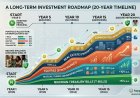
Smart Investing Strategies Every Beginner Must Know
New to investing in Nigeria and don't know where to start? Happyinvest breaks down 10 smart investing strategies every beginner must know with real naira examples, the best investment platforms in Nigeria, how compound interest works, and a simple starter portfolio blueprint. Start building wealth today.
 Yahnic Chigozie

Making Money Simple. Building Wealth Daily.
So somebody told you to "start investing."
Maybe it was a tweet you saw at 2 am. Maybe your friend mentioned how much their Cowrywise portfolio has grown. Maybe you just read our last article on financial independence, and you thought okay, I get the big picture, but what do I actually DO?
That's exactly why we're here today.
Because "start investing" without any further explanation is like telling someone to "start cooking" without telling them what recipe, what ingredients, or what stove to use. Useless advice. And a little annoying.
Today, we're fixing that. This is the investing article I wish someone had given me when I first started, no jargon, no gatekeeping, no "it depends" non-answers. Just the real, practical strategies that work for everyday Nigerians who are ready to make their money grow.
Whether you have ₦5,000 or ₦50,000 to start with, this guide is for you. Let's break it down.
First — What Is Investing, Really?
Before we talk strategy, let's make sure we're on the same page about what investing actually is.
Investing is simply putting your money into something, an asset, with the expectation that it will grow in value over time.
The opposite of investing is spending. When you spend, your money is gone. When you invest, your money goes somewhere it can multiply and come back to you, plus more.
Now, here's the crucial thing most beginners miss: investing is NOT gambling. Gambling is putting money into something random and hoping luck goes your way. Investing is putting money into something based on research, logic, and time, where the odds are genuinely in your favor over the long run.
The Nigerian stock market, for example, has gone through rough patches, but over a 10-year horizon, quality Nigerian stocks have consistently delivered strong returns to patient investors. That's not gambling. That's strategy.
Okay. Now let's talk about how to actually do this.
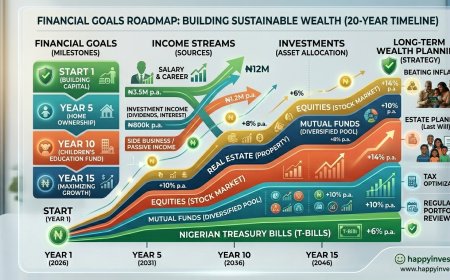
Strategy 1: Define Your "Why" Before You Pick Any Asset
Here's a mistake almost every beginner makes. They open an investment app, see the options for stocks, bonds, mutual funds, dollar funds, and they just pick whatever sounds good or whatever their friend recommended. No clear reason. No plan.
That's backwards. Before you choose a single investment, you need to answer this question: What am I investing FOR?
Your "why" determines everything that you invest in, how long you keep it there, and how much risk you can afford to take.
Let's look at some real Nigerian examples:
If Adaeze is investing to build an emergency fund she might need in 6 months, she should be in something safe and liquid — like a money market fund. Stocks would be wrong here, because markets can dip in the short term, and she might need to withdraw at the worst time.
If Tunde is investing for his child's university education, that's 12 years away, he can afford to take more risk quality stocks, and dollar funds make sense. He has time to ride out any market dips.
If Blessing is investing to buy land in 3 years, she needs a medium-risk, medium-term strategy, perhaps a mix of fixed-income investments and some equity exposure.
Same activity, investing with completely different strategies. Your goal is the compass. Never buy an investment without first knowing exactly what it's working toward.
Take 10 minutes right now and write down your specific investment goals. Give each one a timeline and a naira target. "I want ₦500,000 for a laptop and work equipment in 18 months." "I want ₦2 million saved toward a car in 4 years." "I want a ₦50 million retirement fund in 25 years." Specific. Measurable. Real.
Strategy 2: Understand Risk — It Is Not Your Enemy
A lot of beginners hear the word "risk" and freeze. They become so afraid of losing money that they keep everything in a savings account earning 4% while inflation eats 30% of their purchasing power every year.
That is actually the riskiest thing you can do with your money, the risk of it quietly losing value while sitting still.
Here's how to think about investment risk properly.
Every investment sits somewhere on a spectrum. On one end, you have very low-risk investments like money market funds and government treasury bills. They don't grow spectacularly fast, but they're safe, steady, and predictable. On the other end, you have high-risk investments like individual stocks, crypto, and forex. They can grow very fast, but they can also drop sharply.
The rule is simple: higher potential return always comes with higher potential risk. Anyone promising you high returns with zero risk is lying to you. Full stop.
Your job as a beginner is not to avoid all risk. Your job is to take the right amount of risk for your specific situation, your timeline, and your emotional tolerance.
Here's a practical framework:
Money you will need within 12 months, keep it in very low-risk assets. Money market funds, T-bills, fixed deposits. Don't gamble with money you'll need soon.
Money you won't need for 3–5 years, you can take a moderate risk. A mix of stocks and fixed income makes sense. You have time to recover if there's a market dip.
Money you won't need for 10 or more years, you can afford higher-risk assets like equities and dollar investments, because over that horizon, quality assets almost always recover and grow.

The longer your timeline, the more risk you can afford. The shorter your timeline, the more conservative you should be. This simple rule will save you from a lot of pain.
Strategy 3: Start Small — But Start Now
I want to destroy a very common Nigerian myth today.
The myth is: "I need to have a lot of money before I can start investing."
No. You don't.
You can open a Cowrywise account and start investing with ₦1,000. You can buy shares on the Nigerian Stock Exchange with ₦5,000. You can start a dollar investment on Bamboo with as little as $5. You can contribute to a money market fund with ₦500.
The amount you start with does not matter nearly as much as the fact that you start.
Here's why early starting is so powerful, and I want you to feel this in your chest.
Two people, Chisom and Emeka. Both are 25 years old. Chisom starts investing ₦10,000/month today. Emeka says, "Let me wait until I'm earning more." He starts 5 years later at 30, also investing ₦10,000/month. Both invest until they're 55.
Assume a consistent 15% annual return for both.
Chisom, who started at 25, ends up with approximately ₦163 million. Emeka, who started at 30, ends up with approximately ₦79 million.
Same monthly amount. Same return. The only difference is five years.
The five-year head start cost Emeka ₦84 million. Eighty-four million naira is gone because he waited.
Do not wait. Start with whatever you have. Increase it as you grow. But start TODAY.
Strategy 4: Diversify — The Only Free Lunch in Investing
There's a famous saying in investing that diversification is "the only free lunch," meaning it's one of the few ways to reduce your risk without sacrificing your expected return.
Here's what diversification means in simple terms: don't put all your eggs in one basket.
If you invest all your money in one company's stock and that company collapses, you lose everything. But if you spread your money across 10 different companies in different sectors, one company's collapse barely dents your portfolio.
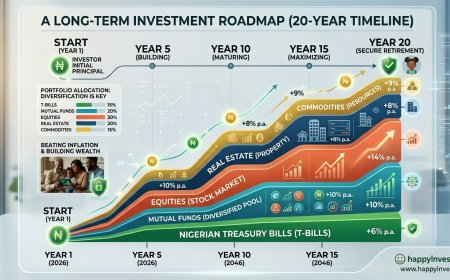
For a Nigerian beginner in 2026, here's what a diversified portfolio actually looks like:
A portion in naira-based safe assets. Money market funds earn 18–22% per annum on platforms like Cowrywise, ARM, or Stanbic IBTC. This is your foundation, stable, liquid, reliable.
A portion of Nigerian stocks. Buy shares in fundamentally strong, well-established Nigerian companies across different sectors. Banking GTCO, Zenith, Access. Telecoms MTN Nigeria, Airtel Africa. Consumer goods: Dangote Cement, BUA Foods, Nestle Nigeria. These companies have track records. They pay dividends. They grow over time.
A portion of dollar-denominated investments. This is critical in Nigeria, and many beginners ignore it to their own detriment. The naira has historically depreciated against the dollar. If all your investments are naira-based, a currency devaluation can wipe out years of gains in real terms. Platforms like Bamboo, Trove, and Rise allow you to invest in US stocks, ETFs, or dollar mutual funds from Nigeria. Even putting 20–30% of your portfolio in dollars protects you significantly.
A portion of government securities. Treasury bills and FGN bonds are government-backed, currently yielding around 20–22% per annum, and very safe. Accessible through your bank, a licensed stockbroker, or platforms like I-invest. Perfect for the conservative portion of your portfolio.
You don't need millions to do all of this. On ₦30,000/month in investments, you can split across all four categories and still be building a genuinely diversified portfolio.
Strategy 5: Understand the Investment Vehicles Available to You
Let's go deeper into the actual options available to you as a Nigerian investor. Think of these like different vehicles, each one goes to the same destination (wealth building), but at different speeds and along different roads.
Money Market Funds (MMFs). These are professionally managed funds that pool money from many investors and invest in short-term, low-risk instruments like treasury bills and commercial paper. Think of it like a super-charged savings account. In Nigeria right now, top MMFs are yielding 18–22% per annum. You can withdraw within 24–72 hours. They're liquid, safe, and regulated by the SEC. Platforms: Cowrywise, ARM Investment Managers, Stanbic IBTC, and United Capital. Minimum investment: as low as ₦1,000. Perfect for: emergency fund, short-term savings, parking cash you'll need within a year.
Stocks (Equities). When you buy a stock, you're buying a tiny ownership stake in a real company. If the company grows and makes more profit, your share value rises. Many companies also pay dividends, a portion of their profits distributed to shareholders. Nigerian stocks are bought through licensed stockbrokers or digital platforms like Chaka, Trove, and the traditional Nigerian Exchange Group (NGX). Minimum investment: around ₦5,000. Perfect for: medium-to-long-term wealth building (5 years and above). Key risk: markets fluctuate. Don't panic when prices dip. The investors who stay through dips are the ones who win.
Dollar Investments. Through platforms like Bamboo, Trove, and Rise, you can invest in US-listed stocks (Apple, Microsoft, Tesla, Amazon, S&P 500 ETFs) directly from Nigeria. Your returns are in dollars, which protects you from naira devaluation. Minimum investment: as low as $5. Perfect for: long-term wealth building and a naira hedge. Important note: platforms must be SEC-licensed. Always verify before depositing money anywhere.
Treasury Bills and FGN Bonds. Treasury bills are short-term government debt instruments that you lend money to the Nigerian government for 91, 182, or 364 days and earn interest at the end. FGN Bonds are longer-term (2–30 years). Both are effectively risk-free in naira terms; the Nigerian government has never defaulted on its domestic debt. Current yields: around 20–22% per annum. Access through: your bank, licensed stockbrokers, or the Debt Management Office (DMO). Perfect for: conservative investors, retirees, and anyone who needs predictable, stable returns.
Real Estate Investment Trusts (REITs). A REIT is a company that owns income-generating real estate, such as shopping malls, office buildings, and housing estates. When you buy units in a REIT, you earn a share of the rental income and property appreciation without buying physical property. Available on the Nigerian Exchange: UPDC REIT, SFS REIT. Minimum investment: a few thousand naira. Perfect for: real estate exposure without the massive capital requirement of buying physical property.
Mutual Funds. A mutual fund pools money from many investors, and a professional fund manager invests it according to a stated strategy equity fund, a balanced fund, a bond fund, etc. Great for beginners who want professional management without choosing individual stocks. Available through most Nigerian asset management companies. Minimum investment: varies, typically ₦5,000–₦50,000. Perfect for: beginners who want diversification without active management.
Strategy 6: Learn the Power of Dollar-Cost Averaging
This is one of the most powerful and underused strategies for beginner investors, and it requires almost zero skill or timing.
Dollar-cost averaging (DCA) simply means: invest a fixed amount at regular intervals, regardless of what the market is doing.
Instead of trying to "time the market" by waiting for the perfect moment to buy, you just invest consistently. Every month, on the same date, the same amount goes in. When prices are high, your fixed amount buys fewer units. When prices are low, it buys more units. Over time, your average cost per unit tends to be lower than if you had tried to time things perfectly.
Let's make this Nigerian and real.
Say you invest ₦10,000 into a Nigerian stock fund every month for 12 months. In some months, the market is up and your ₦10,000 buys fewer units. In other months, the market dips, and your ₦10,000 buys more units at a discount. At the end of 12 months, you've consistently accumulated units across different price points. This smooths out the volatility dramatically.
The beauty of DCA is that it removes emotion from investing. You don't need to watch the market nervously every day. You don't need to debate whether now is a "good time." You just invest consistently, on schedule, and let time do the heavy lifting.
Set up a recurring investment on Cowrywise or Bamboo. Choose your amount. Choose your date ideally, the day after your salary arrives. Set it. Forget it. Let it compound.
Strategy 7: Automate Everything You Can
Here's something real I want you to sit with: willpower is not a reliable financial strategy.
You will have months where life is hard. Where the money feels tight. Where that ₦15,000 you planned to invest feels very tempting for a new pair of shoes or a weekend outing. And in that moment, if investing requires a deliberate decision, you will often choose the shoes.
This is not a character flaw. It's human psychology. We are all wired to prefer immediate pleasure over long-term benefit. The solution isn't to "try harder." The solution is to remove the decision entirely.
Automate your investments so the money moves before you can spend it.
Most Nigerian investment platforms: Cowrywise, Piggyvest, Bamboo, and Stanbic IBTC allow you to set up automatic recurring investments. You choose the amount, the frequency, and the date. The money moves automatically. You never have to make the decision again.
This single habit automation is responsible for more investment success stories than any hot stock pick or market timing strategy. It turns investing from something you "try to do" into something that simply happens, like rent.
Set it up this week. You'll thank yourself in five years.
Strategy 8: Review Your Portfolio — But Don't Obsess Over It
There's a big difference between being an engaged investor and being a nervous wreck.
Beginners often make one of two mistakes. Either they never look at their portfolio at all and have no idea how their investments are performing, or they check their portfolio every single day and panic every time a number turns red.
Both extremes are harmful.
Here's the right approach: check your portfolio once a quarter, every 3 months. Review whether your investments are performing broadly in line with expectations. Check whether your allocation (the split between stocks, bonds, dollar assets, etc.) has drifted significantly from your original plan. Rebalance if necessary, meaning if one asset class has grown a lot and now represents a bigger slice of your portfolio than intended, trim it slightly and redirect to underweighted areas.
What you should NOT do is panic when the market dips. Markets go down. That is normal. That is guaranteed to happen. The investors who panic and sell during dips lock in their losses and miss the recovery. The investors who stay calm, keep contributing, and wait are the ones who end up wealthy.
A useful mindset shift: when the market goes down, your investments are on sale. If you were planning to buy more units anyway, a dip is actually good news. You're buying at a discount.
Think of it like buying rice. If the price of rice dropped by 20% today, you wouldn't panic and throw away the rice you already have. You'd probably buy more. Apply that same logic to your investments.
Strategy 9: Protect Yourself From Scams — This Is Not Optional
I cannot write an investing article for Nigerians without addressing this directly. Because this is where so many people get destroyed, and it breaks my heart every single time.
Nigeria has a massive problem with investment fraud. Ponzi schemes, fake forex accounts, "investment groups" promising 50% monthly returns, cryptocurrency projects that vanish overnight, fake stockbrokers who disappear with your money.
These scams specifically target people who are new to investing and eager to grow their money. They use exactly the right words,"guaranteed returns," "risk-free," "insider strategy," "limited slots," to make it sound both exclusive and safe. It is never safe.
Here are the rules. Treat them like gospel.
If anyone promises you guaranteed returns above 25–30% per annum on a naira investment, it is very likely a scam or unsustainably risky. Legitimate regulated investments are transparent about their realistic returns.
Always verify that a platform is registered with the Securities and Exchange Commission (SEC) Nigeria or the Central Bank of Nigeria (CBN). The SEC website has a list of licensed operators. Check it before sending any money anywhere.
If a WhatsApp group is running an "investment scheme," it is almost certainly a Ponzi. Real investment companies have websites, physical addresses, licensed personnel, and regulatory filings. WhatsApp groups have none of that.
Never invest money you cannot afford to lose completely into any single investment, especially unregulated ones. This rule alone will save you from catastrophic loss.
When in doubt, don't. There will always be another opportunity. Your capital is precious. Protect it.
Strategy 10: Invest in Financial Education — Continuously
Here's the investing strategy that most people forget to mention: invest in your own knowledge.
The more you understand about money and investing, the better decisions you make. The better decisions you make, the faster you build wealth. The faster you build wealth, the sooner you reach financial independence. It all flows from understanding.
Some resources available to you right now, most for free:
Happyinvest (obviously), we're here every week with practical, Nigeria-specific financial education. Bookmark us. Subscribe to our newsletter.
Books that have shaped thinking about wealth building globally include titles like "The Psychology of Money" by Morgan Housel (available on Okada Books and other platforms). Simple language, profound insights about how money really works.
YouTube: search for Nigerian personal finance creators who are teaching real, practical content. There is more free financial education available today than ever before in history.
The SEC Nigeria and CBN websites provide information on regulations, verifying platforms, and staying informed about the official financial landscape.
The more you learn, the less you can be deceived. The more you learn, the more confident and decisive you become as an investor. Knowledge literally pays you dividends.
Putting It All Together — Your Beginner Investment Starter Kit
Let's end with something practical. If you are a complete beginner with ₦20,000/month to invest, here is a simple, balanced approach to get started immediately.
Put ₦8,000 in a money market fund. Use Cowrywise or ARM. This is your base safe, liquid, earning well. If your emergency fund is not yet complete, this all goes there first.
Put ₦6,000 in Nigerian stocks or a Nigerian equity mutual fund. Pick fundamentally strong companies or use a balanced fund managed by professionals. Think of this as your medium-term wealth builder.
Put ₦6,000 in dollar investments. Convert to dollars on Bamboo or Rise and invest in a US index fund like the S&P 500 ETF. This protects you from naira devaluation and gives you global market exposure.
Automate all three transfers to happen on the day your salary arrives. Review quarterly. Increase the amounts as your income grows.
That's it. That's a real, diversified, beginner-friendly Nigerian investment portfolio. No complexity. No confusion. Just a clear, consistent strategy you can build on month by month.
Final Word
Investing is not for a special class of people. It's not reserved for people who went to business school or who have rich parents or who live in Lekki Phase 1.
It's for anyone who decides today, right now, that they want their money to work as hard as they do.
You've read this far. That means you're serious. That means you're ready. Don't let this article be just information. Let it be the beginning of action.
Open that account. Make that first transfer. Start with whatever you have.
The best portfolio in the world is the one you actually start.
At Happyinvest, we're in your corner every step, every naira, every decision.
Making Money Simple. Building Wealth Daily.