Financial Independence: A Step-by-Step Guide for Beginners
Want to achieve financial independence in Nigeria but don't know where to start? This step-by-step beginner's guide from Happyinvest breaks down the 6 levels of financial independence from survival to full freedom with real ₦ examples, practical steps, and a 30-day action plan. Start climbing today.
 Yahnic Chigozie
Making Money Simple. Building Wealth Daily.
Let's be honest with each other for a second.
When you hear "financial independence," what comes to mind? Maybe a rich guy in his fifties, sitting on a yacht somewhere, retired early and living off dividends. Or some tech bro in America who "retired" at 35 and now travels the world.
And your immediate reaction is probably: "That's not for people like me."
I hear you. I really do. Because when you're in Lagos trying to stretch ₦80,000 across rent, food, transport, and family obligations, financial independence sounds like something from another planet.
But here's the truth I want to share with you today: financial independence is not a destination reserved for the wealthy. It's a journey with clear levels that anyone can start, regardless of their current level.
You don't have to be wealthy to begin. You just have to begin.
This guide is for the 23-year-old corper who has just started earning. The 30-year-old salary earner who feels stuck. The student who wants to start smart before the money even comes. The market trader who is hustling daily but doesn't know how to make that hustle turn into wealth.
This is for YOU. Let's go step by step.
What Financial Independence Actually Means
Forget the yacht. Let's bring this home literally.
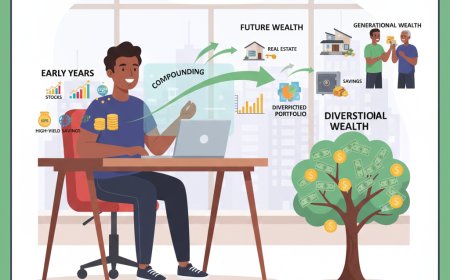
Financial independence, at its core, means this: your money is working hard enough that you are no longer completely dependent on your next paycheck to survive.
It doesn't have to mean you never work again. For most Nigerians, it simply means:
You can handle a ₦50,000 emergency without panicking. You can choose to leave a toxic job because you have savings. You can say no to a bad business deal because you have options. Your money is growing even while you sleep.
That's it. That's the beginning of real financial independence, and it's closer than you think.

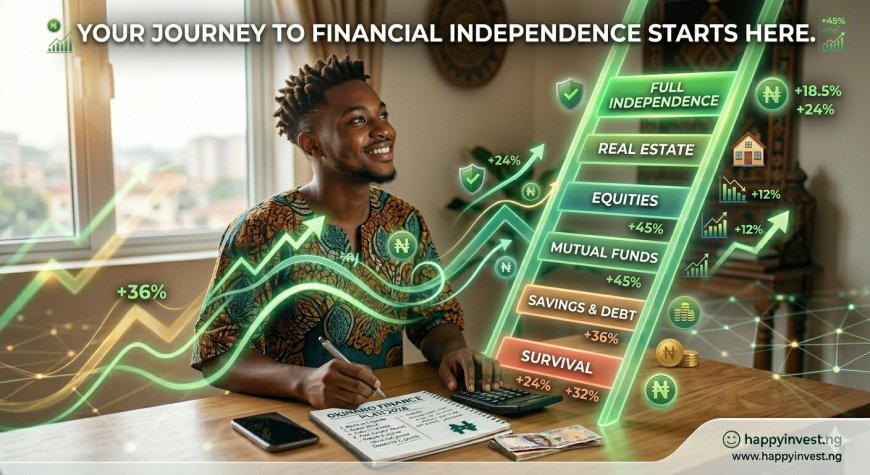
The 6 Levels of Financial Independence (And How to Climb Each One)
Think of this like a ladder. You can't skip rungs. Each level must be built before you climb to the next. The good news? Most Nigerians are closer to Level 2 or 3 than they realize; they just haven't been shown the map.
Level 1: Financial Survival
This is where a lot of people are right now, and there's no shame in admitting it.
Financial survival looks like this: You get paid. Bills come. You pay what you can. The money disappears. You wait for the next salary. Repeat.
There are no savings. No investments. No cushion. The month feels like a tightrope walk on one unexpected bill, and everything collapses.
If this is you right now, your only job at this stage is to do two things:
First, stop the bleeding. Do a raw, honest audit of everything you spend money on. Write it down. Every single thing from recharge cards to food delivery to that DSTV subscription you barely use. You'll probably discover you're losing ₦10,000 – ₦20,000 a month to things you didn't even notice. Cut or reduce anything you can without destroying your quality of life.
Second, find ₦2,000–₦5,000/month that you can commit to saving. That's it. Just that small amount, consistently, every single month. This is not about the amount; it's about building the habit of prioritizing yourself financially.
Opening a Piggyvest or Cowrywise account and automating even ₦2,000/month on salary day is a massive first step. You're no longer spending everything. You're learning to hold something back. That mental shift is the foundation of everything that comes next.
Level 2: Financial Stability
You've climbed the first rung. Now what?
At Level 2, your situation looks like this: Your bills are consistently covered. You're not borrowing to eat or pay rent. You have a small but growing savings habit. You're not rich, but you're not drowning either.
This level is about bringing order to your financial life. Specifically, three things:
Create a real budget and stick to it. Not a vague plan in your head. An actual written budget where every naira has a job before the month starts. Use the 50-30-20 rule as a guide: 50% to needs, 30% to wants, 20% to savings and investments. Adjust the percentages to your reality, but keep that investment percentage protected.
Eliminate bad debt. Not all debt is bad. A loan to buy equipment for your business can be smart. But consumer debt buy-now-pay-later apps, credit card balances, and high-interest personal loans are a wealth killer. Every month you carry that debt, you're paying interest that could have gone into your investment account. Attack the smallest debts first (the snowball method), clear them, then roll that money into clearing the next one. When you're debt-free, you'll feel like someone lifted a rock off your chest.
Start tracking your net worth. Your net worth is simply: what you own (savings, investments, assets) minus what you owe (debts). Even if it's a small or negative number right now, know it. Write it down. Track it monthly. Watching it move in the right direction is one of the most motivating things you can do for your financial journey.
Level 3: Financial Safety
This is the level most Nigerians have never reached, but it's completely within reach.
At Level 3, you have a fully funded emergency fund. That means 3–6 months of your total monthly expenses, sitting in a liquid account, earning interest, waiting for a crisis. You also have zero high-interest consumer debt.
Why does this matter so much? Because without financial safety, every single investment you make is fragile. The moment something goes wrong, job loss, health emergency, car breakdown, family obligation, you're forced to liquidate your investments at the worst possible time. Your wealth resets to zero. Over and over again.
The emergency fund is the insurance that protects your investments. It's the thing that allows you to leave your money invested and let compound interest do its work without interruption.
Here's how to build it in Nigeria in 2026:
Open a dedicated money market fund account, Cowrywise, ARM Money Market Fund, or Stanbic IBTC. These accounts are earning 18–22% per annum on your money currently, which is far better than a savings account, and the money remains accessible within 24–72 hours. This is not your investment account. This is your safety account.
Calculate your monthly expenses honestly. If you spend ₦80,000/month, your emergency fund target is ₦240,000–₦480,000. Set that as your goal, break it down into monthly targets, and automate your contributions.
Once this fund is full, do not touch it except for genuine emergencies. Borehole repairs, yes. New sneakers, absolutely not.
Level 4: Growth Mode
Now we're building. You have a budget that works. You have no bad debt. You have your emergency fund. Now and only now do you shift focus to aggressive wealth building.
This is where your money starts working for you, not just sitting.
Growth mode means you are consistently investing a portion of your income every single month into assets that grow. Let's talk about what that looks like practically for a Nigerian beginner in 2026.
Start with what you can afford and increase over time. If you can only invest ₦5,000/month right now, start with ₦5,000. Aim to increase it by ₦1,000–₦2,000 every quarter as your income grows or your expenses reduce. The amount matters less than the consistency.
Choose your investment vehicles wisely. For beginners, these are the best places to start in Nigeria right now:
Money market funds (for stability and liquidity) are earning roughly 20% per annum, better than any savings account. This is your lowest-risk entry point.
Nigerian stocks through a licensed platform like Chaka, Trove, or a registered stockbroker give you ownership in Nigerian companies. Focus on fundamentally strong companies: Dangote Cement, MTN Nigeria, GTCO, Zenith Bank, and BUA Foods. These have historically delivered strong long-term returns.
Dollar investments through platforms like Bamboo or Rise protect you from naira devaluation. You can invest in US stocks or dollar mutual funds from as little as $5. Even $20/month adds up significantly over 5–10 years.
Government securities, treasury bills, and FGN bonds are government-backed, currently yielding around 20–22% per annum, and very safe. Access them through your bank or a licensed broker.
The key discipline at this level: Never raid your investments. When the market dips and your portfolio is showing a loss, do not panic and sell. That's the worst thing you can do. Dips are normal. Over time, quality investments always recover and grow. Your job is to stay in the game and keep contributing.
Level 5: Financial Freedom
This is where the magic really starts.
At Level 5, your investment portfolio is significant enough that you have genuine options. Your side hustle or business is generating meaningful income. Your passive income dividends, interest, and business profits are covering a real portion of your monthly expenses.
You're not fully free yet, but you feel it coming. You have breathing room. You make financial decisions from a position of strength, not desperation.
The key focus at this level is on two things: scaling your income streams and optimizing your investment returns.
On income streams: By the time you reach Level 5, you should have at least 2–3 income sources. Your primary job or business. A skill-based side hustle. And investment returns. The goal now is to grow each of these and potentially add a fourth, something more passive, like an online business, rental income, or a product you create once and sell repeatedly.
On investment optimization: As your portfolio grows, you start to think about more sophisticated strategies. Asset allocation: how much in stocks vs bonds vs real estate vs dollar assets. Tax efficiency using tax-advantaged accounts where available. Rebalancing periodically adjusting your portfolio back to your target allocation when one asset class grows disproportionately.
At this level, it may be worth speaking to a certified financial planner in Nigeria. Not a random "investment advisor" on WhatsApp, but an actual licensed professional. The SEC Nigeria has a list of registered advisors. A few thousand naira for proper guidance can save you millions in mistakes.
Level 6: Full Financial Independence
This is the summit. The goal.
At Level 6, your passive income money that comes in whether you work or not is enough to cover your total monthly expenses. You work because you want to, not because you have to. Your investments are generating dividends, your properties are generating rent, and your business runs without you being present every day.
This is the life where you wake up in the morning, and your money has already been working for the past 8 hours while you slept.
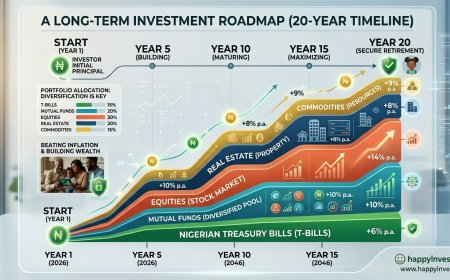
Now, let's be real, Level 6 takes time. For most people, it's a 10–20 year journey of consistent discipline. But it's not unreachable. Thousands of Nigerians have already done it. And every single one of them started somewhere at the bottom of this ladder.
The question is never "is this possible for me?" The question is, "Am I willing to start and stay consistent?"
The 5 Rules That Apply at Every Single Level
Regardless of where you are on the ladder, these five principles always apply:
Rule 1 — Pay yourself first. Before rent, before food, before anything else, a portion of your income goes to savings or investment. Automatic. Non-negotiable.
Rule 2 — Avoid lifestyle inflation. Every time your income increases, resist the temptation to immediately upgrade your lifestyle to match. If your salary jumps from ₦80,000 to ₦120,000, increase your investment first. Then adjust your lifestyle slightly. The gap between income and lifestyle is where wealth lives.
Rule 3 — Never invest money you don't understand. If someone shows you an investment opportunity and you can't explain clearly how you make money from it, walk away. Most investment scams in Nigeria work because people want high returns without understanding the risk. Confusion is expensive. Take time to understand before you commit.
Rule 4 — Think long term, always. Nigeria's economic environment is volatile. Inflation spikes. Exchange rates swing. Political uncertainties come and go. But over 10–20-year periods, quality assets in quality investments grow. Don't let short-term noise destroy your long-term strategy.
Rule 5 — Surround yourself with people who think about money correctly. This is underrated. If all your friends think saving is pointless, pressure you to spend on outings every weekend, and mock people who invest, your financial journey will be 10 times harder. Find communities of people building wealth. Happyinvest exists for exactly this reason.
Common Mistakes Beginners Make (And How to Avoid Them)
Let me save you some pain by naming the mistakes that derail most people at the beginning.
Trying to invest before building an emergency fund. This is backwards. If you don't have a financial cushion and an emergency strikes, you'll liquidate your investments at the worst time. Build the safety net first.
Chasing high returns without understanding risk. Every week in Nigeria, someone is promoting a new "investment" promising 50% in 30 days. If it sounds too good to be true, it always is. The CBN would never allow a legitimate institution to offer those returns. These are Ponzi schemes, and they destroy people financially. Stick to regulated, licensed platforms.
Saving in a regular savings account and calling it investing. If your bank savings account is paying you 4–6% while inflation is running at 30%+, you are losing purchasing power every month. Your money needs to be in assets that outpace inflation. Money market funds, stocks, and dollar assets are not just a savings account.
Giving up after a setback. You'll have bad months. You'll make a mistake. An investment won't perform as expected. Life will hit you, and you'll have to dip into savings. This doesn't mean you've failed; it means you're human. The only financial mistake you can't recover from is quitting entirely.
Waiting for the "right time" to start. There is no right time. The market will always feel uncertain. Your salary will always feel inadequate. Something will always feel in the way. The right time was yesterday. The second right time is now.
Your First 30-Day Action Plan
You've read this far. That already puts you ahead of most people. Now let's make sure this information converts into action.
Here is exactly what to do in the next 30 days:
In your first week, identify which level of the ladder you're currently on. Be honest. Then download your last 30 days of transactions and categorize every single expense. Know your numbers before anything else.
In your second week, set up a budget for next month based on what you discovered. Assign every naira a job. Find the "bleeding" in the expenses you can reduce and plug those gaps.
In your third week, open a dedicated savings account if you don't have one. Cowrywise or Piggyvest work perfectly. Set up an automatic transfer of whatever you can manage, even ₦3,000/month, to happen on your next salary day. This is non-negotiable.
In your fourth week, set a specific financial goal for the next 12 months. Not "save more money." A real, measurable target. "I will have ₦150,000 in my emergency fund by December." "I will start investing ₦10,000/month by April." Specific goals become plans. Vague intentions stay wishes.
Then repeat. Month after month. Year after year.
The Bottom Line
Financial independence is not a privilege. It's a discipline.
It's built in the quiet moments when you choose to transfer money to your investment before you spend it. When you say no to an impulse purchase that would have felt good for a day. When you study a financial concept on a Saturday morning instead of sleeping in. When you stay consistent, even when the results feel slow.
Nobody builds financial independence all at once. They build it one decision, one month, one year at a time.
You are reading this article. That means you care. That means you're thinking about your future. That puts you in a small, serious group of Nigerians who are choosing to build differently.
Don't let this be just another article you read and forget. Pick one action from today's guide and do it before the week ends.
We're here, walking this road with you.
Making Money Simple. Building Wealth Daily.