
Difference Between Shares, Stocks, and Equities (Explained Simply)
Confused about shares, stocks, and equities? Learn the simple differences and how each term is used in investing and the stock market.
 Yahnic Chigozie
If you’re new to investing, you’ve probably heard these words used interchangeably:
-
Shares
-
Stocks
-
Equities
And you may have wondered:
Are they the same thing?
Or do they mean different things?
The short answer?
They are closely related, but not exactly identical.


Let’s break it down in simple terms.
The Big Picture First
All three words refer to ownership in a company.
When you invest in a company listed on the stock market, you are buying a piece of that business.
That ownership can be described using different terms depending on context.
What Are Equities?
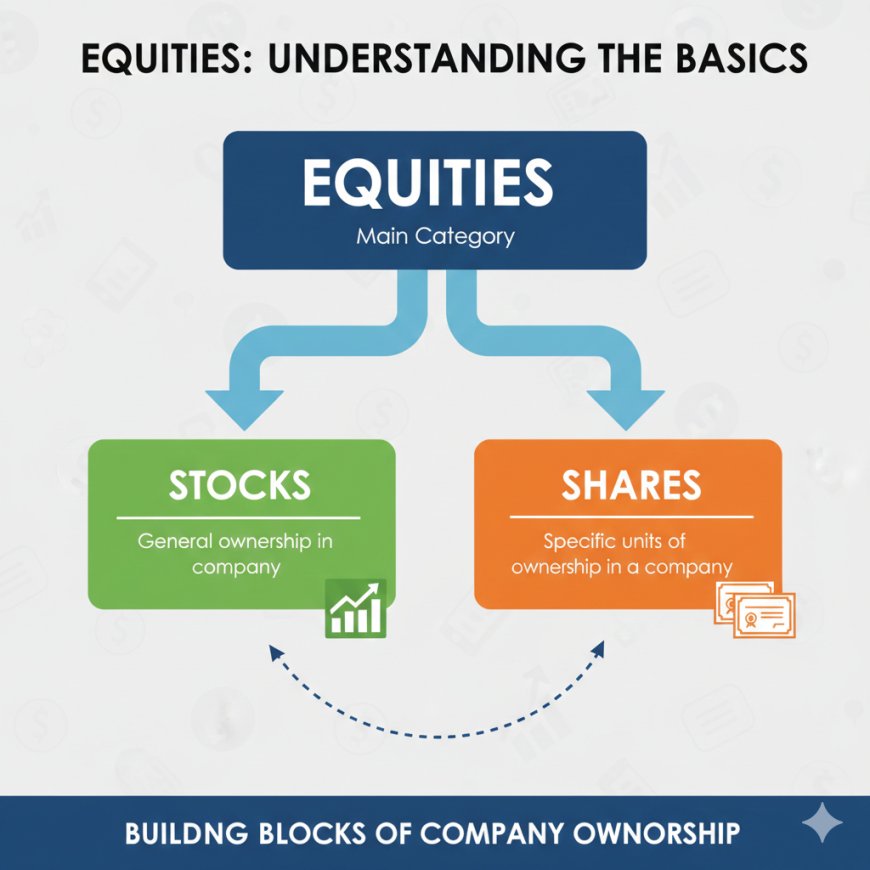
Equities is the broadest term.
It refers to ownership in a company.
If you own equity, you own a portion of that business and may benefit from:
-
Dividends
-
Capital appreciation (price increase)
-
Voting rights
In finance, “equities” is often used in formal or professional discussions.
For example:
-
“I invest in equities.”
-
“The equity market performed well.”
So think of equity as the category.
What Are Stocks?
Stocks are a general term used to describe ownership in one or more companies.
If someone says:
“I own stocks.”
It means they own ownership interests in companies.
“Stock market” also refers to the marketplace where these ownership interests are traded.
In everyday conversation, “stocks” and “equities” often mean the same thing.
What Are Shares?
Shares are the specific units of ownership.
If equity is the category, and stock is the general concept, shares are the actual pieces.
For example:
If a company has 1,000,000 shares outstanding and you own 10,000 shares, you own a portion of that company.
Shares are measurable.


You don’t buy “equity” in vague terms.
You buy a certain number of shares.
Simple Comparison Table
| Term | Meaning | How It’s Used |
|---|---|---|
| Equities | A broad term for ownership in companies | Used in formal finance language |
| Stocks | General term for ownership investments | Used in everyday conversation |
| Shares | Specific units of ownership | Used when discussing quantity |
Practical Nigerian Example
Let’s say you invest in a company listed on the Nigerian Exchange (NGX).
You purchase:
-
5,000 shares of a bank
What does that mean?
You now:
-
Own shares (specific units)
-
Own stock (general ownership)
-
Own equity (legal ownership in the company)
All three terms apply, just in different ways.
Why the Difference Matters
Understanding terminology helps you:
-
Read financial news confidently
-
Understand investment statements
-
Avoid confusion when speaking to brokers or advisors
-
Interpret market analysis correctly
For example:
If an article says:
“Equities declined due to rising interest rates.”
It means stock prices generally fell.
If your broker says:
“You bought 2,000 shares.”
That refers to your specific ownership units.
Bonus: Types of Shares
While we’re here, it’s helpful to know that shares can be:
1. Ordinary (Common) Shares
-
Voting rights
-
Dividends (if declared)
-
Higher risk, higher potential reward
2. Preference Shares
-
Fixed dividend
-
Priority over ordinary shareholders
-
Usually, limited voting rights
Not all investors pay attention to this difference, but it matters.
Shares, stocks, and equities all relate to ownership in a company.
The difference is mostly about:
-
Language
-
Context
-
Specificity
In simple terms:
Equity = ownership concept
Stock = a general investment term
Shares = specific ownership units
Understanding these basics builds confidence in your investing journey.
At Happyinvest.ng, we believe:
Financial clarity leads to financial confidence.
Keep learning.
Keep investing wisely.