Understanding Financial Statements Without Accounting Stress
Learn how to understand financial statements easily. This guide explains balance sheets, revenue growth, earnings, margins, and valuation ratios in simple terms.
 Yahnic Chigozie

(Balance Sheets, Revenue Growth, Earnings, Margins & Valuation Ratios Explained Simply)
Most people hear words like balance sheet, P/E ratio, or operating margin and immediately feel overwhelmed.
They assume:
“This is for accountants, analysts, or professionals; not me.”
But here’s the truth
You don’t need to be an accountant to understand a business.
You only need to know what really matters and what each number is trying to tell you.
This article breaks down the most important financial indicators in plain English, so you can confidently analyze companies without stress, confusion, or spreadsheets overload.
1. Balance Sheet: What a Company Owns vs What It Owes
Think of a balance sheet like a personal net worth statement.
It answers three simple questions:


-
What does the company own? (Assets)
-
What does it owe? (Liabilities)
-
What belongs to owners? (Equity)
What You Want to See
✔ More assets than liabilities
✔ Manageable debt
✔ Growing equity over time
Simple rule:
If a company cannot survive without constant borrowing, it’s risky.
2. Revenue Growth: Is the Business Actually Growing?
Revenue is the money coming in from sales.
High revenue growth means:
-
Customers want the product
-
Demand is increasing
-
The business model is working
What “High” Means
-
Consistent growth over several years
-
Not just one lucky year
-
Growth that beats inflation
💡 Revenue growth shows popularity.
3. Earnings Growth: Is the Company Keeping the Money?
Revenue is nice.
Earnings are better.
Earnings growth tells you:
-
The company is controlling costs
-
It’s becoming more profitable
-
Growth isn’t just hype
What to Look For
✔ Revenue going up
✔ Earnings going up faster
💡 A business that grows sales but not profits has a problem.
4. Operating Margin: How Efficient Is the Business?
Operating margin shows how much profit a company keeps after running the business but before taxes and interest.
Example:
-
₦100 in sales
-
₦30 operating profit
-
Operating margin = 30%



Why High Is Good
-
Strong pricing power
-
Efficient operations
-
Competitive advantage
💡 High margins mean the company has control.
5. Valuation Ratios: Are You Paying Too Much?
Great companies can still be bad investments if the price is too high.
That’s where valuation ratios help.
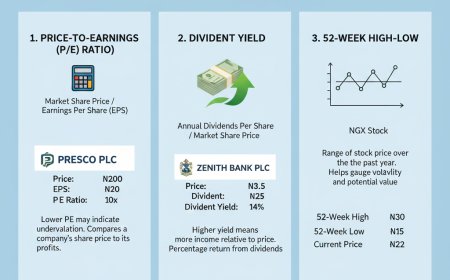
P/E Ratio (Price to Earnings)
Shows how much investors are paying for ₦1 of profit.
✔ Low P/E = possibly undervalued
✖ Very high P/E = high expectations, higher risk
P/B Ratio (Price to Book)
Compares market price to the company’s net assets.
✔ Below 1–2 is often attractive
✖ Too high may mean overpricing
P/S Ratio (Price to Sales)
Useful when earnings are unstable.
✔ Lower P/S = better value
✖ High P/S needs strong future growth to justify it
💡 Valuation tells you whether the opportunity is cheap or expensive.
6. Putting It All Together (The Stress-Free Checklist)
You don’t need to analyze everything.
Just ask:
-
Is revenue growing?
-
Are earnings growing?
-
Are margins healthy?
-
Is debt reasonable?
-
Is the valuation fair or cheap?
If most answers are yes, you’re on the right track.
Understanding financial statements isn’t about memorizing formulas.
It’s about:
-
Seeing patterns
-
Asking the right questions
-
Avoiding obvious risks
Once you simplify the process, investing becomes clearer and far less stressful.
At Happyinvest.ng, our goal is simple:
Make finance understandable, practical, and empowering for everyone.