
Corporate Actions Explained: What Every Nigerian Investor Should Know (And How to Profit From Them)
Learn everything about corporate actions, including mergers, acquisitions, rights issues, bonus shares, stock splits, reverse stock splits, and share buybacks. Discover how Nigerian investors can take advantage of them.
 Yahnic Chigozie
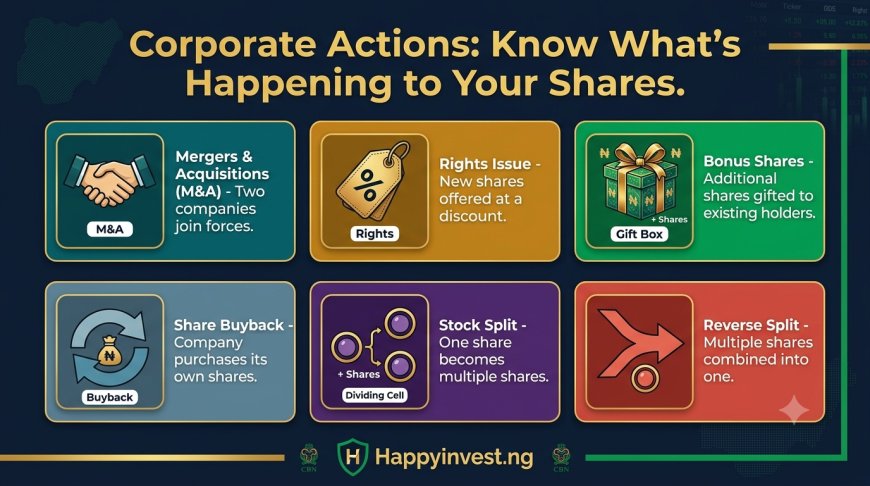
Mergers, Rights Issues, Bonus Shares, Stock Splits, Buybacks & More—Made Simple
Making Money Simple. Building Wealth Daily.
Imagine checking your investment app one morning and discovering that something has changed.
Your company has announced:
-
A rights issue.
-
A stock split.
-
A merger.
-
A share buyback.
Your first reaction?

"Should I be worried?"
Or maybe,
"Should I buy more shares?"
Many investors panic whenever they hear these announcements.
Others ignore them completely.
Unfortunately, both reactions can cost you money.
These events are called corporate actions, and understanding them can help you become a smarter investor.
Some corporate actions create opportunities.
Others require careful decision-making.
In this guide, we'll explain the most common corporate actions in simple English, their advantages and disadvantages, and how investors can respond wisely.
What Are Corporate Actions?
Corporate actions are decisions made by a company's management or board of directors that affect its shareholders.
Some corporate actions change the number of shares you own.
Others change the company's ownership structure.
Some give you new investment opportunities.
Others return money to shareholders.
The important thing is this:
Corporate actions don't automatically mean good or bad news.
The impact depends on why they're happening and the financial health of the company.
1. Mergers & Acquisitions (M&A)
What is it?
A merger happens when two companies combine to become one.
An acquisition happens when one company buys another.
For example:
Company A and Company B decide to combine operations to become a stronger business.
Why Companies Do It
-
Increase market share
-
Reduce competition
-
Expand into new markets
-
Lower operating costs

-
Acquire technology or talent

Advantages for Investors
✅ Larger, stronger companies
✅ Potential increase in profitability
✅ Better economies of scale
✅ Possible increase in share price
Disadvantages
❌ Integration challenges
❌ Cultural conflicts
❌ Job redundancies
❌ Expected benefits may never materialize
Investor Tip
Don't assume every merger is good news.
Read:
-
Why are companies merging?
-
Whether the merger creates real value.
-
The long-term strategy.
Good mergers often strengthen businesses.
Bad mergers can destroy shareholder value.
2. Rights Issues
What is it?
A rights issue allows existing shareholders to buy additional shares before the general public, usually at a discounted price.
Imagine you own:
1,000 shares.
The company announces:
"Buy 1 new share for every 5 shares you already own."
You now have the right—but not the obligation—to purchase additional shares.
Why Companies Do It
Companies raise money to:
-
Expand operations
-
Reduce debt
-
Build new factories
-
Finance acquisitions
-
Improve cash flow
Advantages
✅ Discounted purchase price
✅ Opportunity to increase ownership
✅ Existing shareholders get first priority
Disadvantages
❌ Requires additional money
❌ Share dilution if you don't participate (depending on the structure)
❌ Sometimes signals financial pressure
Investor Tip
Don't participate simply because it's cheaper.
Ask:
-
Why is the company raising money?
-
Will this investment improve future earnings?
-
Is management trustworthy?
Sometimes rights issues create excellent opportunities.
Sometimes they don't.
3. Bonus Shares (Stock Dividends)
What is it?
Instead of paying cash dividends, a company gives shareholders additional shares.
Example:
You own:
100 shares.
The company declares:
1 bonus share for every 10 shares.
You now own:
110 shares.
Why Companies Do It
-
Reward shareholders
-
Improve market liquidity
-
Retain cash for expansion
Advantages
✅ More shares without paying extra
✅ Positive signal if backed by strong business performance
✅ Increased liquidity
Disadvantages
❌ You don't receive cash
❌ Total investment value doesn't automatically increase
❌ Market price usually adjusts after the bonus issue
Investor Tip
Don't assume bonus shares make you richer overnight.
You own more shares—but each share may be worth proportionally less immediately after the adjustment.
What matters is whether the company continues growing over time.
4. Share Buybacks
What is it?
Instead of issuing more shares, a company buys back some of its own shares from investors.
This reduces the total number of shares in circulation.
Why Companies Do It
-
Return value to shareholders
-
Improve earnings per share (EPS)
-
Show confidence in the company's future
-
Use excess cash efficiently
Advantages
✅ Often supports share prices
✅ Can improve earnings per share
✅ May indicate management believes the shares are undervalued
Disadvantages
❌ Uses company cash
❌ Doesn't always improve business performance
❌ Can be poorly timed
Investor Tip
Buybacks are generally more meaningful when:
-
The company has strong profits.
-
It has manageable debt.
-
Management isn't sacrificing future growth just to boost the share price.
5. Stock Splits
What is it?
A stock split increases the number of shares while reducing the price per share proportionally.
Example:
You own:
100 shares worth ₦100 each.
The company announces a 2-for-1 stock split.
You now own:
200 shares worth approximately ₦50 each.
Total value?
Exactly the same.
Why Companies Do It
-
Make shares more affordable.
-
Improve market liquidity.
-
Attract more investors.
Advantages
✅ Lower share price
✅ Easier for smaller investors to buy
✅ Higher trading activity
Disadvantages
❌ Doesn't increase company value
❌ Some investors misunderstand its impact
Investor Tip
A stock split doesn't create wealth.
It simply changes how ownership is divided.
6. Reverse Stock Splits
What is it?
A reverse stock split combines multiple shares into fewer shares.
Example:
You own:
1,000 shares worth ₦2 each.
The company performs a 1-for-10 reverse split.
You now own:
100 shares worth approximately ₦20 each.
Your total investment value stays roughly the same.
Why Companies Do It
-
Increase the share price.
-
Meet exchange listing requirements.
-
Improve the company's public image.
Advantages
✅ Higher share price
✅ May help the company remain listed
Disadvantages
❌ Can signal financial weakness
❌ Doesn't solve underlying business problems
Investor Tip
A reverse split is neither automatically good nor bad.
Focus on:
-
Company earnings.
-
Revenue growth.
-
Debt levels.
-
Management quality.
The business matters more than the share count.
How Smart Investors Take Advantage of Corporate Actions
Instead of reacting emotionally, ask these questions:
Is this action creating long-term value?
Or is it just changing the number of shares?
Is management trustworthy?
A great company with honest leadership is more likely to use corporate actions wisely.
Is the company financially healthy?
Corporate actions work best when backed by strong business fundamentals.
Does this fit my investment strategy?
Not every opportunity is your opportunity.
Only participate if it aligns with your financial goals.
The Biggest Mistakes Investors Make
❌ Buying because everyone else is buying.
❌ Selling out of fear without understanding the announcement.
❌ Ignoring shareholder communications.
❌ Believing more shares automatically mean more wealth.
❌ Focusing on headlines instead of business fundamentals.
Knowledge protects investors from expensive mistakes.
Final Thoughts
Corporate actions are a normal part of investing.
They're not something to fear—they're something to understand.
The most successful investors don't react to announcements with panic.
They ask better questions.
They study the company's financial health.
They think long-term.
Remember:
The number of shares you own is only one part of the story.
What truly matters is the quality of the business behind those shares.
At Happyinvest, we believe informed investors make better decisions, avoid unnecessary mistakes, and build wealth with confidence.
Because successful investing isn't about chasing headlines it's about understanding what those headlines really mean.
Making Money Simple. Building Wealth Daily.