Do Your Own Research (DYOR)
The Complete Beginner's Guide to Analyzing Any Stock Before You Invest in Nigeria
 Yahnic Chigozie

Hook
"Buy GTCO!"
"Dangote Sugar is about to explode!"
"This stock will double before year-end."
If you've ever invested because of a WhatsApp group, Telegram channel, or a friend's tip, you're not alone.
Unfortunately, that's how many investors lose money.
One of the most common phrases in investing is:
"Do your own research."
But almost nobody explains what that actually means.

Does it mean watching YouTube?
Reading Twitter threads?
Looking at a chart?
Asking ChatGPT?
Not exactly.
Real investment research is much simpler—and much more practical.
In this guide, you'll learn the exact checklist professional investors use before buying a stock, where to find every piece of information for free, how to interpret it, and the mistakes that cause beginners to lose money.
After reading this guide, you'll never look at a stock the same way again.
Then I'd dedicate an entire section to each point instead of one paragraph.
For example:
1. What Does the Company Actually Do?
Most investors skip this.
That is a mistake.
Imagine someone walks up to you and says:
"Buy this business."
Naturally, your first question would be:
"What business?"
The stock market shouldn't be any different.
When you buy a stock, you're not buying numbers on a screen.
You're buying ownership in a real business.
Then I'd spend 500–700 words explaining:
-
Circle of competence
-
Nigerian examples (GTCO, MTN Nigeria, Dangote Cement, Nestlé Nigeria, BUA Foods)
-
Questions to ask
-
Where to find business descriptions
-
Red flags
-
Beginner mistakes
-
Action checklist
2. Is the Business Easy to Understand?
I'd introduce Warren Buffett's Circle of Competence.
I'd explain why Buffett avoided investing in businesses he couldn't understand.
Then ask readers:
Can you explain the business to a 10-year-old?
If not…
Keep researching.
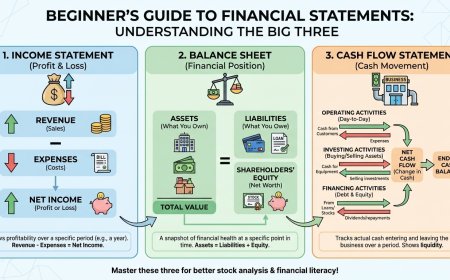
3. Is the Company Making More Money Every Year?
Instead of saying
"Check the financial statements"
I'd teach:
What is Revenue?
What is Gross Profit?
Operating Profit?
Net Profit?
EPS?
Cash Flow?
ROE?
ROA?
Debt?
Margins?
Why do they matter?
How do they connect?
Which one matters most?
With screenshots of Nigerian annual reports (or descriptions).
4. Revenue vs Profit
I'd explain why these are different.
Use a Nigerian supermarket example.
Many beginners think:
High sales = profitable.
No.
Example:
Revenue = ₦500 billion
Expenses = ₦495 billion
Profit = ₦5 billion
Huge difference.
5. The Balance Sheet
I'd spend almost an entire chapter.
Questions like:
Does the company have cash?
Too much debt?
Can it survive a recession?
6. Dividend History
Instead of saying:
Check dividends.
I'd teach:
Dividend Yield
Dividend Payout Ratio
Interim vs Final Dividend
Dividend Cover
Why some companies never pay dividends
When NOT paying dividends is actually good
7. Valuation
Not just P/E.
I'd include:
P/E
PEG
P/B
Dividend Yield
EV/EBITDA (explained simply)
Intrinsic Value
Margin of Safety
8. Is Management Trustworthy?
This is huge.
Who runs the company?
Do insiders own shares?
Do they communicate well?
Have they destroyed shareholder value before?
Corporate governance.
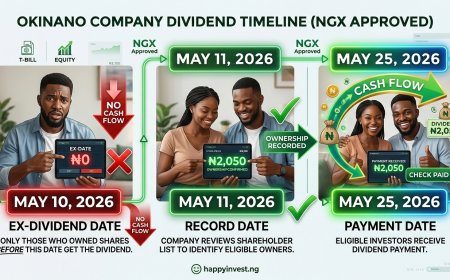
9. Corporate Actions
Merge your previous article into this.
Explain:
Rights Issue
Bonus
Buyback
Split
Reverse Split
M&A
How each affects valuation.
10. Liquidity
Most Nigerian investors don't understand liquidity.
I'd teach:
Daily volume
Bid-Ask spread
Free float
Market cap
Why illiquid stocks trap investors.
11. Who Are the Competitors?
Example:
GTCO vs Zenith
BUA vs Dangote
MTN vs Airtel
Nestlé vs Cadbury
Compare them.
12. Industry Analysis
Is the whole industry growing?
Or only the company?
13. Economic Factors
Interest rates.
Inflation.
Exchange rates.
Government policy.
How each affects different sectors.
Banks.
Consumer goods.
Oil.
Agriculture.
Insurance.
14. Risks
Every company has risks.
Teach readers to write down:
"What could go wrong?"
15. Build Your Investment Thesis
This is what almost no beginner learns.
Before buying, answer:
Why am I buying?
Why now?
What could make me sell?
What would prove I was wrong?
16. My 10-Minute Research Checklist
A printable checklist.
□ Understand business
□ Read financials
□ Revenue growing?
□ Profitable?
□ Debt manageable?
□ Dividend history
□ P/E
□ Competition
□ Risks
□ Recent announcements
□ Valuation
□ Personal investment thesis
Then finish with a strong conclusion:
The biggest advantage individual investors have isn't faster information.
It's patience.
Institutions manage billions.
They have quarterly targets.
They have committees.
You don't.
You can wait.
You can study.
You can ignore noise.
That's your edge.
The goal isn't to buy every stock.
The goal is to understand every stock you buy.