Who Really Moves the Stock Market?
Discover who really moves the stock market. Learn about institutional investors, hedge funds, central banks & more, and how to invest smarter in Nigeria.
 Yahnic Chigozie
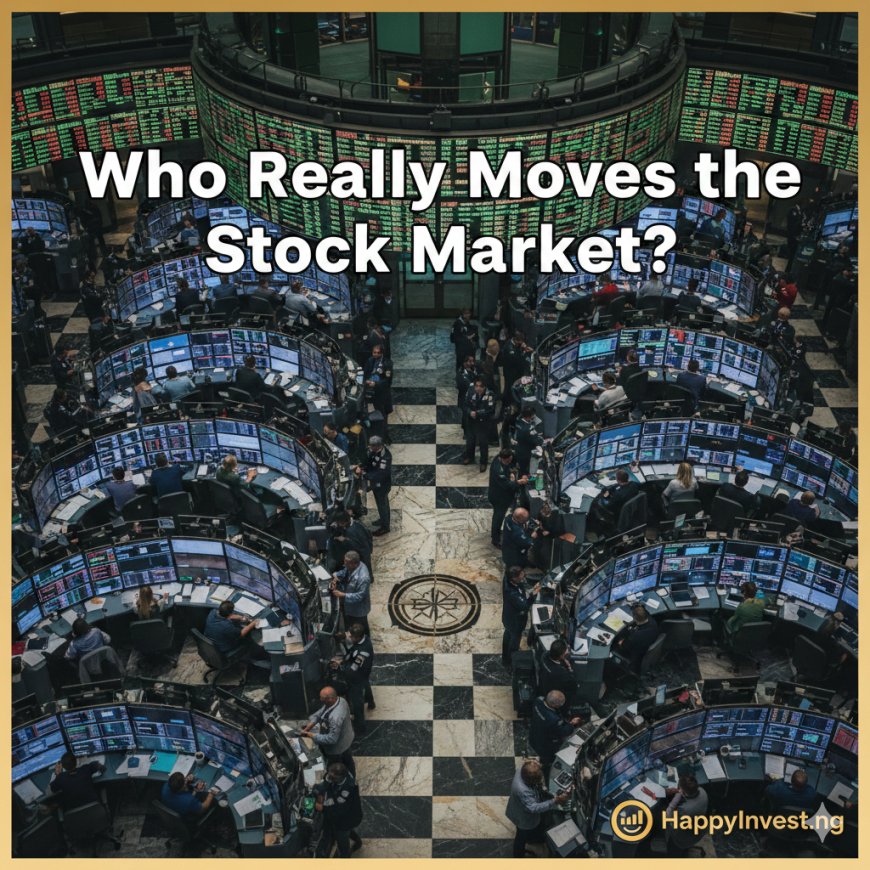
Who Really Moves the Stock Market?
A behind-the-scenes look at the forces, players, and psychology that drive stock prices and what it means for your money.
Whether you're just starting your investment journey or you've been watching the market for years, understanding who really moves the stock market is one of the most important pieces of financial knowledge you can have. Because when you understand the players, you stop feeling like a victim of the market and start thinking like a participant.
Let's pull back the curtain.
If the stock market were a football pitch, institutional investors would be the Super Eagles, the biggest, most powerful team on the field. These are large organizations that pool together enormous sums of money and invest on behalf of others. They include:
▸ Pension funds (managing retirement savings for millions of workers)
▸ Mutual funds and unit trusts
▸ Insurance companies investing policyholder premiums
▸ Sovereign wealth funds (government-owned investment funds like Norway's Government Pension Fund)
▸ Endowment funds (like those of major universities)
Institutional investors control trillions of Naira in assets. When Nigeria's largest asset manager, with over $2 billion under management, decides to buy or sell a stock, the market feels it. Their trades are so large that they can single-handedly move a stock's price by several percentage points in a single trading session.
|
Key Insight: Institutional investors account for roughly 70–80% of all daily trading volume on major stock exchanges. When they move, the market moves with them. |
Because of their size, institutional investors often get access to better research, earlier information (through legal channels), and more sophisticated trading tools. This creates an asymmetry, but it also creates an opportunity for smart individual investors who can read the signals these giants leave behind.
2. Retail Investors: The People's Army
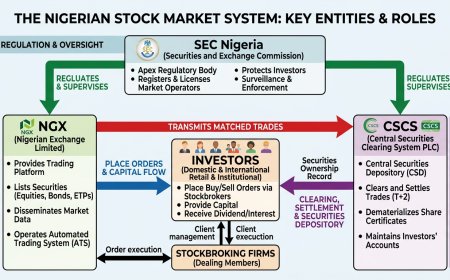
That's us, everyday individuals buying and selling stocks through brokerage platforms, investment apps, and financial advisors. In Nigeria, retail investors include people trading on the Nigerian Stock Exchange (NGX) through firms like Stanbic IBTC Stockbrokers, CardinalStone, or platforms like Chaka and Bamboo.
For a long time, retail investors were considered too small to matter individually. But two things changed that:
▸ The rise of social media and online communities (Reddit's WallStreetBets famously drove GameStop shares up over 1,700% in early 2021, costing hedge funds billions)
▸ Commission-free trading apps that lowered the barrier to entry dramatically
Today, retail investors collectively represent a significant and growing force in global markets. While each individual trade is small, millions of retail investors moving in the same direction, driven by news, social media trends, or influencer recommendations, can create powerful price movements.
|
Real Example: In 2021, Nigerian retail investors rushed into Airtel Africa and MTN Nigeria stocks after strong earnings reports. The coordinated buying pressure pushed share prices to multi-year highs within weeks. |
3. Market Makers: The Silent Architects of Liquidity
Here's a player that most people never hear about, yet they are essential to every trade you make. Market makers are financial institutions or specialized firms whose job is to ensure the market is always liquid, meaning there's always someone ready to buy when you want to sell, and sell when you want to buy.
They do this by constantly quoting both a buying price (bid) and a selling price (ask) for securities. The small difference between these two prices, called the spread, is how they make their profit.
Examples of market makers include Goldman Sachs, Citadel Securities, and Virtu Financial. On the NGX, the Exchange itself facilitates market-making activities through designated market makers for certain securities.
Market makers are critical because without them, markets would be illiquid. You might want to sell your shares, but find no buyer for days. Their constant presence ensures smoother, faster transactions. But they also influence prices: when a market maker adjusts their bid-ask spread due to uncertainty or risk, it signals the broader market and can trigger price movements.
4. Hedge Funds: The Aggressive Speculators
Hedge funds are the daredevils of the financial world. They are private investment partnerships that use aggressive, often complex strategies to generate high returns, which are typically off-limits to regular mutual funds and retail investors.
These strategies include:
▸ Short selling (betting that a stock price will fall)
▸ Leverage (borrowing money to amplify returns and risks)
▸ Derivatives trading (options, futures, swaps)
▸ Arbitrage (exploiting price differences across markets)
▸ Algorithmic and high-frequency trading
Hedge funds can be tremendously destabilizing to markets. During the 2008 financial crisis, aggressive short-selling by hedge funds accelerated the collapse of bank stocks. But they can also provide useful price discovery when a hedge fund short-sells a company it believes is fraudulent or overvalued; it can expose problems that others miss.
|
Famous Case: George Soros' Quantum Fund famously 'broke the Bank of England' in 1992 by short-selling the British pound, making over $1 billion in a single day and forcing the UK out of the European Exchange Rate Mechanism. |
5. Central Banks and Governments: The Ultimate Market Movers
If institutional investors are the Super Eagles, then central banks and governments are FIFA itself; they set the rules of the game, and when they change the rules, everyone has to adjust.
Central banks, such as the US Federal Reserve (the Fed), the European Central Bank (ECB), and the Central Bank of Nigeria (CBN), control monetary policy, specifically interest rates and the money supply. These decisions have enormous ripple effects on stock markets:
▸ When interest rates are LOW: Borrowing is cheap. Companies invest more, consumers spend more, and stocks rise. Investors also shift money from low-yield savings accounts into the stock market.
▸ When interest rates are HIGH: Borrowing is expensive. Company profits shrink, consumer spending falls, and stocks often decline. Bonds become more attractive compared to stocks.
Governments also influence markets through fiscal policy, tax changes, spending programmes, import/export regulations, and sector-specific policies. In Nigeria, when the government announced fuel subsidy removal in 2023, it immediately impacted energy stocks, transport companies, and consumer goods companies listed on the NGX.
|
Key Fact: When the US Federal Reserve raised interest rates aggressively in 2022–2023 to fight inflation, global stock markets fell sharply, including Nigerian stocks exposed to foreign investor flows. This shows how interconnected global markets really are. |
6. Corporate Insiders: The Ones Who Know Best
Company executives, board members, and major shareholders, collectively known as corporate insiders, have information that the public doesn't. While trading on truly non-public information (insider trading) is illegal in most jurisdictions, insiders can still legally buy and sell their company's stock, and these moves are closely watched.
When a CEO buys millions of naira worth of their own company's shares, it sends a powerful signal: they believe the stock is undervalued. Conversely, when multiple executives start selling large amounts of stock simultaneously, it can signal that they know something troubling is coming.
Smart investors track insider transactions because history shows that insider buying, in particular, is a reliable predictor of future stock price increases.
7. Algorithmic and High-Frequency Traders: The Speed Demons
In the modern stock market, a significant portion of trades are not made by humans at all; they're executed by computer algorithms in microseconds. High-frequency trading (HFT) firms use powerful computers and complex mathematical models to execute thousands of trades per second, profiting from tiny price differences.
These algorithms respond to market data, news headlines, social media sentiment, and even weather patterns. They can amplify market movements dramatically. When a negative news headline breaks, algorithms can trigger a cascade of sell orders before a human trader can even read the headline.
While HFT is still relatively limited on the NGX compared to markets like the NYSE or LSE, its influence is growing as Nigerian markets modernize and attract more foreign algorithmic traders.
8. Media, Analysts, and Influencers: The Narrative Shapers
The stock market is partly a numbers game, but it's also a story game. The narratives that emerge around companies, sectors, and the economy as a whole powerfully shape investor sentiment and sentiment drives prices.
Financial analysts at investment banks and research firms publish ratings and price targets that can move stocks significantly. A major bank upgrading a stock from 'Sell' to 'Buy' can add double-digit percentage gains in a single day.
Media coverage also plays a huge role. A positive feature on a company in a major business publication can drive retail investor interest. Conversely, an investigative report exposing accounting fraud can wipe out billions in market cap overnight.
In today's digital age, social media influencers have joined this ecosystem. From Twitter (now X) to YouTube to Instagram, financial influencers sometimes called 'finfluencers' can move markets, particularly among younger retail investors. This is why regulators are increasingly scrutinizing paid stock promotions on social media.
|
Nigerian Context: On the NGX, analyst reports from firms like CardinalStone Research and Cordros Capital are closely followed by institutional and retail investors alike. Their quarterly earnings previews and stock recommendations frequently trigger price movements. |
9. Foreign Portfolio Investors: The Global Connectors
In emerging markets like Nigeria, foreign portfolio investors (FPIs), international funds and institutions that invest in local stocks and bonds, are enormously powerful market movers. When global economic conditions are favourable, and Nigeria's fundamentals look attractive, FPIs pour money in, driving markets higher.
But when global risk appetite falls due to rising US interest rates, geopolitical tensions, or concerns about a country's economic management, FPIs can exit rapidly, causing sharp market declines and currency depreciation.
This 'hot money' phenomenon means that Nigerian stock market investors must always keep one eye on global developments, not just local ones.
How It All Connects: The Ecosystem in Action
The stock market is not a single entity controlled by any one player. It is an ecosystem a dynamic, interconnected web of forces where:
▸ Central bank decisions set the macro backdrop
▸ Institutional investors make large strategic allocations
▸ Hedge funds probe for mispricings and inefficiencies
▸ Market makers ensure liquidity and smooth price discovery
▸ Retail investors provide breadth and, occasionally, collective force
▸ Algorithms execute at lightning speed
▸ Media and analysts shape narrative and sentiment
▸ Insiders signal their conviction through their own trades
Each of these players is responding to the others, creating a complex feedback loop that produces the price movements we see every day.
What This Means for You as an Investor
Understanding who moves the market helps you invest more wisely. Here are key takeaways:
▸ Follow the Institutional Money
Track what large institutions are buying and selling. In Nigeria, the NGX publishes data on institutional vs. retail investor activity. When institutions are accumulating a stock, it's often a sign of confidence.
▸ Don't Fight the Central Bank
There's an old market saying: 'Don't fight the Fed.' The same applies to the CBN. When monetary policy is tightening (rates rising), be more cautious. When it's easing (rates falling), it's often a tailwind for stocks.
▸ Be Wary of Hype and Narratives
Media coverage and social media trends can create bubbles. Before chasing a 'hot stock' you heard about online, do your own fundamental research. Ask: Is the underlying business actually strong?
▸ Watch Insider Buying
On the NGX, insider transactions are publicly disclosed. When company directors are buying their own shares, especially in significant quantities, it's often a bullish signal worth investigating.
▸ Think Global, Invest Local
As a Nigerian investor, your local stocks can be affected by international events. The US Federal Reserve's decisions, global oil prices, and international risk sentiment all impact the NGX. Stay informed beyond Nigeria's borders.
Final Thoughts: Knowledge Is Your Edge
The stock market can seem like a mysterious, unpredictable force. But once you understand the players, the institutional giants, the aggressive hedge funds, the policy-setting central banks, the narrative-shaping media, and the growing army of retail investors, the fog begins to lift.
You don't need to outmanoeuvre Goldman Sachs or predict the Federal Reserve's next move perfectly. What you need is a clear-eyed understanding of the forces at play so you can make smarter, more confident decisions with your own money.
At HappyInvest.ng, our mission is to help you develop exactly this kind of financial intelligence so that you can build real, lasting wealth in Nigeria and beyond.
The market belongs to those who understand it. And now, you understand it a little better.
© HappyInvest.ng — Empowering Nigerians to Invest Smarter